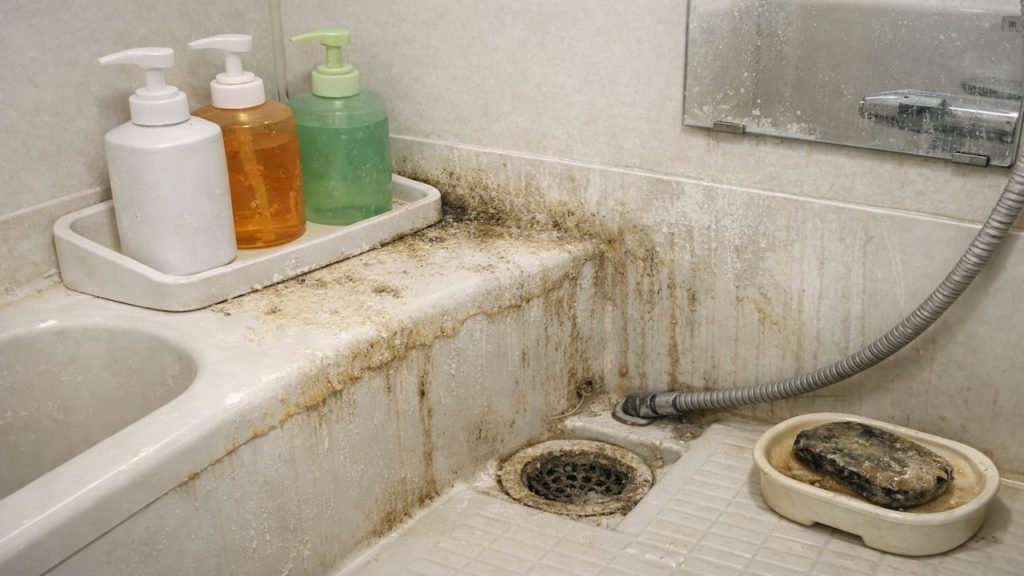
You look up and see black spots on the unit bath ceiling again. It feels like it grows faster than you can clean.
In Japan, tight bathrooms trap steam, and winter heating or rainy-season humidity makes ceilings stay damp. That moisture hides until the mold shows itself.
In this guide, you’ll learn how to catch ceiling moisture early with five simple checks. You’ll also learn a reset routine that fits Japanese unit baths and daily ventilation habits.

Hi, I’m Ken — I’m Japanese, and I live in Malaysia long-term, so I explain everyday life in Japan from a practical ‘from abroad’ perspective.
I hold a building design qualification and I’ve been on site for 20+ years across hundreds of jobs. I turn Japan’s unspoken rules into simple checks, so you can avoid costly mistakes and take the next step with clear actions that feel safe.
1. Unit bath black mold on ceiling: 5 Checks
Use these checks to find the moisture pattern before mold spreads across the ceiling.
Ceiling mold is usually a symptom, not a mystery—your unit bath is holding steam longer than you think. Check where droplets form, where air stalls, and where water never fully dries. Ceiling corners.
- Scan ceiling corners with bright light after shower
- Press tissue to ceiling spot and check damp
- Check fan grille for dust and weak suction
- Look for droplets on ceiling within 10 minutes
- Smell near ceiling for sour musty odor
You might think “it’s just a few dots, I’ll wipe later.” Small dots are early warnings, and Japan’s compact unit baths amplify humidity. Catch it now, and cleaning stays easy.
2. Catch moisture problems early
The fastest way to stop ceiling mold is finding where moisture stays trapped.
In many Japanese apartments, the bathroom fan is the main dryer, not the window. Steam rises, cools, and clings to the ceiling, especially when the door stays shut. Moisture map.
Leaving ventilation running during and after bathing is commonly recommended in bath manuals. According to eu.toto.com.
Basic mold cleanup guidance also stresses fresh air and safe cleaner use while you work. According to CDC.
- Time how long mirror stays foggy after shower
- Check ceiling above shower head for droplets
- Confirm door gap allows air to enter
- Test fan suction with toilet paper square
- Inspect ceiling paint for dull soft patches
You may blame “dirty air” or “old building” and give up. Age matters, but early moisture control works in most Japanese unit baths. Fix airflow first, then clean.
3. Why ceiling mold starts in a unit bath
Ceiling mold starts because condensation keeps feeding spores in the same spots.
Warm steam hits a cooler ceiling and turns into micro-droplets—then they sit. In Japan, small bathrooms and strong hot showers create a lot of vapor quickly. Those droplets dissolve soap residue and body oils, and that film becomes mold’s buffet.
- Lower shower temperature one notch to reduce steam
- Keep ceiling surface dry by wiping after bathing
- Stop storing wet towels inside bathroom overnight
- Separate shampoo bottles from ceiling drip path
- Run fan with door cracked for intake air
You might say “I already run the fan, so why mold?” If the fan is clogged or lacks intake air, it moves almost nothing. Airflow reality.
4. How to remove ceiling mold without making it worse
You remove ceiling mold best when you clean safely and dry fast.
Wear gloves, ventilate, and avoid mixing cleaners, then wipe and rinse gently—ceiling surfaces scratch easily. Supplies can be cheap at ¥300–1,500 if you only need a sponge, cloth, and basic cleaner. Dry finish.
- Open door and start fan before cleaning
- Apply cleaner to cloth not ceiling directly
- Wipe mold spot gently and lift residue
- Rinse cloth with water and wipe again
- Run fan for 2 hours after wiping
You may think bleach is the only answer and go heavy. Strong fumes and over-wetting can spread moisture higher into seams. Keep it controlled, then make drying your final step.
5. FAQs
Q1. Is black mold on the ceiling dangerous?
For many people it is a hygiene and irritation issue, not instant doom, but sensitivity varies. Do not ignore spreading patches, and improve ventilation in Japan’s humid seasons.
Q2. How long should I run the bathroom fan?
In many Japanese unit baths, running it during bathing and for a long stretch after helps the ceiling dry. If you cannot run it long, at least keep the door slightly open for intake air.
Q3. Why does mold return in the same corner?
That corner is where condensation forms first and dries last. Corner pattern. Fix the airflow path and reduce steam, or cleaning will keep repeating.
Q4. Should I wipe the ceiling every day?
Not the whole ceiling, just the trouble zone right after showering. A quick wipe removes droplets before they become film.
Q5. When should I call the landlord or a pro?
If mold spreads fast despite good drying, or the ceiling feels soft, suspect hidden leaks or insulation issues. In Japanese rentals, report early so repairs stay small.
Pro's Tough Talk

I’ve spent 20+ years working around Japanese homes, so I’ve seen what tends to work—and what tends to go wrong—in everyday use. You’re not dirty. But ceiling mold is your bathroom telling you it never fully dries in the rainy season.
Cause 1: you trap steam by shutting the door, so the ceiling sweats like a cold drink. Cause 2: the fan grille is packed with dust, so airflow is a straw with a kink. Cause 3: you “clean” by wetting everything, then walk away and let it stay damp. You wipe the wall, then look up and sigh. You think the ceiling is too high, so you pretend it is fine.
Now, start the fan and crack the door. Today, wipe the usual corner right after bathing. This weekend, clean the fan grille and check suction.
Drying is the real cleaner, and the wipe is just the setup. If you did this and it still fails, next is checking for hidden leaks above the ceiling or weak insulation. That is the line between “routine” and “repair.”
Seriously.
Keep treating it like a cosmetic issue and it will keep treating your ceiling like its personal canvas.
Summary
Check corners, droplets, fan suction, and musty smell, then match the pattern to your daily shower routine. Early spotting.
If mold returns in the same place, focus on intake air and fan performance, not harder scrubbing. If the ceiling feels soft or stains spread, escalate.
Do one quick wipe after tonight’s shower and run the fan long enough to dry the ceiling. Small habit beats endless deep cleaning, so explore more unit bath ventilation and cleaning routines next.