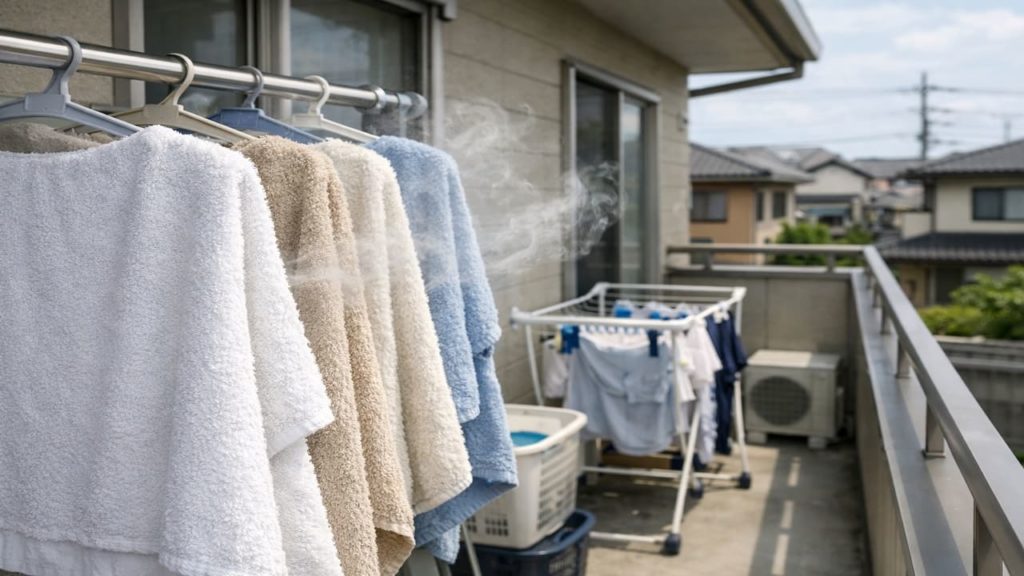
You hang laundry on the balcony, it seems to dry, and then that musty smell shows up when you bring it in. It’s annoying because you feel like you did the normal routine.
In Japan, balconies are often small and boxed in, and humidity can spike fast during rainy season or cold snaps. Thick towels stay damp inside longer than you think, especially when airflow is weak.
In this guide, you’ll learn the 5 checks that stop musty balcony laundry by spotting hidden damp areas, fixing airflow around thick fabrics, and using a quick rinse reset when residue is the real cause.

Hi, I’m Ken — I’m Japanese, and I live in Malaysia long-term, so I explain everyday life in Japan from a practical ‘from abroad’ perspective.
I hold a building design qualification and I’ve been on site for 20+ years across hundreds of jobs. I turn Japan’s unspoken rules into simple checks, so you can avoid costly mistakes and take the next step with clear actions that feel safe.
1. Musty smell after Balcony laundry 5 checks
Musty smell means damp time was too long.
Even if the surface feels dry, the inner layers can stay wet—then bacteria and leftover grime keep reacting. Japan’s humid swings make this worse, because “dry” turns into “re-damp” in minutes. Small balconies also trap air, so moisture lingers near fabric. Sneaky problem.
- Smell the thick seams before you fold
- Check towel corners for cool dampness
- Compare one towel against a thin T-shirt
- Look for drying shadows behind balcony walls
- Note the time until fully crisp dryness
“But it dried all day, so it can’t be damp,” right? Nope, that’s the classic trap, especially with thick cotton. What you felt was the outside. The inside was still negotiating. Hidden moisture.
2. Towel thickness airflow and quick rinse
Thick towels need airflow not just sunshine.
Sun helps, but airflow does the real work—without moving air, water just hangs around inside the pile. If you hang towels flat and close together, you build a little humid cave. In many Japanese apartments, railing space is limited, so spacing mistakes happen by default. Balcony math.
- Hang towels with a wide U-shape gap
- Space items one palm width apart
- Flip thick towels halfway through drying
- Move towels to the windiest edge
- Rinse towels quickly if smell starts
“I don’t have room to space things out.” Fair point, but you still have options. Fewer items per run beats musty everything. Also, rearranging once mid-dry is basically free. Small move, big win.
3. Why musty smell happens after balcony drying
Residue plus slow drying feeds the smell.
Detergent film, skin oils, and body sweat stay in towels more than you think—then slow drying gives microbes time to party. In Japan, pollen season and dusty roadside air can add extra grime that holds odor. Add a shaded balcony or a wind-blocking building layout, and the cycle repeats. Same plot, different laundry.
- Too much detergent leaves sticky film behind
- Softener coats fibers and traps dampness
- Overloaded washer reduces rinse power badly
- Late-night hanging starts with higher humidity
- Balcony shade keeps fabric cooling and damp
“So it’s the washer, not me.” Sometimes, yes, but not always. Most of the time it’s a combo: residue + time + weak airflow. You don’t need perfection, you need fewer odor-friendly conditions. Simple physics.
4. How to fix musty balcony laundry fast
Do a quick rinse reset before it sets.
If you catch mustiness early, you can fix it without a full redo—most of the cost is mostly time/effort, not money. If you want backup, basic supplies like oxygen bleach or vinegar run about ¥200–800, and you use very little. The key is to remove residue, then dry with actual moving air. No drama.
- Run one extra rinse with no detergent
- Spin longer to cut damp time sharply
- Hang towels folded to create airflow channels
- Use a fan indoors to finish drying
- Sun-dry briefly then shade-dry to avoid re-damp
“I don’t want to rewash everything again.” Good, don’t. Start with the worst-smelling items and do the rinse reset first. If smell survives after fully drying, then you escalate to a warm wash or soak. Decision point.
5. FAQs
Q1. Why do towels smell musty even when they feel dry?
The surface dries first, but the inner loops stay damp longer—then bacteria and residue keep producing odor. Thick seams and folded edges are usually the guilty spots.
Q2. Is fabric softener making the musty smell worse?
It can. Softener coats fibers, reduces absorbency, and slows drying, especially with thick cotton. If you’re chasing odor, pause softener for a week and compare.
Q3. Should I use hot water to remove the smell?
Hot water helps if residue is baked in, but it’s not always required. Try an extra rinse and stronger spin first, and only go hotter if the smell persists after full drying.
Q4. What’s the fastest way to stop the smell today?
Extra rinse plus longer spin works fastest for most cases. Then finish drying with real airflow, like a fan near an open window, not a still balcony corner.
Q5. When is it better to dry indoors instead of the balcony?
If it’s rainy season, late evening, or your balcony is shaded and windless, indoor finish-drying is safer. Use the balcony for the first phase, then move inside before humidity climbs.
Pro's Tough Talk

I’ve spent 20+ years working around Japanese homes, so I’ve seen what tends to work—and what tends to go wrong—in everyday use. You hang a towel, you trust the sun, and you get betrayed by a smell. During Japan’s rainy season, balconies turn into humid little terrariums. Yeah, welcome.
Here’s the cold truth: thick fabric is a sponge with secrets. The outside lies to you while the inside stays damp, like a burger that’s hot outside and frozen inside. Then residue acts like glue, holding moisture and feeding odor. Your detergent “fresh scent” is just a perfume over a problem.
Do an extra rinse with zero detergent. Today. Extend the spin so the towel starts drier. This weekend, change how you hang it so air can pass through.
If you still smell funk after a full dry, it needs a deeper wash or a proper soak, no excuses. If the smell only shows up on thick towels, your hanging method is the main culprit. If every item smells, your rinse and load size are the issue. Quick diagnosis.
You know that moment when you bring laundry in, fold it fast, then sniff it and freeze? That’s the musty jump-scare. Stop trusting “feels dry” like it’s a lie detector. Fix the process, not your nose.
Summary
You’re not dealing with “mystery odor,” you’re dealing with slow-dry conditions and residue that didn’t rinse out—classic balcony laundry problems. Check thickness, spacing, and whether the inner layers ever truly get crisp dry.
If your quick rinse + longer spin + airflow finish still fails, that’s your sign to escalate to a deeper wash or soak. If only towels fail, fix hanging; if everything fails, fix rinse strength and load size.
Today, do one rinse reset and change your towel hang so air actually moves through it, then stop folding anything until it’s fully dry. Make airflow your new default and your next load will smell like nothing at all, which is the goal. If you want to go further, read the guide on preventing humidity traps in small apartments.


