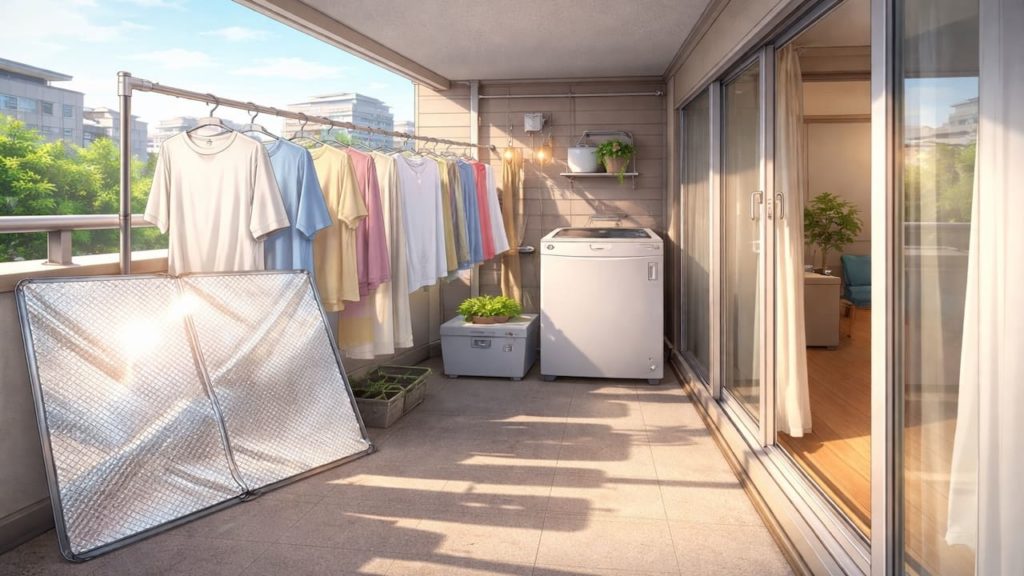
A typhoon is coming, and you’re staring at balcony laundry like it’s still a normal day. That’s how clothes fly, poles fall, and your “quick dry” turns into a safety problem.
In Japan, typhoon season overlaps with sticky humidity, sudden gusts, and balcony layouts that act like wind tunnels. A small loose item can become a projectile, and wet towels can turn into heavy sails.
In this guide, you’ll learn 5 steps to prep balcony laundry for a typhoon by bringing items in early, securing hooks and rails, and using towels smartly so you stay safe and keep damage low.

Hi, I’m Ken — I’m Japanese, and I live in Malaysia long-term, so I explain everyday life in Japan from a practical ‘from abroad’ perspective.
I hold a building design qualification and I’ve been on site for 20+ years across hundreds of jobs. I turn Japan’s unspoken rules into simple checks, so you can avoid costly mistakes and take the next step with clear actions that feel safe.
1. Typhoon prep for Balcony laundry 5 steps
Your first step is to remove anything that can fly.
When a typhoon is near, the balcony stops being “drying space” and becomes a risk zone — especially in Japan’s late-summer to autumn storms. Poles, hangers, racks, even clothespins can get lifted or knocked over. Do the prep before winds rise, not when it already feels scary. Safety first. Always.
- Bring all laundry inside before wind strengthens
- Remove loose hangers and small plastic clips
- Take down detachable poles and store indoors
- Clear balcony floor so nothing rolls around
- Close windows and lock balcony doors
You might think “I’ll just grab it when it gets worse.” That’s the trap. Once gusts start, stepping onto the balcony is the wrong mission.
2. Bring in early secure hooks and towels
Early take-in beats any clever setup outside.
Timing is everything — typhoons ramp up fast, and Japan’s building gaps can amplify wind without warning. Bring laundry in while it still feels boring outside, then secure hooks and rails so nothing rattles or falls. Towels are useful as padding and water control, not as extra outside “weight.” Fast, clean, done.
- Bring items in while balcony still feels calm
- Secure laundry pole hooks so they cannot pop
- Wrap towels around rattling rails to damp noise
- Move racks away from doors and glass
- Store wet laundry in a tub to stop dripping
“But towels dry fast outside.” Sure, and they also become heavy flapping sails. Bring them in and use them like tools.
3. Why balcony laundry is dangerous in a typhoon
Wind turns everyday items into flying hazards.
A typhoon doesn’t push gently — it hits in bursts that create sudden lift and torque. Anything long and light (like poles) can swing, and anything flat (like towels) can catch wind like a sail. In Japan, official weather and risk updates help you decide when to stop outdoor tasks before conditions spike. According to jma.go.jp.
- Gusts lift poles then drop them hard
- Wet fabric adds weight and amplifies force
- Balcony gaps funnel wind into sharp angles
- Loose clips become small fast projectiles
- Falling items can damage lower floors quickly
You might assume “it’s just rain and wind.” Nope. In typhoons, wind is the main threat, and balcony stuff is the ammo.
4. How to prep the balcony and manage wet laundry
Prep inside the home and stop balcony exposure early.
Do a quick indoor plan — where wet items go, how you avoid drips, and what you’ll do if power cuts. The cost is mostly time/effort, because you’re using towels, bins, and smart placement, not shopping. Japan guidance for typhoons and heavy rain emphasizes checking risk info early and acting before danger rises. According to bousai.metro.tokyo.lg.jp.
- Set a wet zone with towels on the floor
- Hang indoors near airflow not near curtains
- Use a bucket for dripping clothespins and hooks
- Keep walk paths clear for quick movement
- Do not go outside once winds start rising
“I’ll secure things when it starts.” No. Secure before, then stay inside. If it’s already loud outside, you’re late.
5. FAQs
Q1. How early should I bring balcony laundry in?
Bring it in as soon as a typhoon looks likely for your area, not when rain starts. The goal is to finish balcony work while conditions still feel normal.
Q2. Should I leave racks outside if I add weight?
No, because gusts can still tip, slide, or throw parts around. Remove racks and poles from the balcony and store them indoors where they can’t move.
Q3. What should I do with half-dry laundry I already washed?
Move it indoors, place towels under it, and finish with airflow if you can. Avoid blocking exits and avoid placing wet items near electrical cords.
Q4. Is it safe to step onto the balcony during the typhoon to check?
It’s a bad idea because debris and sudden gusts are unpredictable. If you missed something, leave it and deal with it after conditions improve.
Q5. My laundry pole is fixed and cannot be removed, what then?
Secure the hooks, remove anything attached, and pad contact points with towels to reduce rattling. Keep the balcony door locked and stay away from glass during peak wind.
Pro's Tough Talk

I’ve spent 20+ years working around Japanese homes, so I’ve seen what tends to work—and what tends to go wrong—in everyday use. Typhoon prep isn’t “being careful,” it’s stopping stupid stuff from turning into flying metal.
Three cold truths. One, a laundry pole is basically a spear when the wind gets angry. Two, wet towels are like sails, and the wind loves free sailboats. Three, once the gusts start, your balcony is a tiny arena where you lose balance fast.
Bring everything in now. Today. Secure hooks and remove loose parts before the wind rises. This weekend, set a wet zone inside so you’re not dripping across the room.
If you still hear banging after you prep, something is still loose, or a hook is vibrating against metal. Fix it only if conditions are calm, and only for a quick safe move. If it’s already howling, stop playing hero and wait it out.
Bro, no.
You know that “one last shirt” you leave out because it’s almost dry. Then you hear a clank and pretend it was the neighbor. And the classic moment you open the balcony door and the wind punches you in the face. That’s your sign.
Summary
Typhoon prep for balcony laundry is simple: bring everything in early, remove poles and racks, and secure any fixed hooks. The earlier you do it, the safer it stays.
If you still have wet items, manage them indoors with towels and airflow, and keep walk paths clear. Once winds rise, do not step onto the balcony to “check.”
Do the take-in now, then set an indoor wet zone and keep moving safely inside. Early action prevents the big mess and you can go read the next guide on strong-wind balcony safety habits.