Your pet keeps testing the fence like it’s a puzzle, and you’re one slip away from a scary escape.You want safety without turning your yard into a cage.
In Japan, tight lots, rainy seasons, and small side yards make weak spots easy to miss.Humidity also softens soil and shifts boards, so yesterday’s “safe” gap can open today.
In this guide, you’ll learn how to make a pet-safe fence that holds up.You’ll check digging, mesh, height, and the little hazards people forget.

Hi, I’m Ken — I’m Japanese, and I live in Malaysia long-term, so I explain everyday life in Japan from a practical ‘from abroad’ perspective.
I hold a building design qualification and I’ve been on site for 20+ years across hundreds of jobs. I turn Japan’s unspoken rules into simple checks, so you can avoid costly mistakes and take the next step with clear actions that feel safe.
1. Fence safety around pets at home: 5 tips
Pet-safe fencing is about escape paths and injury risks.
Pets don’t need a big hole to get out — they need one repeatable weakness. In Japan, damp soil after rain makes digging easier, and narrow alleys hide gaps you rarely inspect. If you buy small safety add-ons, expect ¥1,000–8,000 for basic mesh, ties, and edge guards. Start with what your pet actually tries.
- Check gaps at ground line after heavy rain
- Confirm gate latch cannot be pawed open
- Remove sharp wire ends and exposed staples
- Match fence height to jump and climb ability
- Keep furniture away from fence climbing zones
You might think “my pet has never escaped,” but that’s not a safety plan. One storm, one bored afternoon, one new smell, and the fence becomes a target. Build it so curiosity fails safely. That’s the goal.
2. Dig guards mesh and safe height
Block digging with guards then control climbing with height.
Dig guards work because they remove the easy tunnel start at the base — pets quit faster when the first scoop hits something solid. Mesh works because it closes squeeze points and keeps paws from getting stuck, but it must be secured cleanly. Height works only when you also remove “launch points” like planters and bins. Budget ¥2,000–15,000 for dig barriers, mesh, and fasteners depending on length.
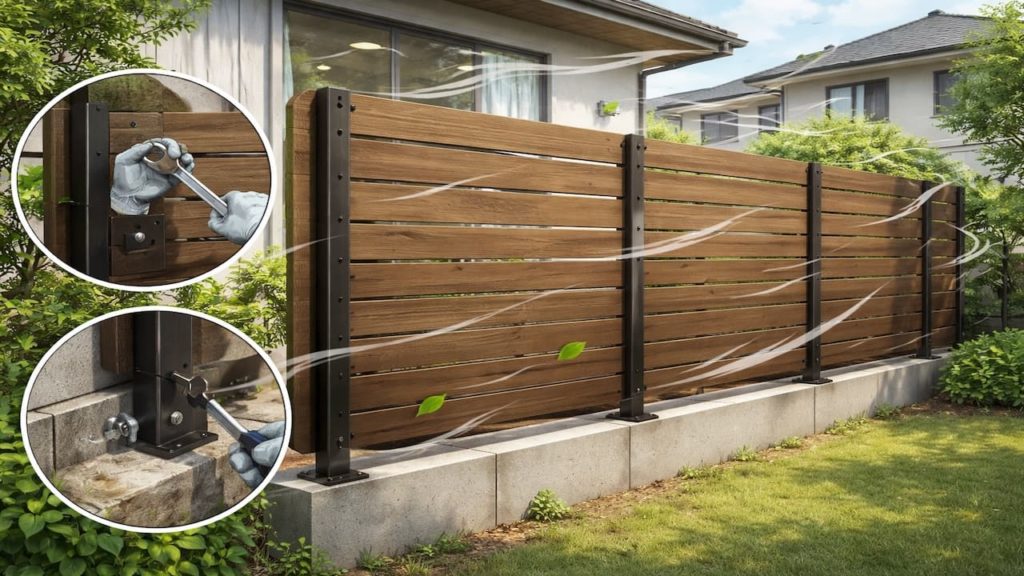
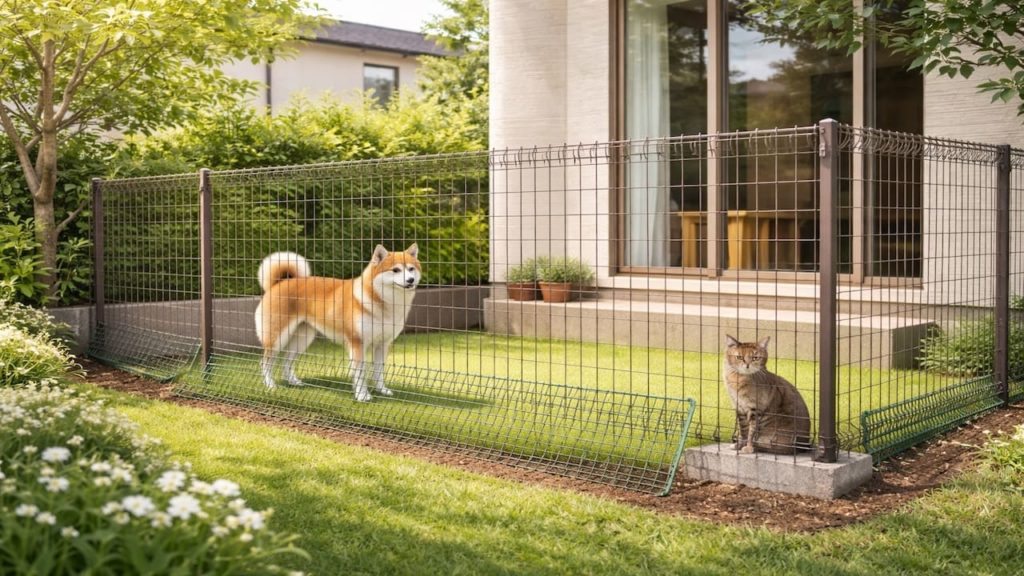
- Bury an L footer mesh along fence base
- Attach mesh tight with no loose loops
- Use small openings to prevent head squeeze
- Raise height where the pet can jump
- Add smooth top edge to stop climbing grip
Some people add height and call it done, then the pet digs under like it’s a side quest. Others add mesh but leave a soft soil trench, so digging gets worse. Do base first, then height, then details. One system.
3. Why pets escape fences at Japanese homes
Pets escape when soil softens and gaps stay hidden.
In Japan’s rainy season, ground near the fence line turns workable, and a pet can carve a tunnel faster than you’d guess. Small side yards also trap humidity, so boards warp and open tiny seams near posts. If you need supplies, ¥1,000–6,000 covers a small roll of mesh, ground pins, and basic tools. The enemy is repetition.
Digging escapes often happen along fence lines, and buried wire at the base can help prevent it. According to akcreunite.org.
- Rain softens soil and speeds up digging
- Loose boards open gaps near post joints
- Gate corners create repeated squeeze attempts
- Outside noise triggers chasing at the boundary
- Bored pets invent new escape routines fast
You may blame “stubborn behavior,” but the fence is teaching the behavior by failing the same way. Fix the repeatable weakness and the habit fades. Then you train, not chase. Much easier.
4. How to pet-proof a fence without overbuilding
Make one test section perfect then copy it.
Start with the worst zone, usually a corner or gate run — then build a standard you can repeat. Add an L footer or dig strip, tighten mesh to eliminate squeeze gaps, and make the top edge unclimbable where needed. In Japan’s humid air, choose corrosion-resistant fasteners so the fix doesn’t loosen in one season. A practical range is ¥5,000–30,000 for a small bay including mesh, guards, and hardware.
An L-shaped footer can prevent animals from digging under fences by extending wire outward at the base. According to humaneworld.org.
- Install mesh skirt and pin it flat outward
- Secure corners with extra ties and staples
- Fix gate gap using a brush strip seal
- Remove climb aids like bins near fence
- Walk perimeter weekly and retighten loose points
You might want to “finish everything” in one day, but rushed installs leave sharp ends and loose loops. That’s how paws get scratched and mesh becomes a snag hazard. Do one bay clean, then repeat the same pattern. Consistency wins.
5. FAQs
Start with the base line because most escapes begin there — then match height and mesh to your pet.
Q1. How deep should a dig guard go?
Depth depends on soil and the pet, but the key is stopping the first easy scoop. A mesh L footer pinned outward often works because the pet hits it immediately and gives up.
Q2. What mesh opening size is safest?
Use openings small enough that heads and paws cannot push through and get stuck. If your pet can fit its nose through, assume it will try to widen it.
Q3. How tall should a pet fence be?
Height depends on jump and climb ability, not weight. If there are climb aids nearby, even a taller fence can be defeated.
Q4. Is chicken wire safe for pets?
It can work as a buried barrier, but exposed sharp edges are a problem. If you use it, finish edges cleanly and keep it tight so it cannot snag.
Q5. How often should I inspect the fence?
After heavy rain, after strong wind, and whenever your pet starts a new habit. In Japan’s wet seasons, weekly quick checks prevent surprises.
Pro's Tough Talk

I’ve spent 20+ years working around Japanese homes, so I’ve seen what tends to work—and what tends to go wrong—in everyday use. Your pet isn’t “bad,” it’s just consistent. And the fence is either consistent too, or it loses.
Here’s the cold breakdown. If the base is soft, they dig like it’s a mining job. If the mesh is loose, they hook it and worry it like a loose thread on a sweater. If the top has a foothold, they climb like a tiny parkour athlete. It’s not personal, it’s mechanics.
Block the base line now.
Tighten mesh and remove sharp ends today.
Fix climb aids and gate gaps this weekend.
If you still see new escape attempts the fence still has a repeatable weakness. If the pet stops trying after the base and corners are reinforced, you’re done, keep inspecting. If it keeps trying in one spot, upgrade that spot only and stop doing random fixes everywhere.
Yeah, no.
Classic scene: you “just stepped inside,” and the pet starts digging like a prisoner movie. Another one: you fix the fence, then the pet discovers the gate corner like it’s a secret level.
Summary
Pet fence safety comes down to blocking dig paths, closing squeeze gaps, and preventing climbs. Focus on the base line, corners, and gate details first.
Use a repeatable system: dig guard or L footer, tight mesh, safe edges, and enough height without climb aids. If the same spot keeps getting tested, it’s telling you where to reinforce.
Do one full perimeter check today, then lock down the worst zone and copy the fix so your home stays calm and your pet stays safe.