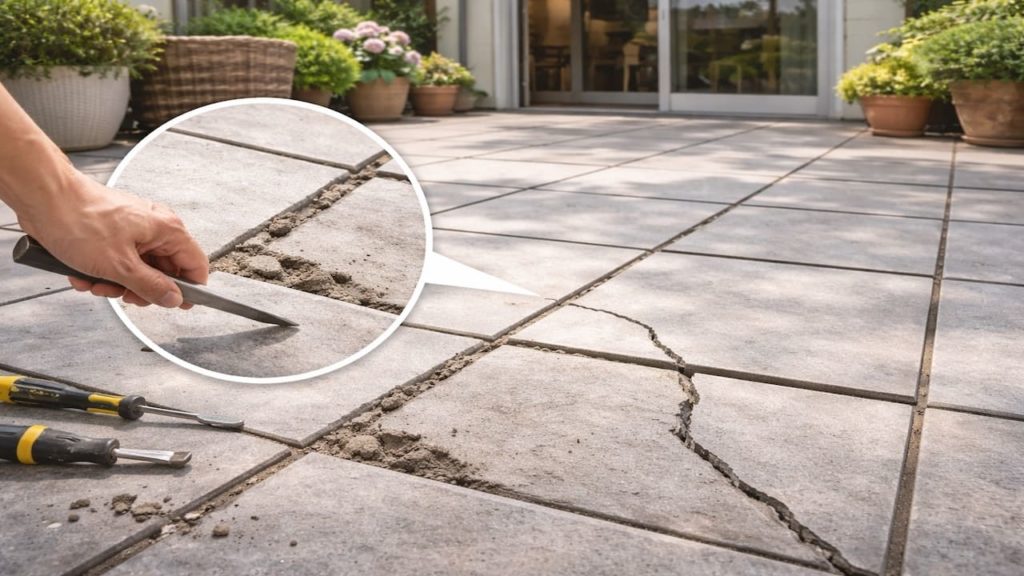
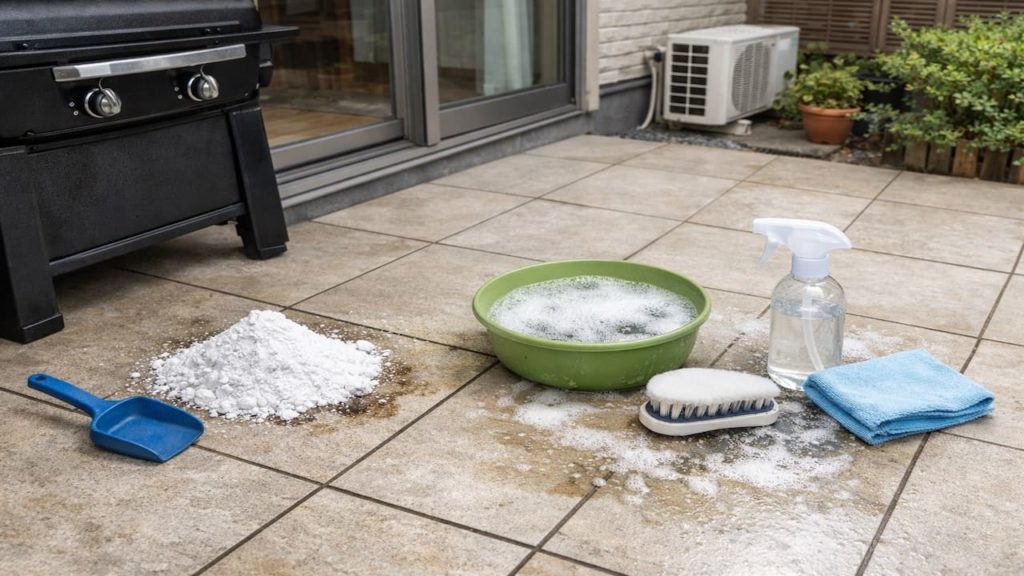
You sweep the patio and the grout turns into powder again. The joints look rough, and little chunks keep breaking off when you brush or rinse.
That usually means the grout is too weak, too porous, or cured under bad conditions. In Japan, wet seasons and cold nights can turn a small mix mistake into full joint failure.
In this guide, you’ll learn how to spot weak grout and choose a better mix before you keep patching the same line. You’ll also learn what to change so the next grout actually stays put.

Hi, I’m Ken — I’m Japanese, and I live in Malaysia long-term, so I explain everyday life in Japan from a practical ‘from abroad’ perspective.
I hold a building design qualification and I’ve been on site for 20+ years across hundreds of jobs. I turn Japan’s unspoken rules into simple checks, so you can avoid costly mistakes and take the next step with clear actions that feel safe.
1. Patio grout keeps crumbling: 5 signs it needs a better mix
If grout crumbles under light brushing it is underperforming.
Outdoor joints need strength and low water absorption, not just a pretty finish—especially on patios that stay damp after rain. In Japan, humidity keeps joints wet longer, so weak grout never gets a true dry cycle and keeps degrading. Check whether the grout is failing only at the surface or all the way through. Powder tells you a lot.
- Rub joint with finger and see powder transfer
- Tap joint edge and watch grains pop loose
- Check if joints hollow out after each rain
- Look for sandy texture instead of tight dense paste
- Inspect corners where water sits and fails first
You might think it is just “old grout” and any new bag will fix it. If the base stays wet or the mix is too watery, the same failure repeats. Fix the cause, then choose the right product. Same joint, different outcome.
2. Water freeze and dust
If water gets into grout then freezes it will shred the joint.
Freeze expands water inside pores, creating micro cracks that turn into dust and chips over time—small damage, repeated often. Even mild cold nights can do it if the joint stays saturated from poor drainage or constant rinsing. A clean-looking joint can still be waterlogged underneath, then it fails when temperatures swing. If water within mortar freezes it expands and can cause internal cracking and permanent damage. According to tccmaterials.com.
- Check for puddles that linger along joint lines
- Look for flaking after cold nights and wet days
- Inspect joints near edges where runoff collects
- Check for hairline cracks before powder starts
- Notice dusty joint tops after drying cycles
You might say your area never freezes, so it cannot be the reason. Even without freezing, repeated wetting and drying can weaken poor grout and wash fines out. Water is still the enemy, just with a different weapon. Moisture cycles matter.
3. Why grout fails outdoors when the tile looks fine
Grout fails when it is mixed weak and asked to live wet.
Too much water in the mix makes grout porous, soft, and easy to erode. Bad packing leaves voids, and those voids become tiny channels that pull water in and push fines out. Japan’s humid air keeps joints from drying fast, so slow curing plus moisture exposure can leave a chalky surface that never toughens up. Weak paste.
- Overwatered mix creates porous weak joint structure
- Poor packing leaves voids that hold water
- Early washing pulls cement out of the joint
- Movement at edges cracks grout and starts crumble
- Dirty joints block bonding and cause sandy joints
You might blame the tile installer and stop there. Sometimes the installer did the basics, but the product choice was wrong for outdoor conditions. Stronger grout and better prep can rescue the same patio. It is fixable.
4. How to rebuild patio grout so it stops crumbling
Remove weak grout fully then regrout with a denser mix.
Plan for ¥1,500–6,000 for grout, a grout saw, and basic tools, depending on what you already own. Pick a grout rated for exterior use and movement tolerance, keep the mix tight, and pack joints hard in small sections—then clean gently with minimal water. Avoid dry sweeping dusty grout debris because fine dust can become airborne, so use wet methods or a vacuum instead when possible. Under OSHA silica guidance, dry sweeping or dry brushing can increase respirable crystalline silica exposure and wet methods or HEPA vacuuming are safer controls. According to osha.gov.
- Dig out crumbly grout until solid edges appear
- Vacuum joints clean so new grout can bond
- Mix stiff and rest before final remix
- Pack joints tight then tool surface smooth
- Cure protected from rain and hard sun exposure
You might want to skim a thin layer over the top to save time. That usually debonds and flakes because the base underneath is still weak and dusty. Full removal feels annoying, but it is the only reset that lasts. Do it once, do it right.
5. FAQs
Q1. Is crumbling grout always a sign the patio is moving?
No it can be a weak mix problem even when the tile is stable. If you also see repeated cracks in straight lines, then movement is likely involved too.
Q2. Can I just add more water to make grout easier to spread?
That usually makes it weaker and more porous. If it is too stiff, work smaller batches and pack harder instead of thinning it.
Q3. Why does grout fail faster near the patio edge?
Edges see more water entry, more temperature swing, and more movement. They also get hit by runoff and cleaning water, which erodes weak joints first.
Q4. How long should I protect new grout from rain?
Longer is better, especially in humid weather—wet curing too early can weaken the surface. Use a cover and keep foot traffic light until it feels hard and stable.
Q5. Should I seal outdoor grout to prevent crumbling?
Sealer can reduce staining and water entry, but it will not save a weak joint. Fix the mix and packing first, then seal if the product and surface support it.
Pro's Tough Talk

I’ve spent 20+ years working around Japanese homes, so I’ve seen what tends to work—and what tends to go wrong—in everyday use. When grout turns to dust, it is not being “a little dramatic,” it is failing its job.
Weak grout is like a cookie left out in the rain, and water will keep taking bites until nothing is left. You mix it too wet, wash it too early, and then act surprised when it crumbles like chalk on a blackboard during the rainy season.
You know the scene: you patch a tiny spot with leftover mix in a yogurt cup, step back proud, then next week it powders again. Another scene: you hose the patio clean, blast the joints, and wonder why the lines look hollow after it dries.
Stop it.
Dig it out, vacuum it clean, pack a better grout tight, and protect it while it cures. If it still crumbles after that, your base is staying wet or the patio is moving, so change the plan.
Summary
Crumbling grout is usually weak, porous, or repeatedly saturated, and it often starts where water sits. Check for powder transfer, hollowing joints, and edge zones that stay wet.
Freeze damage can accelerate failure, but even without freezing, moisture cycles and an overwatered mix will erase joints. The durable fix is full removal, proper packing, and protected curing.
Dig out one failing joint line and test a better batch today so you stop patching dust. Once it holds, keep going with the next patio maintenance step while the rhythm is alive.