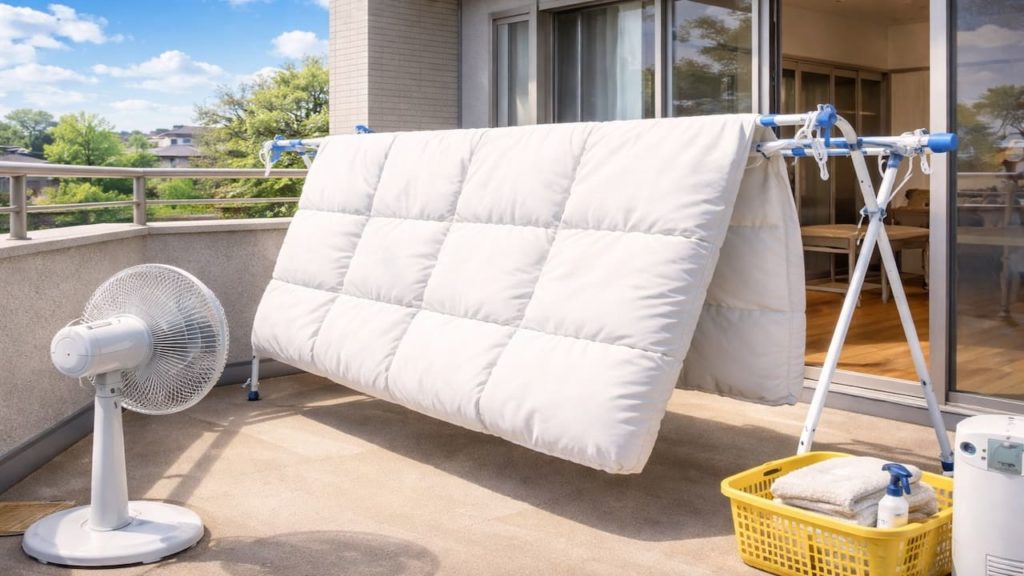
Trying to dry a futon indoors usually happens on the exact wrong day: rain, cloudy skies, and no balcony time. You still need the futon to feel fresh tonight, not "maybe tomorrow."
In Japan, tsuyu humidity and compact rooms make moisture linger, especially near the floor and inside closets. Indoor drying works, but only if you move air the right way and avoid sealing dampness back in.
In this guide, you'll learn how to use airflow to finish indoor futon drying even when the sun is not an option. You'll get a simple routine that fits Japanese apartments, tatami rooms, and winter heater air.

Hi, I’m Ken — I’m Japanese, and I live in Malaysia long-term, so I explain everyday life in Japan from a practical ‘from abroad’ perspective.
I hold a building design qualification and I’ve been on site for 20+ years across hundreds of jobs. I turn Japan’s unspoken rules into simple checks, so you can avoid costly mistakes and take the next step with clear actions that feel safe.
1. Futon indoor drying: 5 tips
Airflow beats waiting when the sun disappears.
Indoor drying fails when air stays still, which is common in Japanese homes with sliding doors and low ventilation. Treat the futon like a thick sponge: the surface dries first while the core stays damp. A fan is more useful than heat because it removes the humid boundary layer—especially during tsuyu and after night sweating. No-sun days.
Keeping indoor humidity at or below about 60% helps reduce mold risk at home. According to EPA.
- Stand futon on edge to expose layers
- Run fan across surface not straight at it
- Flip futon after thirty minutes for balance
- Open two points for cross breeze in rooms
- Keep futon away from walls and curtains
It sounds too basic. But Japanese rainy days punish "just leave it out," because moisture returns once you fold. Use airflow first, then decide storage, and your nose will thank you.
2. Use airflow when sun is not possible
Make air pass through the futon not around it.
Airflow works when you create a path, not a blast, and Japanese rooms often need you to build that path on purpose. Lift the futon so the underside can breathe, because tatami and floor mats hold moisture after humid nights. Aim the fan so air skims along the fabric, then exits to a window or door gap; trapped air just cycles humidity. Air path.
Controlling moisture and keeping indoor humidity around 50% or lower can help prevent mold. According to CDC.
- Prop futon with chairs to create airflow tunnel
- Point fan along futon length for laminar flow
- Crack a window to vent wet air outside
- Close bathroom door after shower to reduce spikes
- Dry futon before cooking steam fills the room
No sun, no problem. The mistake is drying in a sealed box, which many Japanese rentals become in rainy season. Build a one-way airflow lane—then the futon stops feeling clammy.
3. Why indoor futon drying feels slow in Japan?
Humidity rebounds because the room rewets the futon.
Even if the futon feels dry, Japan's humid air can rehydrate it in minutes once you stop airflow. Floor-level air is often wetter than you think, especially in one-room layouts where laundry dries indoors. Heating in winter can lower relative humidity, yet the futon core may still hold moisture from sweat and condensation. Rainy season reality.
- Check humidity near floor where moisture pools
- Notice spikes after baths and indoor laundry
- Separate surface dryness from core dryness time
- Watch for rebound after you stop the fan
- Limit closet storage until room stays stable
You might blame the futon. But the room is the problem—Japan's small spaces trap wet air after daily life. Once you see rebound, you stop folding too early and drying feels faster.
4. How to dry a futon indoors with steady airflow
Use a timed cycle and confirm stability before folding.
Set a cycle that fits Japanese routines: morning after you wake up, and again before bedtime if it was humid. Start with 30 minutes per side with a fan, then 30 minutes standing on edge, then recheck the feel near seams. If you need basics like clips or a cheap hook to hang a corner, budget ¥100–500 for basic supplies once and reuse them. Simple cycle.
- Start fan cycle right after morning wake up
- Lift underside with rack to prevent tatami damp
- Flip and rotate futon to avoid wet pockets
- Vent room after showers before drying session
- Fold only after two hours stable room readings
"Two hours stable" sounds strict. But it prevents the classic Japanese closet surprise: musty odor after you store it. Follow the cycle—then storage becomes boring, in a good way.
5. FAQs
Q1. Can I dry a futon indoors without a dehumidifier?
Yes, if you move air and vent wet air out of the room. A fan plus a cracked window is often enough in Japan outside of peak tsuyu days. Indoor setup.
Q2. How long should I run a fan when drying a futon indoors?
Use a cycle instead of one long blast. As a baseline, 30 minutes per side works well—then stand it on edge and check for rebound.
Q3. What is the biggest mistake during rainy season indoor drying?
Folding too early and sealing moisture inside. If the room humidity jumps after you stop, keep airflow going and delay closet storage.
Q4. Is it safe to dry a futon on tatami?
It can be, but tatami holds moisture and slows underside drying. Lift the futon and push airflow at floor level to avoid damp patches.
Q5. Why does my futon smell fine then get musty later?
The core may still be damp even if the surface feels dry. Storage in a small Japanese closet can re-wet it, so confirm stability first.
Pro's Tough Talk

I've been on site for 20+ years. I've worked on hundreds of jobs. Japan's humid seasons make small mistakes show up fast, especially in tight apartments. Closet funk.
Three causes, no drama: you dry the top and forget the underside, you shut the room and recycle wet air, and you fold the moment it feels "okay." It's like painting over a wet wall, and like stuffing a sweaty gym shirt into a drawer. You flip once late, then shove it in.
Three-step fix: stand it up, move air across it, then vent the wet air out. Do it morning and night when tsuyu hits. You point the fan at your face, not the futon, and wonder why nothing changes.
Come on.
Your goal is boring stability before storage. If you can keep the room calm for two hours, the closet stops fighting back.
If you rush it again, congrats, you just adopted a pet smell.
Summary
Indoor futon drying is doable when you build airflow and let wet air escape. Japan's rainy season and compact rooms make rebound the real enemy.
Use a simple timed cycle, lift the underside, and delay folding until the room stays stable. If musty odor returns after storage, treat it as a core moisture sign.
Move air first then fold with confidence. Keep learning small-season routines so futon care stays easy even on sunless days.