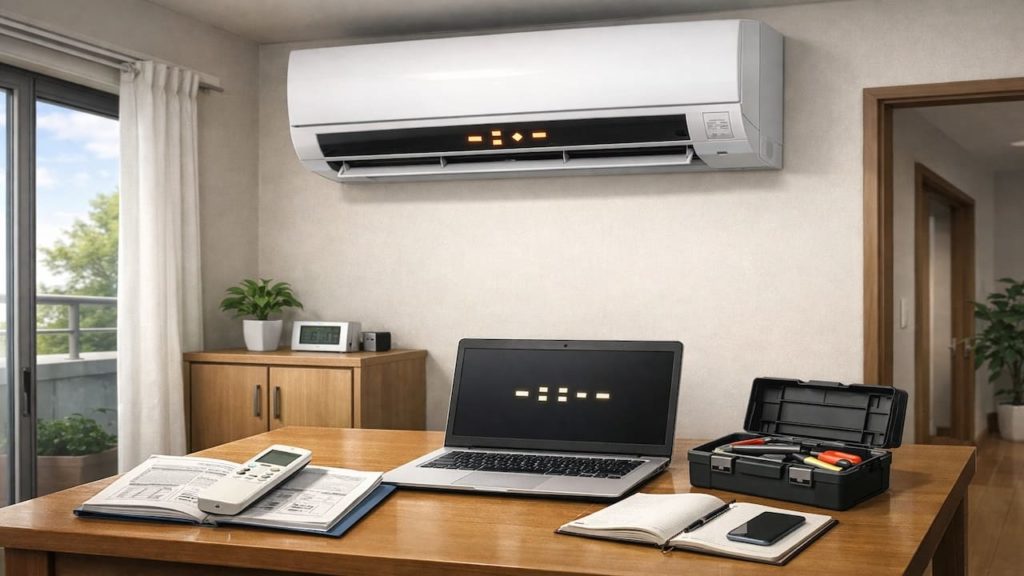
Your aircon suddenly stops and shows an error code on the indoor unit or remote. It looks scary, but it is also useful information.
An error code is the unit telling you what protection stopped it, not a judgment on you. In Japan apartments, humidity, dust, and tight installs can trigger codes more easily.
In this guide, you’ll learn how to read the code and choose the right next step. You will avoid risky guessing and decide when a reset is enough or when to call service.

Hi, I’m Ken — I’m Japanese, and I live in Malaysia long-term, so I explain everyday life in Japan from a practical ‘from abroad’ perspective.
I hold a building design qualification and I’ve been on site for 20+ years across hundreds of jobs. I turn Japan’s unspoken rules into simple checks, so you can avoid costly mistakes and take the next step with clear actions that feel safe.
1. Aircon error code: 5 steps
Treat the code as a clue and capture it before it disappears.
Many units clear the display after power resets, so the first job is recording what you saw. In Japan rentals, you also want a clean explanation for the building manager — it saves time. Evidence. Do these steps in order and keep the room safe.
Daikin provides an error code search tool that explains code status and likely causes. According to Daikin.
- Write the code and note blinking lights
- Take a photo of display and unit label
- Turn unit off and wait five minutes
- Check breaker position and restore power once
- Run fan mode briefly and watch for return
You may want to keep pressing buttons until it works. That can erase the pattern and waste the best clue, especially in Japan where service slots can be tight. Capture first, then act.
2. Read it calmly and decide the next move
Your next move depends on whether the code returns fast.
If the unit runs normally after a single reset and the code does not return, it may have been a temporary protection stop. In Japan summer, sudden humidity spikes can trigger sensors and then clear. Calm check. If the code comes back quickly, treat it as persistent.
Panasonic describes a remote self-diagnosis method to retrieve and cycle through error codes. According to Panasonic.
- Check whether code appears on remote display
- Confirm indoor lamp blinking pattern and timing
- Search the code in your manual quickly
- Try one controlled reset and retest cooling
- Stop testing if breaker trips again
You might think every code means replacement. In many Japan homes, the right move is documenting the code and doing one safe test, then stopping before damage.
3. Why aircon error codes show up
Error codes appear when the unit protects itself from abnormal conditions.
Protection can be electrical, airflow, drainage, or communication between indoor and outdoor units. In Japan, older buildings with shared circuits and compact balconies can stress systems. The code is the system’s way of saying “I stopped for a reason” — not “I am dead.” Protection logic.
- Airflow restriction from dirty filters and dust
- Drain blockage causing overflow and sensor trips
- Outdoor airflow blocked by stored balcony items
- Power fluctuation from overloaded apartment circuits
- Remote communication errors from weak batteries
You may blame the brand, but most codes point to conditions around the unit. In Japan apartments, small environment changes can trigger protection, so start with the simplest causes.
4. How to respond to an aircon error code safely
Do one safe test cycle then decide whether to stop.
Choose checks you can do without opening sealed panels or touching wiring, especially in Japan rentals. Keep the unit off if you smell burning, see water near outlets, or the breaker trips twice. Safety first. The cost is mostly time/effort, because the best early steps are observation and airflow cleaning.
- Clean filters gently and reinstall fully dry
- Clear outdoor unit space and remove obstructions
- Confirm drain hose end is dripping freely
- Replace remote batteries and retry basic operation
- Call service with code photo and cycle notes
You might feel tempted to “reset until it works.” Don’t. If you did a controlled test and the same code returns, next is stopping operation and requesting proper diagnosis with the recorded code.
5. FAQs
In Japan, the fastest fix is often better information — code, timing, and one clean test.
Q1. Should I keep running the aircon if it shows a code?
If the code is active and operation stops, do not force it. Record the code and do one controlled restart, then stop if it returns.
Q2. Is it okay to flip the breaker repeatedly to clear it?
One reset is fine, but repeated breaker flipping can hide the cause and add stress. If it trips twice, treat it as a real electrical or load issue.
Q3. What is the best first thing to check at home?
Record the code then clean the filters and airflow path. That solves many protection triggers without risky disassembly in Japanese apartments.
Q4. Why does the code appear only during humid nights?
Humidity increases condensate and can expose drain or sensor weaknesses. It can also worsen airflow issues if dust becomes damp and sticky.
Q5. What details help a technician the most?
Give the exact code, photos, when it happens, and whether a reset helped once. Also share if the breaker tripped or if water was seen.
Pro's Tough Talk

I’ve spent 20+ years working around Japanese homes, so I’ve seen what tends to work—and what tends to go wrong—in everyday use. I get it, seeing a code feels like the unit just “gave up.” In Japan’s humid summer, protection stops happen more than people admit.
Cause 1: airflow is choking, so the unit protects itself like a runner refusing to sprint while breathing through a straw. Cause 2: drainage or moisture trips sensors, like a sink that looks fine until it suddenly burps back. Cause 3: power and communication hiccups, like two people talking through a bad phone line and then hanging up. You stare at the blinking lamp and pretend it will feel shame and behave. You press buttons, then the display clears, and now you have zero proof.
Write the code and take a photo now.
Do one clean restart test and stop guessing today.
Call service with the code and timing notes this weekend.
One calm test beats ten angry resets. If you did this and it still fails, next is a technician checking sensors, drain, and electrical protection based on that code. That is how you prevent real damage.
Seriously.
If your plan is “turn it off and on until reality bends,” you are not troubleshooting, you are doing a ritual.
Summary
Record the error code first, then do one controlled reset and test. The code is your best clue.
Clean filters, confirm drainage, and remove outdoor obstructions before you blame the core parts. If the same code returns fast, stop and escalate.
Capture the code and choose one safe next move today. Calm action beats panic, and it gets you a faster fix in Japanese apartments.