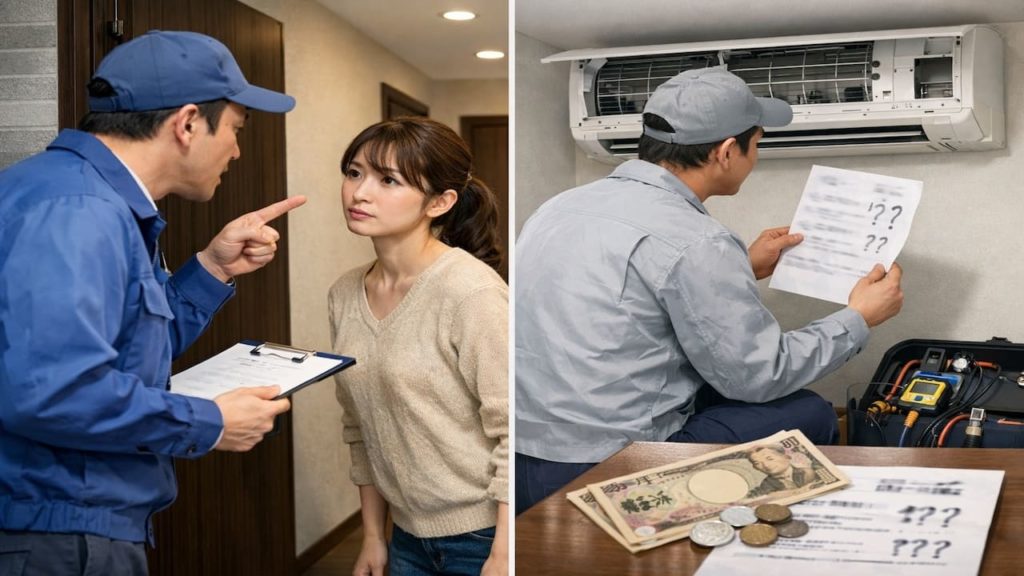
You just got a new aircon, and something already feels wrong. That is the worst timing, because you want comfort, not troubleshooting.
In Japan, small sealed rooms and humid summer air can expose tiny install mistakes fast. The first week is when leaks, noise, and weak airflow show their face.
In this guide, you’ll learn how to catch install mistakes before they get expensive and what to check without opening the unit. You will also learn what proof makes an installer take you seriously.

Hi, I’m Ken — I’m Japanese, and I live in Malaysia long-term, so I explain everyday life in Japan from a practical ‘from abroad’ perspective.
I hold a building design qualification and I’ve been on site for 20+ years across hundreds of jobs. I turn Japan’s unspoken rules into simple checks, so you can avoid costly mistakes and take the next step with clear actions that feel safe.
1. Aircon new unit problems: 5 checks
Week 1 problems usually come from drainage mounting or airflow setup.
A new unit can cool and still be installed wrong, especially in Japan apartments where pipes run through tight wall holes. Check drainage first because humid air creates a lot of water quickly. First-week symptoms.
Room air conditioners must be mounted level to drain correctly, and humid conditions make drain checks more important. According to Energy Saver (energy.gov).
Do these checks in the same order every time—so you get clear evidence, not vibes.
- Check drain outlet for steady dripping outside
- Look for indoor drips under the front edge
- Listen for gurgling when cooling starts up
- Feel airflow strength at louvers for 20 seconds
- Watch for ice or frost after 30 minutes
You might think “it is new so it cannot leak,” but new installs leak all the time. The first week is when hoses settle and bad slopes reveal themselves—especially during Japan’s muggy nights. If outside drain water is zero, treat that as a drain-path issue, not “normal.”
2. Catch install mistakes in the first week
Document repeatable signs so the installer cannot dismiss you.
Many install mistakes are small, but they worsen with vibration and moisture in Japan’s long cooling season. A loose drain hose connection can cause water leakage, and manuals warn about that exact point. Proof matters.
Some Daikin installation manuals note that forgetting to tighten the drain hose fixing can cause water leakages.
- Record a 10 second video of the drip
- Take a photo of drain outlet drip daily
- Write the time mode and set temperature
- Test with window cracked 2 cm for 5 minutes
- Check wall hole area for wetness or sweat
You may feel picky, but you are protecting your ceiling and flooring. Installers respond to clear patterns, not long explanations—so keep it simple. If the symptom appears every night, it is not “settling,” it is a defect in setup.
3. Why new installs go wrong in week 1
Small alignment errors turn into water and odor fast.
Condensation water needs a clean downhill path, and one shallow dip can trap water like a plug. That trapped water creates gurgles, then overflow, then smells in Japan’s humid air. Drain physics.
Another cause is poor insulation on piping, which can sweat and stain walls when the room is cooled hard. The last cause is vibration from loose mounting, which gets louder as screws settle.
- Notice drip only after long continuous cooling
- Check if odor appears in the first minutes
- Watch for stains growing on ceiling corners
- Listen for rattles when fan speed changes
- Confirm outdoor hose end is not underwater
You might assume the machine is defective, but most week-1 trouble is routing and finishing. Fixing slope and sealing stops the chain reaction—especially in Japan rentals where stains become your problem. If the unit freezes up, stop and treat airflow or refrigerant checks as urgent.
4. How to get it fixed before it worsens
Use a short checklist call and ask for recheck items.
Start with safe checks you can do without tools, then request a recheck of drain slope, wall-hole sealing, and mounting level; ¥100–500 for basic supplies like tape and towels is enough. In Japan apartments, sealing around the wall penetration also reduces humid air sneaking in and sweating the pipes. Fast control.
Keep the message focused: “Here is the video, here is the time, here is what I tested.” Clean communication.
- Stop cooling and run fan only to dry
- Wipe floor dry and protect slippery zones
- Send your video and request a revisit
- Ask for drain slope and level confirmation
- Ask for insulation check at wall penetration
You might worry you sound demanding, but this is basic quality control—nothing personal. If the installer fixes it, great, and you move on. If you did this and it still fails, next is a second opinion service inspection and a written report.
5. FAQs
Q1. What is the most common new-unit problem in the first week?
Drainage mistakes are the #1 repeat offender. Japan humidity produces lots of condensate, so a bad slope shows up immediately as drips or gurgles.
Q2. My unit cools fine but I hear gurgling, should I worry?
Yes, because gurgling often means air is pushing through trapped water in the drain path. It can turn into overflow later, so document it early.
Q3. How do I know if the unit is not level?
Look for drips from one side and check if the drip point shifts when fan speed changes—level issues often drip from the same corner. A quick revisit is easier now than after stains.
Q4. Should I keep running it to “test” more?
If there is indoor leaking, stop cooling and protect the floor first. Testing while it leaks can spread stains and swell flooring in Japan rentals.
Q5. What should I send the installer to get action fast?
Send one short video, one photo of the drain outlet, and your mode and set temperature. Add the time it happened and whether opening a window changed anything.
Pro's Tough Talk

I’ve spent 20+ years working around Japanese homes, so I’ve seen what tends to work—and what tends to go wrong—in everyday use. In tsuyu humidity, week-1 mistakes show up fast because the unit is basically a water-making machine. New doesn’t mean correct.
Three causes, every time. Drain routing has a dip, so water sits there like a kinked straw and starts bubbling. The wall hole seal is sloppy, so humid air sneaks in and the pipes sweat like a cold can on a table. Mounting is loose, so vibration spreads like a loose picture-frame nail slowly walking out.
Stop cooling and run fan-only now.
Send the installer your proof today.
Do the drain slope and wall-hole recheck this weekend.
Week-1 evidence saves you months of quiet damage. If you did this and it still fails, next is a second-opinion inspection with a written note you can show the building side.
“It’s new” is not a repair plan.
You hear a drip at 2 a.m., put a towel down, and tell yourself it’ll vanish by morning. You see a faint ceiling ring, ignore it for a week, then act shocked when it becomes modern art.
Summary
Use the 5 checks in week 1: outside drain drip, indoor drips, gurgles, airflow strength, and icing signs. Japan’s humid season makes mistakes obvious fast.
Document the pattern with a short video and repeatable timing, then ask for drain slope, level, and sealing rechecks. First-week fixes are usually small, but delays make them bigger.
Record one clean proof and request a revisit today. Do that, and you stop stains and slippery floors before they become your new normal.