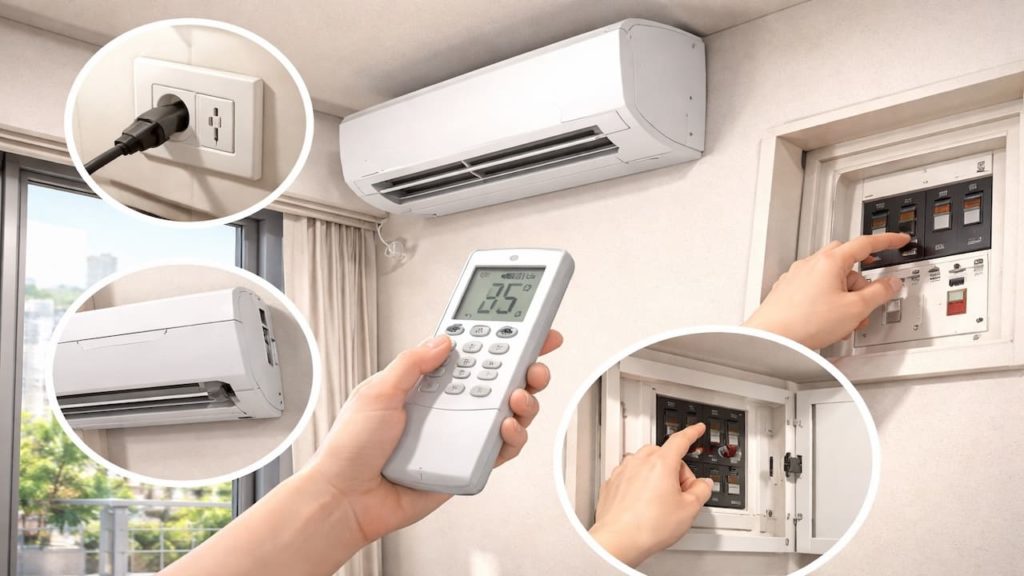
Your aircon vibrates at night, and the noise feels louder than daytime.You want sleep, not a late-night repair adventure.
Night vibration is usually a mix of loose parts, airflow settings, and how the building carries sound.In Japan, thin-wall apartments and humid seasons make small rattles travel far.
In this guide, you’ll learn how to quiet night vibration without risky DIY.You’ll check the unit calmly, then decide what is safe to adjust.

Hi, I’m Ken — I’m Japanese, and I live in Malaysia long-term, so I explain everyday life in Japan from a practical ‘from abroad’ perspective.
I hold a building design qualification and I’ve been on site for 20+ years across hundreds of jobs. I turn Japan’s unspoken rules into simple checks, so you can avoid costly mistakes and take the next step with clear actions that feel safe.
1. Aircon vibration at night: 5 checks
Find whether the vibration is indoor or outdoor first.
At night, the room is quiet, so a normal hum can feel like a problem. Japan apartments often transmit vibration through wall studs and balcony slabs. Start by listening close to the indoor unit, then the outdoor unit area, without touching spinning parts. If the vibration changes with fan speed, the source is often airflow parts, not refrigerant.
Loose vanes and abnormal indications can point to installation or part fit issues. According to mitsubishielectricmalaysia.com.
- Stand near indoor unit and note vibration pitch
- Stand near outdoor unit and note vibration pitch
- Switch fan speed low then medium then high
- Turn swing on and listen for rattling
- Press front panel lightly to find buzzing spot
Some people assume the outdoor unit is always the culprit. But indoor panels and vanes can buzz like crazy in Japan’s quiet bedrooms — especially on low fan. Don’t guess from across the room. Pinpoint the source, then move to the safe fixes.
2. Quiet the unit without unsafe hacks
Most night vibration is loose plastic and mounting play.
Indoor units can rattle when the front panel is not seated, filters are slightly warped, or the vane linkage taps a cover. In Japan homes, airflow is often set to low for sleep, which can create a steady resonance. Check for objects near the indoor outlet, and for anything touching the outdoor casing. If the operation lamp flashes, treat it as a clue, not a challenge.
Basic troubleshooting includes removing obstructions and restarting after checks. According to Daikin.
- Reseat filters and close panel until it clicks
- Remove items touching indoor casing or pipes
- Clear outdoor unit area of loose objects
- Check mounting bracket screws for visible looseness
- Restart unit and test vibration in cool mode
It is tempting to wedge cardboard or tape into gaps. That can trap moisture, worsen mold, and even interfere with moving parts — a bad match for Japan’s humid nights. Keep fixes reversible and clean. If a part needs force, it is not a safe home fix.
3. Why vibration gets louder at night
Night vibration feels worse because the building amplifies it.
When the neighborhood quiets down, you hear frequencies you ignored before. Japan apartments often have hard surfaces, short corridors, and hollow walls that carry a low hum. Low fan and quiet mode can lock into a single resonance instead of masking it with airflow noise. Bedding position matters too, because your head is close to the sound path.
- Move bed head away from indoor unit wall
- Close sliding doors to change sound path
- Place a rug to reduce floor vibration carry
- Test medium fan to break steady resonance
- Change louver angle to avoid direct wall blast
Some people think the unit suddenly became worse overnight. Often the difference is the environment, not the machine — Japan buildings can act like a speaker box at night. Focus on resonance control, not endless temperature changes. If the sound becomes metallic or grinding, stop and escalate.
4. How to quiet the unit safely
Use one safe adjustment at a time and confirm results.
Start with airflow tuning, then do simple vibration isolation that does not alter wiring or piping. In Japan rentals, you want fixes that do not leave marks and do not require drilling. If you need supplies, plan ¥100–500 for felt pads or a soft foam strip. Do not open the sealed casing or touch the fan wheel.
- Set fan to medium and aim airflow upward
- Enable swing to avoid fixed resonance angle
- Run 10 minutes before sleep then use timer
- Add felt pads to panel contact points gently
- Ask service to relevel brackets if needed
People love “tighten everything” advice, but overtightening plastic can crack it. Keep pressure light — just enough to stop play. If you did this and it still fails, next is checking the blower balance and bracket alignment. Safety first, because night fixes invite bad decisions.
5. FAQs
Q1. Why is the vibration worse only on low fan at night?
Low fan can create a steady frequency that resonates with panels and walls. Medium fan often breaks the resonance and sounds calmer.
Q2. Is it safe to press the indoor panel while it runs?
Light pressure on the outer panel is usually fine, but never insert fingers inside vents. If pressure changes the sound a lot, reseat the panel and filters.
Q3. Should I put rubber under the outdoor unit feet?
Only if you can place pads without shifting the unit. If the unit is on a narrow stand or shared balcony frame, ask a technician to avoid accidents.
Q4. The unit buzzes when swing is on. What does that mean?
The vane linkage may be rubbing a cover or a vane may be slightly loose. Turn swing off and check vane seating after powering down.
Q5. When should I stop troubleshooting and call service?
Stop if you hear grinding, sharp metallic rattles, or the vibration suddenly spikes. Also stop if the operation lamp flashes in a repeating pattern.
Pro's Tough Talk

I’ve spent 20+ years working around Japanese homes, so I’ve seen what tends to work—and what tends to go wrong—in everyday use. In tsuyu season, tiny rattles spread through thin walls like gossip. You’re not imagining it.
Cause one, loose panels and filters, like a shopping cart wheel that wobbles forever. Cause two, resonance, where low fan locks into one note and the room turns into a drum. Cause three, mounting play, so vibration walks into the wall. You lie down, it starts buzzing, and you stare at the ceiling counting every pulse.
Switch fan to medium and test now.
Reseat the panel and filters today.
Add simple pads or call service this weekend.
Quiet comes from removing play and breaking resonance. Seriously. If you did this and it still fails, next is a technician checking blower balance and bracket level.
You finally fall asleep, then a single rattle wakes you like a jump scare. Keep “fixing” it with random wedges, and you’ll invent a new musical genre called Bedroom Vibrations.
Summary
Do the 5 checks to locate whether vibration is indoor or outdoor. Japan housing can amplify small noise, so location matters more than you expect.
Use safe fixes like reseating panels, clearing obstructions, and changing fan speed to break resonance. If the sound turns metallic or unstable, stop and get service.
Tonight test medium fan and reseat the panel properly. Then keep your setup simple so the unit stays quiet through long humid nights.