You want shade and rain cover in Japan, but you also want something that won’t turn into a wind hazard. The words “awning” and “canopy” sound similar, yet they behave very differently once the weather flips.
The choice gets messy because rules, drilling limits, and storage space matter as much as coverage. In Japan’s humid rainy season and sudden gusts, the wrong setup can trap damp air or yank loose when you least expect it.
In this guide, you’ll learn how to choose between an awning and a canopy in Japan. You’ll match your use case, check rules, and pick a wind-safe option that fits real Japanese housing.

Hi, I’m Ken — I’m Japanese, and I live in Malaysia long-term, so I explain everyday life in Japan from a practical ‘from abroad’ perspective.
I hold a building design qualification and I’ve been on site for 20+ years across hundreds of jobs. I turn Japan’s unspoken rules into simple checks, so you can avoid costly mistakes and take the next step with clear actions that feel safe.
1. Awning vs canopy in Japan: 5 checks to choose
Pick based on how you will use it every day.
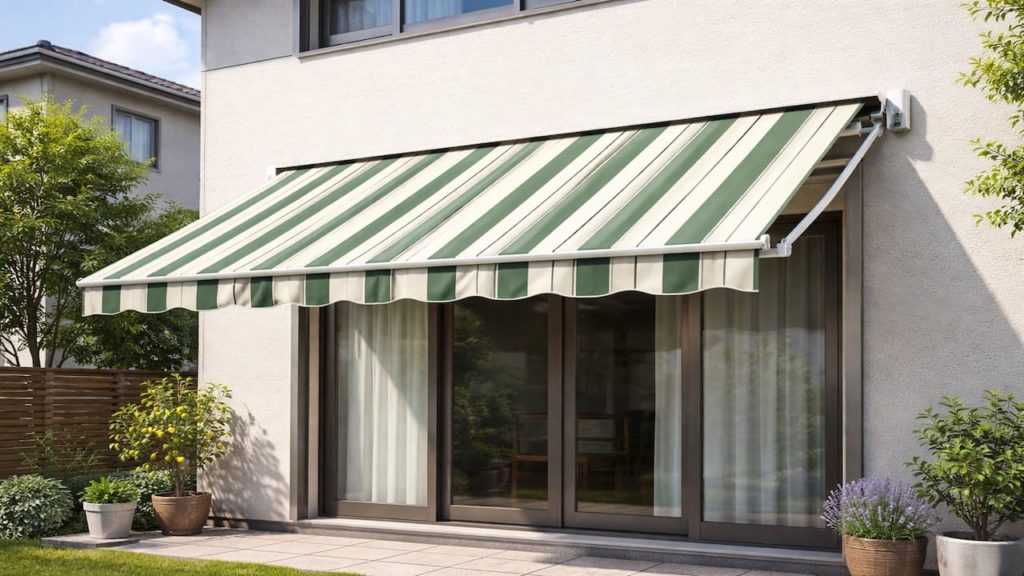
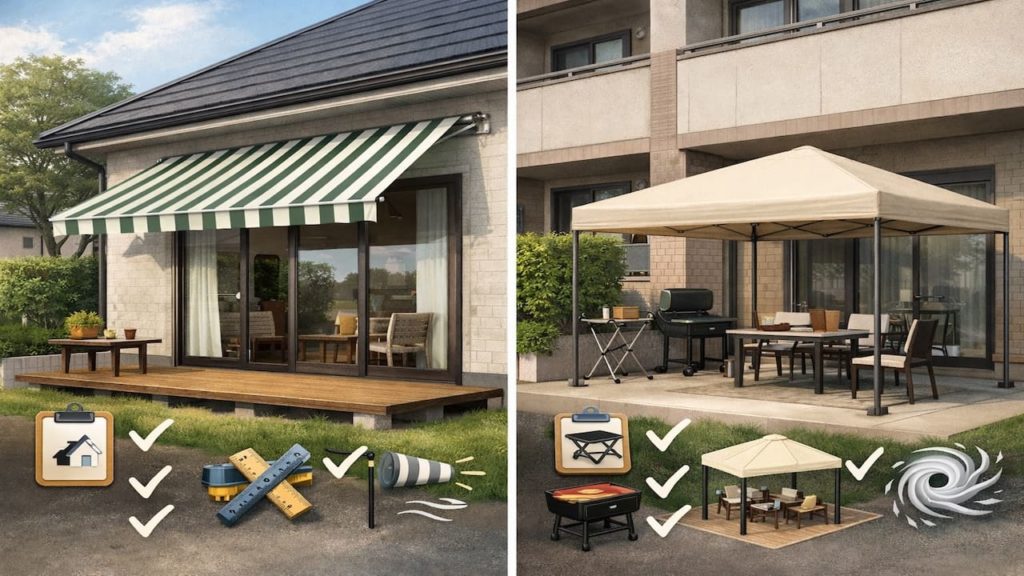
An awning is usually fixed or semi-fixed and shines when you need repeatable shade at a window or balcony edge. A canopy is usually free-standing and wins when you need flexible coverage over a spot like a bike, a small table, or a stroller corner. In Japan, space is tight and weather swings fast, so “easy to remove” can matter more than “maximum coverage”—daily reality.
- Choose awning for window shade and glare control
- Choose canopy for movable spot coverage on demand
- Check setup time for sudden rain and gusts
- Confirm storage space when not in use
- Match size to narrow balconies and side yards
Some people think the bigger roof is always better, but bigger also means more wind load and more rule exposure. Small wins. If you can’t manage it alone in bad weather, you won’t keep using it. Choose the thing you can actually handle.
2. Use case rules and wind
Rules and wind decide what is realistic not your preference.
Start with rules because many balconies and exterior-facing parts are treated as shared building elements with limited modification rights, even if you can “use” them. That’s why drilling, permanent brackets, and anything that changes the facade can trigger approval needs. According to mlit.go.jp. Then wind: high floors and building gaps create gust tunnels, and a big sheet of fabric can behave like a sail.
- Use canopy if rules ban drilling entirely
- Use awning only with written installation permission
- Check if facade appearance changes are prohibited
- Set a daily wind rule for retraction
- Plan tie-down points before you buy
You might assume “temporary” means “allowed,” but buildings often judge by risk and visibility, not your intent. Rule logic. If it can fall or leak, it becomes your problem. Pick the type that fits the rule box first.
3. Why awnings and canopies behave differently in Japanese weather
Awning edges catch gusts while canopy legs fail at the base.
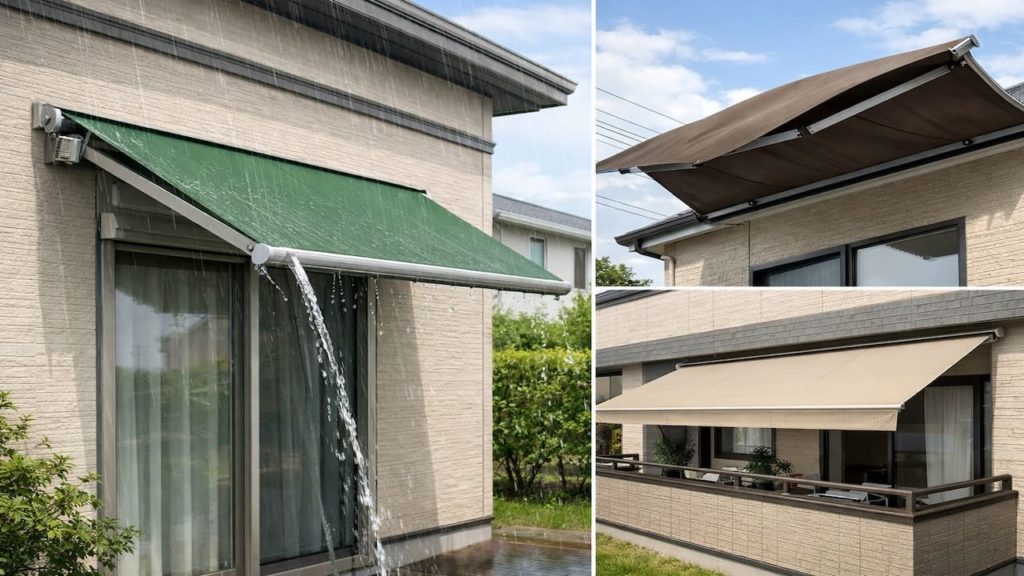
An awning tends to fail by uplift and ripping at the edge, because wind gets under it and pries upward. A canopy tends to fail by sliding, twisting, or toppling, because the legs lose friction on wet concrete and the frame racks. In Japan, “moderate” winds can already make umbrellas useless and walking annoying, which is a hint your fabric roof is getting stressed too—same physics. According to data.jma.go.jp.
- Awning fails when wind lifts the front edge
- Canopy fails when feet slide on wet floors
- Low pitch traps hot damp air under cover
- Side screens block breeze and slow drying
- Narrow passages accelerate gusts between buildings
People blame quality, but design mismatch is usually the real cause. Different failure mode. If your site is windy, treat fabric like a sail, not a curtain. If your site is slick, treat legs like skates.
4. How to choose and set one without breaking rules
Choose the simplest setup you can remove fast.
Think in two layers: daily comfort and storm mode. For apartments, default to no-drill solutions unless you have written approval, and keep the footprint clear for balcony use and cleaning. For typical small setups, budget ¥5,000–40,000 for a basic canopy or compact awning kit plus straps and pads, then spend more on stability only if your site truly needs it.
- Measure coverage zone and mark drip splash areas
- Pick smaller fabric than your first instinct
- Add two safety tethers to solid fixed points
- Use anti-slip pads under canopy feet
- Practice a two-minute take-down routine
You may think “I’ll just leave it up,” but Japan’s weather loves surprise gusts and sudden rain shifts. Bad habit. Make removal easy and you’ll actually do it. If removal feels annoying, you’ll gamble, and that’s when damage happens.
5. FAQs
Q1. Which is better for a small apartment balcony?
A compact canopy is usually safer if drilling is not allowed and you need something reversible. An awning can work if the building rules allow exterior changes and you can retract it quickly.
Q2. Which handles wind better?
Neither “wins” by default. A well-tethered canopy can be stable, while a retractable awning can be safer if you actually retract it before gusts build.
Q3. What is the simplest rule-friendly approach?
Assume no drilling unless you have written approval. Then choose a removable canopy or clamp-style mount that leaves no permanent holes.
Q4. Can an awning make a balcony feel more humid?
Yes if it blocks the breeze and traps warm air near the opening. Leave a high vent gap and avoid sealing both sides tight.
Q5. What is one quick check before buying?
Stand where the roof would be and imagine removing it alone in bad weather. If you can’t picture doing it fast, pick a smaller and simpler option.
Pro's Tough Talk

I’ve spent 20+ years working around Japanese homes, so I’ve seen what tends to work—and what tends to go wrong—in everyday use. If you buy the “bigger is better” roof, wind will teach you a new hobby: emergency teardown.
An awning fails like a sail strapped to a shopping cart, pulling and jerking at the edge. A canopy fails like a wobbly folding table, legs skating on wet concrete until it tips. Nobody’s stupid here, and not every product is trash, but the failure is baked into the setup when you ignore the forces. In Japan’s typhoon season, those forces show up without an invitation.
Right now: choose the smallest roof that covers the real wet zone. Today: set tethers and pads so it can’t walk around. This weekend: practice take-down until your hands do it without thinking.
If you can’t remove it fast you shouldn’t install it. If rules are unclear or the facade will change, go reversible first, then upgrade only after you live with it.
You know the scene: you’re holding a pole with one hand while your laundry tries to fly away. ムリだろ。 Don’t let your “shade plan” become the building’s surprise kite festival.
Summary
Choose awning vs canopy by daily use, not by the biggest coverage. In Japan, space limits and sudden gusts punish heavy setups.
If rules or drilling are unclear, lean reversible and removable. If wind is common at your spot, prioritize fast take-down and stable tie-downs.
Pick the option you can remove in minutes and use daily so it stays safe and actually helps. Then keep exploring related fixes on balcony airflow, rain splash control, and storm-ready habits.