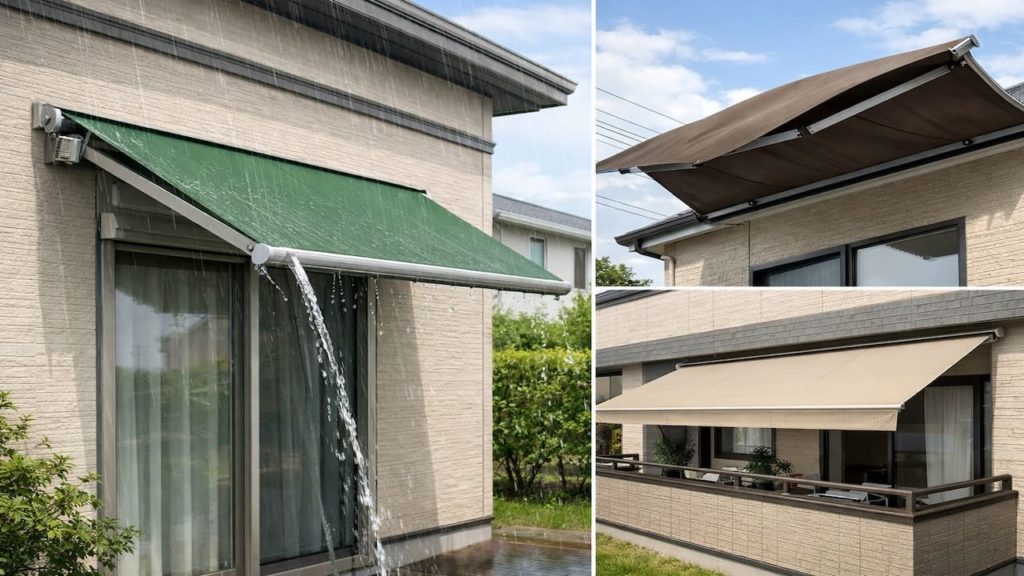
Your awning drips onto a neighbor’s side, and now you feel that quiet pressure. Even if it is “just rain,” it can turn into complaints fast.
The cause could be the runoff path, a low edge, splash off hard ground, or water rolling along the cassette. In Japan, tight boundary lines and close eaves make small drips land exactly where they should not.
In this guide, you’ll learn how to stop awning runoff from bothering neighbors. You’ll trace the water path, reduce splash, and adjust the edge so rain stays on your side.

Hi, I’m Ken — I’m Japanese, and I live in Malaysia long-term, so I explain everyday life in Japan from a practical ‘from abroad’ perspective.
I hold a building design qualification and I’ve been on site for 20+ years across hundreds of jobs. I turn Japan’s unspoken rules into simple checks, so you can avoid costly mistakes and take the next step with clear actions that feel safe.
1. Awning drips onto neighbors: 5 checks
Track where the water leaves the awning before you change anything.
Most people guess, then buy random parts, then the drip moves one meter and they still lose. Do a simple water path check during rain or with a hose, and watch where the first drip forms—then where it lands. In Japan’s narrow side yards, even a small angle change can shift runoff onto the boundary line.
- Stand under edge and watch first drip point
- Check if drip forms at one corner only
- Look for water rolling along the front bar
- Confirm ground below is hard and splashy
- Note wind direction that pushes drip sideways
You might think “rain is natural, so it is fine.” But neighbors don’t care about your logic when their wall or walkway gets soaked. Find the exit point, then control it.
2. Runoff path and splash control
Stop splash first because splash travels farther than you expect.
If water drops onto concrete, gravel, or a metal cover, it rebounds and sprays sideways. That spray can reach a neighbor wall even if the main drip line is on your side—annoying. In Japan, many homes have narrow passageways and shared boundary walls, so splash becomes the real offender. Fixing splash often reduces the problem without touching brackets.
- Check if drip hits concrete right at boundary
- Add absorbent strip under the drip landing zone
- Move planters to break splash at ground level
- Test hose flow and watch spray direction closely
- Confirm downspout is not adding extra runoff
Some people say “just extend it less.” That helps sometimes, but splash can still happen at partial extension. Control landing and spray, and the whole situation calms down.
3. Why awning runoff becomes a neighbor problem
A small drip becomes conflict when it crosses the property edge.
The awning changes how rain falls: it concentrates water into a line and drops it from a fixed edge. Wind then pushes that line sideways, and hard surfaces throw it back as spray. In Japan, boundary gaps are tight, so the runoff line can land off your side by just a few centimeters—enough to trigger complaints. Also, the Japanese Civil Code prohibits installing structures that discharge rainwater directly onto neighboring land. According to japaneselawtranslation.go.jp.
- Edge line drops water in one concentrated strip
- Wind shifts the drip line past your boundary
- Splash rebounds from hard ground onto walls
- Low tilt sends water to the neighbor-side corner
- Dirty fabric channels water into weird grooves
You might think “it only happens in heavy rain.” Heavy rain is exactly when people get stressed and start blaming anything near the boundary. Handle it now while it is a small fix, not a big argument.
4. How to redirect runoff without tearing everything down
Create a controlled drip line that lands safely on your side.
Start with low-cost control: adjust tilt, shift extension habits, and add a simple splash breaker under the landing zone. If you need hardware, keep it basic: a small gutter add-on, drip edge strip, or seal tweaks to stop corner tracking, usually ¥500–3,000 for simple parts and supplies. Do it on a dry day so sealant cures, because Japan’s humid air slows drying and weakens quick fixes. If the runoff still crosses the line, you re-check corner level and bracket alignment.
- Tilt slightly steeper to shorten drip throw distance
- Add splash pad or gravel strip under drip zone
- Install small drip edge strip to stop corner tracking
- Clean fabric grooves that channel water sideways
- Retract during wind driven rain to avoid spray
Some folks try to “aim water” toward the neighbor because it is easier. Don’t do that. Aim it onto your own safe landing zone, and keep the water path predictable.
5. FAQs
Q1. How can I tell if it is drip or splash causing the issue?
Watch during a steady rain and look at the neighbor wall or ground for fine mist patterns. Drip makes a line and a puddle, while splash makes scattered specks and streaks.
Q2. What is the quickest first fix that usually helps?
Break the splash under the drip landing zone. A small absorbent or gravel strip can reduce sideways spray fast, even before you touch the awning angle.
Q3. Does changing the tilt really matter?
Yes, because a flatter awning throws water farther and encourages corner tracking. A slightly steeper tilt often shortens the drip throw and keeps runoff on your side.
Q4. Why does it drip more on one corner?
The front bar may be slightly out of level, or fabric tension may guide water to one side. Dirt and algae can also form tiny channels that steer runoff.
Q5. When should I stop DIY and call the installer?
If the bracket level is off, the mount is loose, or the cassette is leaking water from unexpected spots. If you cannot keep water off the boundary line after basic controls, get it rechecked.
Pro's Tough Talk

I’ve spent 20+ years working around Japanese homes, so I’ve seen what tends to work—and what tends to go wrong—in everyday use. If your awning drips onto neighbors, it’s not “unlucky rain.” It’s a water path you didn’t control, and now the boundary is doing the talking.
Three causes, no sugar: tracking, throwing, and splashing. Tracking is water sneaking to one corner like it found the only escape route. Throwing is a flat tilt launching droplets farther than your brain expects. Splashing is the ground acting like a trampoline and spraying sideways onto walls.
Right now, put a splash breaker under the drip zone. Today, clean the edge and recheck which corner is leading. This weekend, adjust tilt and lock in a safe landing spot.
If water still crosses the line after splash and tilt changes you need alignment fixes. That means checking level, bracket seating, and any corner tracking that comes from the bar, not the rain. If the neighbor is already annoyed, stop experimenting and get the mount inspected.
It’s like pouring tea with a chipped spout, and blaming gravity. You dash out in slippers to pull laundry in, and the neighbor’s wall is getting peppered. Come on.
Summary
First, trace where the drip forms and where it lands. Then separate drip from splash, because splash is often what reaches the neighbor side.
If simple splash control and tilt changes do not keep water on your side, treat it as an alignment and tracking problem at the bar or brackets. If the boundary keeps getting wet, stop trial-and-error.
Break the splash zone today and confirm the drip corner. Then keep moving through related awning checks so each next step reduces risk and friction at home.