You want an awning mainly for rain protection, not just shade. But you also don’t want a floppy canopy that dumps water in the wrong place.
The “rain problem” can be angle, runoff path, wind exposure, or a size choice that backfires. In Japan, sudden showers and humid seasons make drying slow, so small mistakes show up fast.
In this guide, you’ll learn the 5 checks that keep rain off your door and walls. You’ll pick a workable angle, control runoff, and avoid wind trouble so the awning feels like a smart buy.

Hi, I’m Ken — I’m Japanese, and I live in Malaysia long-term, so I explain everyday life in Japan from a practical ‘from abroad’ perspective.
I hold a building design qualification and I’ve been on site for 20+ years across hundreds of jobs. I turn Japan’s unspoken rules into simple checks, so you can avoid costly mistakes and take the next step with clear actions that feel safe.
1. Awning for rain protection: 5 checks before buying
Rain protection only works when water leaves on purpose.
People buy an awning and assume rain just “falls off nicely”—then it drips on steps, splashes onto walls, or runs toward the neighbor side. In Japan, narrow entries and tight boundary gaps make a small drip line a real daily annoyance—especially in the rainy season. Check these five items before you fall for the design photo.
- Confirm you can set a steep rain angle
- Trace where drip line will land on ground
- Check wind exposure at the exact mounting wall
- Match size to door swing and walking path
- Verify wall structure can take bracket loads
Some folks say “any awning is better than none.” Not for rain. A bad awning makes you step into a drip zone every morning, and you’ll hate it more than bare sky.
2. Angle runoff wind and size
Angle and runoff path matter more than brand names.
A flatter angle looks neat, but it throws water farther and encourages pooling, so drops hit harder and splash wider in Japan’s tight genkan area—then you track wet footprints inside. A realistic installed total in Japan is often around ¥150,000–400,000 depending on size and conditions, so you want the geometry right before paying real money. According to rehome-navi.com. Wind is the silent cost too: the bigger the projection, the more it behaves like a lever on your wall.
- Choose a model with wide pitch adjustment range
- Plan drip landing zone away from hard concrete
- Pick shorter projection if wind hits that wall
- Keep full extension as rare heavy rain mode
- Size width to cover door but not dominate facade
You might think “bigger is safer for rain.” Bigger can dump more water in one strip and load the brackets harder. Pick the size that controls water, not the size that looks impressive.
3. Why rain protection fails after installation
Most failures come from water tracking and splash.
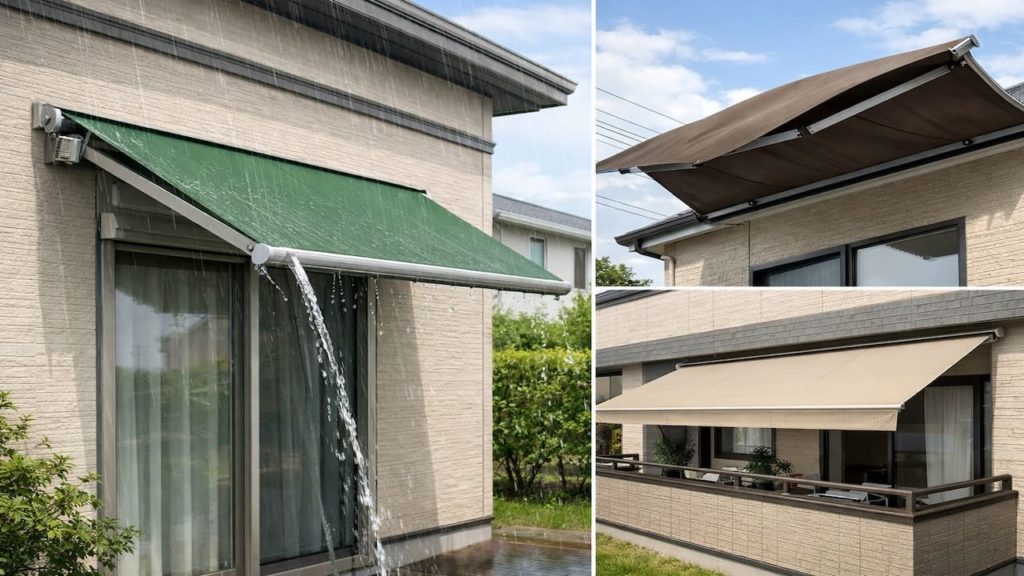
Water rarely falls straight down. It tracks along the front bar, follows seams, and finds the lowest corner, then it drops in the worst spot—like right onto a step edge. In Japan’s humid months, that constant damp zone invites slippery bio-film and stains, so the problem feels bigger every week. Wind-driven rain also hits the underside and pushes water where you didn’t plan.
- Front bar is slightly out of level
- Fabric sags and creates a pooling belly
- Drip line lands on hard surface and splashes
- Corner tracking sends water to one side
- Wind pushes runoff sideways into the entry
Some people blame the fabric quality right away. Maybe, but geometry and drip landing are usually the real villains. Fix the path and the “mystery leak” disappears.
4. How to buy the right awning for rain
Buy for rain mode first and looks second.
Start by choosing a model that can tilt steep enough for rain, then decide where the runoff will land, then confirm the wall can take the bracket load. In Japan, do not ignore neighbor distance and walkway width, because the drip strip can easily cross a boundary line in a narrow side yard—instant stress. Treat wind as a decision rule: if the wall gets gusts, choose shorter projection and plan a retract habit.
- Measure door swing and headroom under front bar
- Mark drip landing zone with tape during hose test
- Confirm wall type and anchor plan before ordering
- Choose projection that fits wind and daily traffic
- Set a rain rule for pitch and extension
People say “I’ll figure it out after install.” That’s how you end up stuck with a drip line you can’t move without redoing brackets. Decide the rain setup now, then you’re done.
5. FAQs
Q1. Can an awning really stop rain from entering the doorway?
It can reduce it a lot, but only if pitch and drip landing are planned. In Japan’s sudden showers, wind-driven rain still sneaks in, so you aim for “much less wet,” not “perfectly dry.”
Q2. What angle should I prioritize for rain protection?
Steeper is usually better for rain because it reduces pooling and makes runoff predictable—flat looks clean but behaves messy. If your model has limited pitch range, treat that as a red flag for rain use.
Q3. How do I prevent splash onto walls and steps?
Make the drip line land on a softer zone like gravel, a splash pad, or a garden strip instead of bare concrete. If you can’t change the ground, shorten extension during heavy rain to pull the landing closer.
Q4. Is a bigger projection always better for rain?
No, bigger can increase wind load and make a stronger drip strip that splashes farther. A medium projection with the right pitch often feels drier than an oversized one.
Q5. What is the fastest pre-buy check that saves the most regret?
Confirm you can set a steep rain pitch and control the drip landing. If you can’t control those two, you’re buying a drip machine, not rain protection.
Pro's Tough Talk

I’ve spent 20+ years working around Japanese homes, so I’ve seen what tends to work—and what tends to go wrong—in everyday use. Rain awnings fail when people buy for looks and pray for physics. Japan’s wet season doesn’t respect prayers.
Three ugly truths: water tracks, wind cheats, and splash multiplies. Tracking means it crawls to the lowest corner like it owns the place. Wind cheats by shoving droplets sideways under your “roof.” Splash multiplies because concrete is basically a trampoline for rain.
Right now, picture the drip landing like you’re drawing a crime scene. Today, measure pitch range and refuse anything that can’t tilt steep. This weekend, do a hose test plan on the ground zone.
If you can’t control where the water lands you will hate this awning. If the wall is windy, you pick shorter projection and make retraction your habit. If the installer can’t explain the anchor plan, you pause the deal.
It’s like buying a “quiet fan” that screams, and then acting surprised. Wait, you wanted the rain to politely fall straight down?
Summary
For rain protection, you need pitch, runoff control, and a safe drip landing zone. Size only helps when it supports those basics.
If wind exposure is high or the drip line will land on hard concrete, adjust your plan before buying. If you can’t control the water path, expect daily irritation and extra fixes.
Pick a model with real pitch control and plan the drip landing first. Then keep checking related awning topics so your next choice improves comfort instead of adding new problems.