Your awning remote does nothing, and the motor sits there like it’s ignoring you. You press again, harder, like that helps.
It might be a dead battery, lost pairing, or a range problem caused by walls and interference. In Japan, reinforced concrete apartments and tight entry layouts can mess with signal more than you expect.
In this guide, you’ll learn how to get an awning remote working again with simple checks. You’ll confirm battery, pairing, and range so you stop guessing and start moving the awning.

Hi, I’m Ken — I’m Japanese, and I live in Malaysia long-term, so I explain everyday life in Japan from a practical ‘from abroad’ perspective.
I hold a building design qualification and I’ve been on site for 20+ years across hundreds of jobs. I turn Japan’s unspoken rules into simple checks, so you can avoid costly mistakes and take the next step with clear actions that feel safe.
1. Awning remote not working: 5 checks
Check power and signal in a fixed order.
Remote issues feel random until you test them the same way every time—then the cause shows up fast. Start with battery and LED behavior, then confirm the motor has power, then test range near the receiver. Japan homes often have thick exterior walls or metal doors that block signals, especially in condos and narrow genkan areas.
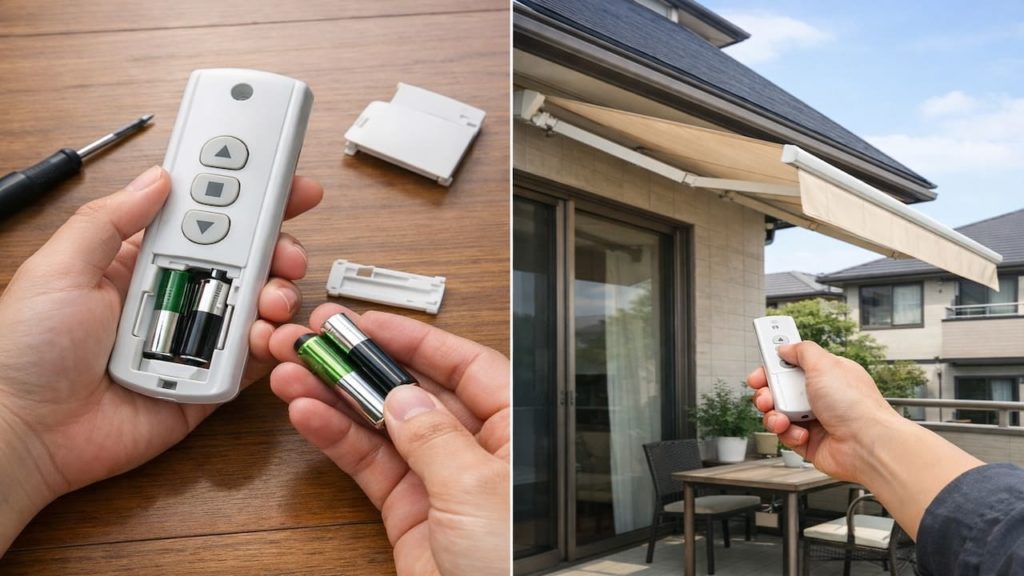
- Replace remote battery with fresh matching type
- Test motor power using wall switch or breaker
- Move close to receiver and retry commands
- Check remote LED response on button press
- Look for sensor lock mode disabling control
You might think the remote is broken and order a new one. Most of the time it’s battery or range, and you just didn’t prove it. Do the five checks, then decide based on evidence.
2. Battery pairing and range
Most failures are battery or pairing not the motor.
A weak battery can still flash an LED but fail to transmit cleanly—so you get false hope. Pairing can also get lost after power cuts or controller resets, and Japan gets plenty of sudden outages during storms. Budget ¥200–1,000 for fresh batteries and a small screwdriver set, and treat the rest as time/effort to test properly. According to somfysystems.com.
- Match battery type exactly and replace both cells
- Hold remote close and test short range first
- Power cycle motor then retry remote command
- Re-pair remote using the motor program button
- Remove obstacles like metal doors near receiver
Some people say range is “just distance.” Not in real housing. Concrete, steel, and even a wet exterior wall can weaken signal. If it works close but not far, the remote is fine and your environment is the problem.
3. Why awning remotes stop responding suddenly
Signal loss happens when the control chain breaks.
A remote system is a chain: battery, transmitter, receiver, and motor controller—one weak link kills the whole thing. Japan apartments often stack devices close together, so interference and blocked paths are common, especially near sliding doors and metal frames. Power dips can also leave the receiver in a weird state where it ignores commands until it is reset.
- Battery voltage drops under load during transmit
- Receiver loses pairing after power interruption event
- Interference blocks signal near dense electronics cluster
- Remote buttons wear and stop making contact
- Sensor mode overrides remote input for safety
You might think this means the motor is dying. Usually the motor is fine and the remote chain is what failed. Prove each link and you stop wasting days.
4. How to restore control fast without chaos
Reset one thing at a time and confirm the change.
Start with the battery swap, then do a close-range test, then power cycle the motor, then re-pair if needed—clean steps. Keep notes, because repeated random pressing makes it harder to know what fixed it. Budget ¥500–2,000 if you need a basic outlet tester or replacement battery pack, and keep the rest as time/effort. In Japan’s humid season, keep remotes dry and away from sweaty entry shelves where moisture creeps into buttons.
- Replace battery then test from one meter away
- Cut power thirty seconds then restore power
- Press program button and re-pair remote once
- Test each direction and stop after one response
- Store remote high and away from damp zones
Some folks try full system resets immediately. That can wipe settings and create new problems, especially if multiple remotes exist. Do it stepwise, confirm what changed, and you’ll get control back with less damage.
5. FAQs
Q1. How do I know if the remote battery is actually the issue?
If the LED is dim, inconsistent, or only works when you press hard, suspect the battery first. If a fresh battery changes nothing, move to range and pairing checks.
Q2. What if the remote works only when I stand very close?
That is almost always a range or interference issue. Thick concrete walls and metal frames in Japanese condos can block signals, so test different positions and remove nearby obstacles.
Q3. Can a power outage break the remote connection?
Yes, pairing or receiver state can get weird after power dips. A clean power cycle often restores response, and re-pairing is the next move if it still ignores commands.
Q4. What is the single fastest fix to try first?
Replace the battery and test close range. It solves a huge share of cases and tells you immediately if you are dealing with signal or pairing.
Q5. When should I stop and call service?
If you confirm motor power, swap batteries, test close range, and re-pair, and it still shows zero movement or sound. Also stop if the awning moves unpredictably, because that is a control safety issue.
Pro's Tough Talk

I’ve spent 20+ years working around Japanese homes, so I’ve seen what tends to work—and what tends to go wrong—in everyday use. When a remote fails, people go full panic mode and start pressing buttons like it’s a video game combo.
Three causes, cold and simple: dead juice, lost pairing, blocked signal. Dead juice is the classic “LED lies to you” battery. Lost pairing is the remote talking but the receiver pretending it doesn’t know you. Blocked signal is concrete and metal acting like a shield in Japan’s humid rainy season.
Right now, swap the battery. Today, stand close and test range, then power cycle once. This weekend, re-pair cleanly and store the remote away from damp entry chaos.
If it works close but not far your remote is fine. That means you fix placement, interference, and storage, not the motor. If it never works even close after re-pairing, then you chase wiring, receiver, or a bad controller.
It’s like yelling at a locked door instead of using the key. It’s like blaming the TV when the remote has no batteries. Bruh.
Summary
Start with battery, then prove motor power, then test range close to the receiver. That order turns a “mystery” into a clear cause.
If it works only up close, treat it as signal blocking or interference and adjust where you use and store the remote. If it never works up close, re-pair and then escalate.
Swap the battery and do a close range test today. Then keep moving through related awning checks so the next problem is smaller and easier.