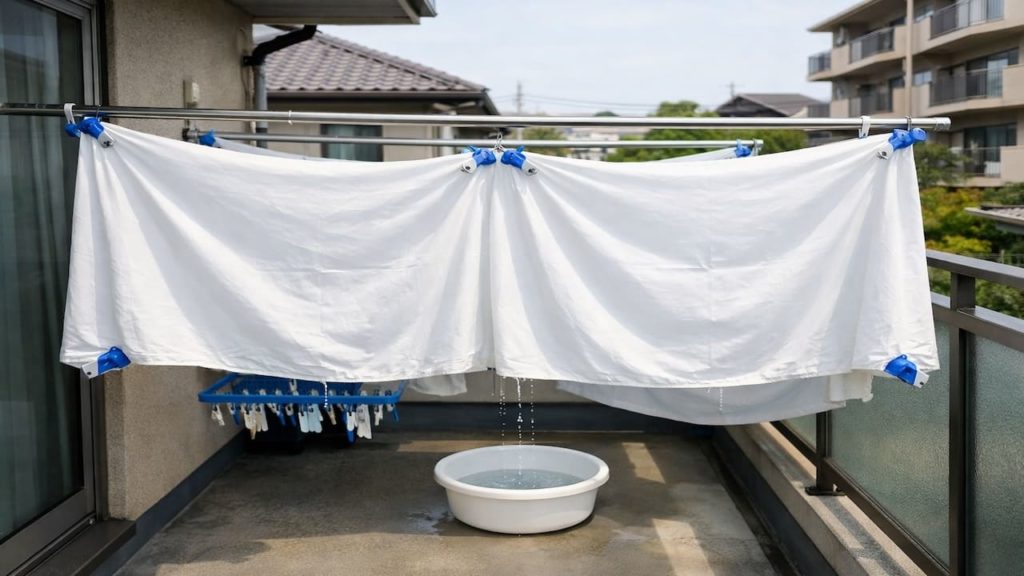
You hang sheets on the balcony, and they look fine for five minutes. Then they sag, drip, and start touching things you really don’t want them touching.
In Japan, balconies are tight, wind comes in weird angles between buildings, and rainy season humidity makes fabric stay heavier for longer. Sheets amplify every small setup mistake.
In this guide, you’ll learn 5 checks that keep balcony sheets under control by fixing corner clips, stopping sag, and preventing drip so your sheets dry clean instead of dragging misery.

Hi, I’m Ken — I’m Japanese, and I live in Malaysia long-term, so I explain everyday life in Japan from a practical ‘from abroad’ perspective.
I hold a building design qualification and I’ve been on site for 20+ years across hundreds of jobs. I turn Japan’s unspoken rules into simple checks, so you can avoid costly mistakes and take the next step with clear actions that feel safe.
1. Sheets on Balcony laundry 5 checks
Sheets fail when the corners are not controlled.
Sheets are big, light, and annoying — they catch wind like a sail and collapse like a wet curtain. In Japan, balcony rails and racks often force narrow hanging lines, so the sheet can’t spread properly. Once a corner slips, the whole sheet shifts and sags. That’s when drip and dirt happen.
- Clip all four corners before anything else
- Check corners are clipped to rigid points
- Keep sheet edges off balcony floor surfaces
- Confirm sheet does not block airflow path
- Watch for corner slip in first minutes
You might think “I clipped it once, it’s fine.” With sheets, one weak clip is a countdown timer. Fix the corners, and the rest gets easier.
2. Corner clips sag control and drip
Corner clips decide whether the sheet stays flat.
A sheet needs tension across the top, not just hanging weight — otherwise it bows and folds into itself. If clips are too close together, the center droops and holds water longer. In Japan’s humid days, that pooled water drips and re-wets the lower parts. You want wide corner spread and stable grip.
- Use two clips per top corner point
- Spread corners as wide as the rack allows
- Clip the hem seam not thin fabric
- Lift the bottom edge with extra pins
- Angle the sheet to catch cross breeze
“My clips are strong enough.” Strength is only half the story. Placement and tension matter more than raw grip.
3. Why sheets sag and drip on balcony lines
Sag happens when wet weight beats your frame.
Sheets hold a surprising amount of water, especially in thick hems and corner seams. If your line flexes, the sheet sinks and folds, trapping damp air inside the fold. Japan’s rainy season makes this worse because evaporation slows while weight stays high. Drip is just gravity finishing the job.
- Wet corners stay heavy and pull downward
- Flexible lines bow and create a low point
- Folds trap humid air and slow drying
- Wind flips edges and breaks clip tension
- Low hanging edges brush rails and walls
“So I need a stronger rack.” Sometimes, but often you just need better tension and less folding. Control the shape, and drip drops fast.
4. How to keep sheets flat and stop drip
Lock the shape first then chase airflow.
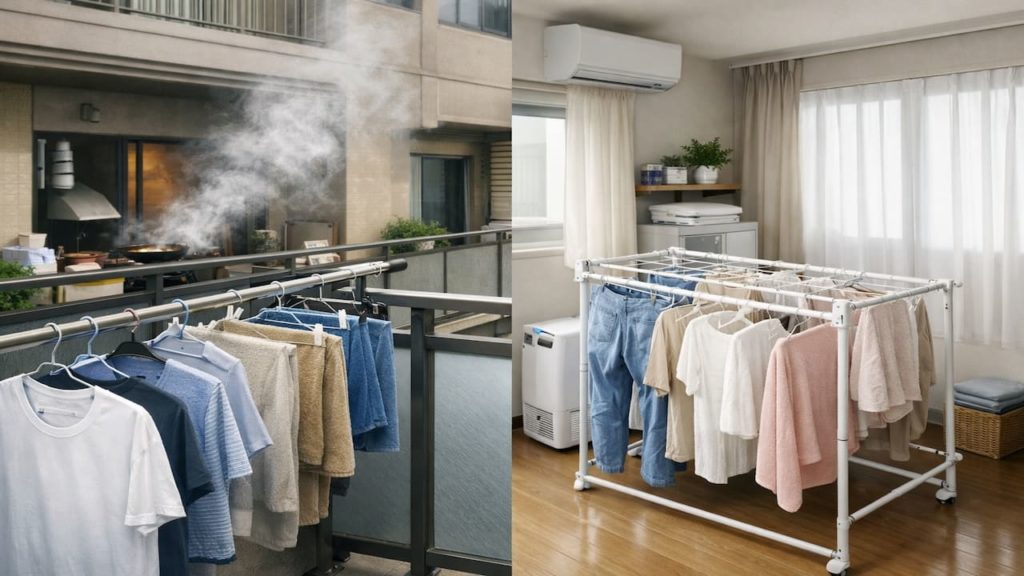
Start with corner tension, then lift the center so water can’t pool — that’s the sheet win condition. If you buy anything, sheet clips and extra pins usually run ¥300–1,500, and they pay for themselves in saved re-dry time. In Japan apartments, finishing indoors can be the clean move when humidity stays high. Keep the sheet off splash zones and rotate once.
- Clip corners wide to create top tension
- Add two mid clips to lift center
- Raise the rack height for steadier airflow
- Rotate sheet once when surface feels drier
- Finish indoors with airflow before evening humidity
“Rotating is annoying.” True, but it’s faster than rewashing a sheet that picked up balcony grime. If drip keeps happening, your sheet is too low or too folded.
5. FAQs
Q1. How many clips do I need for one sheet?
At minimum, clip all four corners. If the center sags, add two mid clips to lift the lowest point and keep airflow moving.
Q2. Why does my sheet touch the balcony wall or floor?
The top line is too narrow or the sheet is too low. Spread the corners wider and raise the rack so the bottom edge stays clear.
Q3. What’s the best way to prevent drip marks?
Stop pooling by lifting the center and keeping the sheet flat. Also keep the sheet away from rails and floors where dirty splash can jump.
Q4. Should I finish-dry sheets indoors during humid days?
Yes if the sheet stays cool and heavy after hours outside. A short indoor finish with airflow prevents re-damp and helps the corners fully dry.
Q5. My clips keep slipping off corners, what should I do?
Clip the hem seam or folded corner, not a thin single layer. If the corner is rounded, fold it once to create a thicker bite point.
Pro's Tough Talk

I’ve spent 20+ years working around Japanese homes, so I’ve seen what tends to work—and what tends to go wrong—in everyday use. Sheets on a balcony look calm until the wind shows up and turns them into a sail. In humid Japanese weather, wet fabric stays heavy longer, so the sag problem gets louder.
Here’s the cold breakdown in three parts. First, weak corner control lets the sheet crawl and fold. Second, your line or rack bows, creating a low point where water pools, like a hammock holding rain. Third, once the sheet folds, airflow dies inside the fold, like trying to dry a book you closed while wet.
Clip the corners wide and bite the seam. Today. Lift the center with two extra clips so it cannot pool. This weekend, rotate once mid-dry and finish indoors before evening humidity climbs.
If the sheet still drips after you lift the center, your rack is too low or too close to the balcony edge where splash and wind hit hardest. Move it inward and raise it, then reduce folding at all costs. If corners always stay damp, treat corners as indoor-finish zones.
You know the moment you open the door and see the sheet stuck to the railing. And the moment you pull it in and it brushes the floor for one second too long. Yeah. Fix the corners, stop the drama.
Summary
Sheets on a balcony go wrong when corners slip, the line bows, and the center pools water. Check corner grip, height, and whether the sheet stays flat instead of folding.
If sag and drip keep happening, widen the corner spread, lift the center, and avoid low hanging edges near rails and floors. When humidity stays high, indoor finish-drying is the reliable move.
Today, clip corners wide, add two mid clips, and rotate once before the day gets sticky. Keep the sheet flat and your balcony stops acting like a sheet sabotage machine.
Accident reports include cases where laundry poles and fixtures fell from balconies, showing why stable hanging and secure setups matter. According to jikojoho.caa.go.jp.
Guidance for residential fire safety planning includes keeping balconies and similar areas clear so evacuation routes and equipment remain usable. According to tfd.metro.tokyo.lg.jp.