You want to dry laundry on the balcony, but the space is tiny and everything feels in the way. One rack blocks the door, another blocks the walkway, and suddenly laundry day becomes a mini obstacle course.
In Japan, balconies are often narrow, drainage slopes are common, and the usable area is smaller than it looks once you factor in rails and safety zones. Add humid seasons and sudden weather shifts, and clutter gets annoying fast.
In this guide, you’ll learn 5 tips to dry balcony laundry in a small space by using vertical racks, working corners smartly, and keeping safe paths clear so your balcony stays usable while your clothes still dry.

Hi, I’m Ken — I’m Japanese, and I live in Malaysia long-term, so I explain everyday life in Japan from a practical ‘from abroad’ perspective.
I hold a building design qualification and I’ve been on site for 20+ years across hundreds of jobs. I turn Japan’s unspoken rules into simple checks, so you can avoid costly mistakes and take the next step with clear actions that feel safe.
1. Small space Balcony laundry 5 tips
Small balconies work when you build “lanes”.
If everything sits in the middle, you lose movement and airflow at the same time — worst combo. A small-space setup needs one clear walking lane and one fixed drying lane. Once those lanes exist, your rack stops drifting around like a lost shopping cart. Less chaos.
- Mark a clear door-to-edge walking lane
- Place rack parallel to railing for airflow
- Keep heavy items closer to wall side
- Hang small items high to free floor
- Use a timer for quick take-in habit
“But I want maximum drying area.” Max area without a path becomes a daily hassle. A stable lane setup gives you speed and consistency. Calm balcony.
2. Vertical racks corners and safe paths
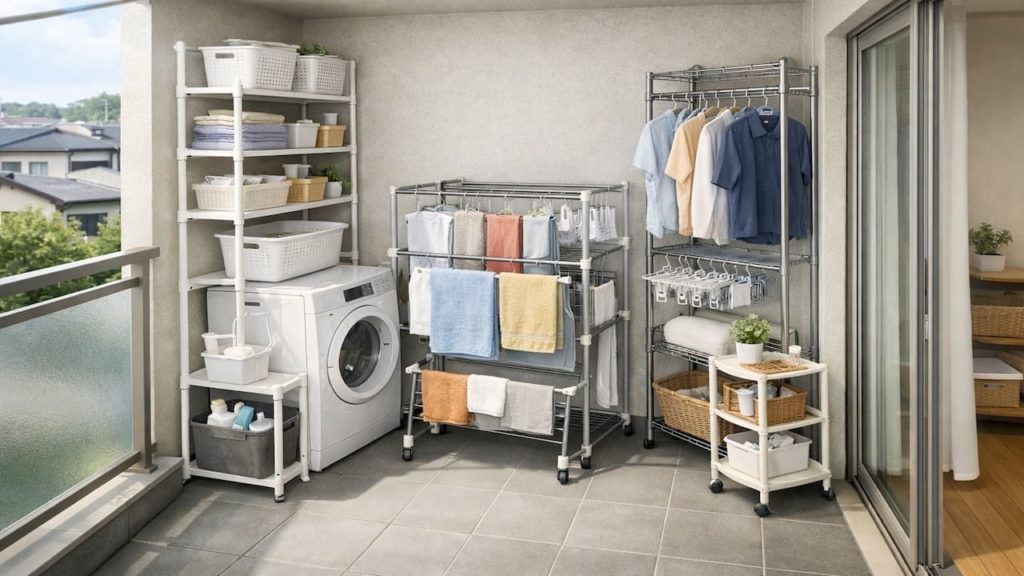
Go vertical, then hide the mess in corners.
Vertical racks win because they stack hanging zones without expanding your footprint — that’s the whole point. Corners also help because they reduce swing and keep fabric away from the main path. But “safe paths” matters too, because balconies can be evacuation-related areas in Japan, so you don’t want your laundry gear blocking access. Keep the route boring.
- Choose a tall rack with wide base
- Set the rack in a corner zone
- Clip hems so nothing swings outward
- Leave a clear path to hatch area
- Keep the door swing area fully clear
“Vertical racks feel unstable.” Some are, especially narrow-base models. Pick wide-base and keep heavy items low. Stability first.
3. Why small balconies feel impossible for laundry
Your rack fights airflow when it blocks movement.
When space is tight, you naturally cluster clothes, and clustered fabric traps damp air. The balcony wall and rail can create dead zones where wind never reaches your rack. In humid seasons, that dead air keeps items cool and slightly damp longer. Slow-dry risk.
- Crowded fabric blocks airflow between layers
- Walls create dead zones behind the rack
- Low racks sit in stagnant air pockets
- Long hems touch rails and pick up dust
- Doorway drafts miss the laundry center area
“So my balcony is just bad.” It’s not bad, it’s just small. The fix is layout, height, and spacing. Simple physics.
4. How to dry laundry in a small balcony safely
Fix the footprint, then tune airflow and timing.
A decent vertical rack and clips usually cost around ¥2,000–8,000 depending on materials and size — and it’s worth it if your current setup blocks your life. Start by setting one permanent rack position, then use height to separate items and spacing to keep air moving. Finish thick items indoors when humidity stays high. No drama.
- Lock rack position and stop rearranging daily
- Hang heavy items low to prevent tipping
- Use corners for long items like towels
- Rotate thick items halfway through drying
- Finish indoors with airflow before evening humidity
“I don’t want extra steps.” You already do extra steps when you re-dry and rewash. One stable setup reduces total effort. Less friction.
5. FAQs
Q1. What’s the best rack type for a tiny balcony?
A vertical rack with a wide base works best because it saves floor footprint while giving multiple hanging levels. Avoid narrow-base tall racks that tip easily.
Q2. Where should I place the rack in a small space?
Use a corner so it doesn’t block the main path and so fabric swings less in wind. Keep the door swing and any access zones clear.
Q3. How do I keep airflow when everything is close together?
Use height separation and leave a small gap between items rather than stacking layers. Rotate thick items once mid-dry so damp cores meet airflow.
Q4. What’s the biggest mistake in small-space balcony drying?
Blocking the path with gear because it makes everything harder and can create safety issues. A clear lane plus a fixed drying lane is the fastest improvement.
Q5. When should I stop using the balcony and finish indoors?
If humidity stays high and thick items stay cool after hours, finish them indoors with airflow. That prevents musty smell and saves time.
Pro's Tough Talk

I’ve spent 20+ years working around Japanese homes, so I’ve seen what tends to work—and what tends to go wrong—in everyday use. A tiny balcony doesn’t need “more effort,” it needs a smarter layout, especially in Japan’s humid seasons.
Here’s the cold truth. If you block the path, you’ll start avoiding the balcony, then laundry sits longer, then everything dries slower. If you use a low wide sprawl rack, you kill airflow like putting a blanket over a fan. And if you keep moving the rack around, your setup never stabilizes and you keep re-learning the same lesson.
Lock the rack into one corner. Today. Go vertical and keep heavy items low. This weekend, create one clear lane and treat it like it’s sacred.
If clothes still dry slow after this, your loads are too thick for your balcony airflow, so finish-dry indoors and stop gambling. If the rack feels shaky, downgrade the height or upgrade the base width. Small-space drying is like packing a suitcase: control the shape or it controls you.
You’ve done the sideways shuffle with a basket while the rack bites your shin. And you’ve opened the door and the hanger hooks catch like a fishing net. Yeah, no.
Summary
Small balcony laundry becomes easy when you stop spreading outward and start stacking upward. Create one walking lane and one drying lane so your space stays usable.
If drying is slow, it’s usually blocked airflow, dead zones near walls, or thick items staying damp. Move the rack into a corner, keep spacing, and rotate thick pieces once mid-dry.
Today, lock a vertical rack into a corner and keep a clear path, then finish thick items indoors when humidity fights you. Make your setup stable and the balcony stops feeling like a laundry trap.
Balconies should be kept clear to maintain evacuation readiness and avoid placing items that obstruct use. According to tfd.metro.tokyo.lg.jp.
Balconies are commonly treated as common areas with exclusive-use rights under standard management rules, so building rules still apply. According to mansion-info.mlit.go.jp.