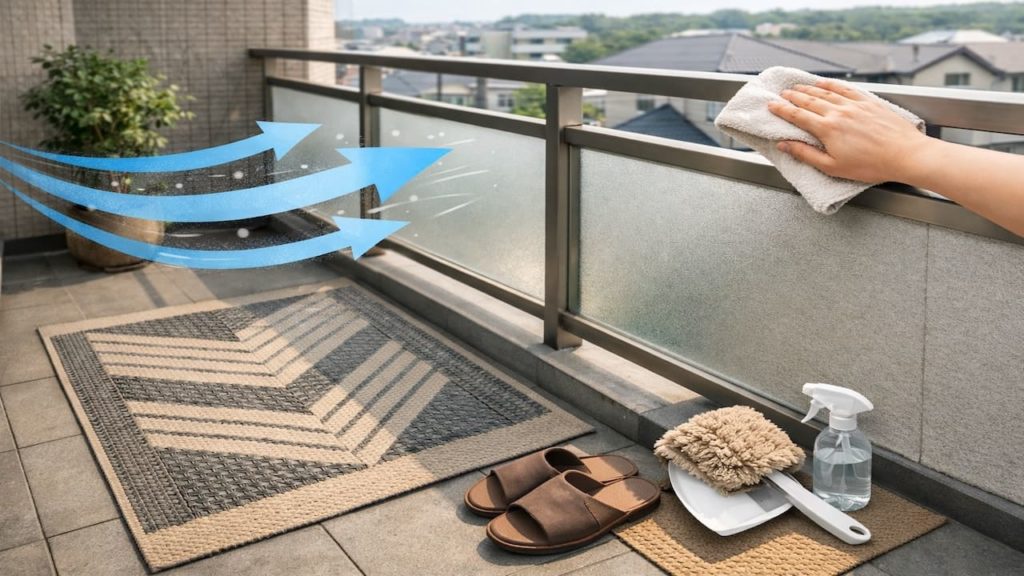
You grab the balcony railing and it moves more than it should. Even a small wobble makes your brain jump to worst-case.
The cause might be loose bolts, hidden rust, gaps at joints, or a panel that has shifted over time. In Japan, salty air, rainy season moisture, and tight apartment wind corridors can speed up wear.
In this guide, you’ll learn how to check a loose balcony railing safely and decide your next move. You’ll spot the risk signs fast, document them, and know when to stop DIY and report it.

Hi, I’m Ken — I’m Japanese, and I live in Malaysia long-term, so I explain everyday life in Japan from a practical ‘from abroad’ perspective.
I hold a building design qualification and I’ve been on site for 20+ years across hundreds of jobs. I turn Japan’s unspoken rules into simple checks, so you can avoid costly mistakes and take the next step with clear actions that feel safe.
1. Balcony railing feels loose: 5 checks
Treat any railing wobble as a safety issue first.
Do not lean on it “to test it harder”—you are the load. In many Japanese apartments, rail panels, brackets, and handrails can feel fine until one joint loosens and the movement suddenly jumps. Start with checks that do not require force. Calm inspection—no hero moves.
- Push lightly with two fingers and watch movement
- Check if wobble is at one corner only
- Listen for clicking sounds at brackets and joints
- Look for fresh scrape marks near connection points
- Confirm the floor edge seal is not cracking
You might think “it’s just a little shake,” but a railing is not allowed to be a surprise toy. If it moves, you reduce use and you investigate with your eyes first.
2. Bolts wobble rust and gaps
Find whether the movement is hardware or the rail itself.
There are two different problems: loose fasteners, or a base that is failing. Loose fasteners often show as a tight pattern: one bracket, one screw line, one rattle spot. Base issues show as gaps that change, rust stains that spread, or movement that travels along the whole rail. In Japan’s humid months, rust can grow under paint where you cannot see it. Silent damage.
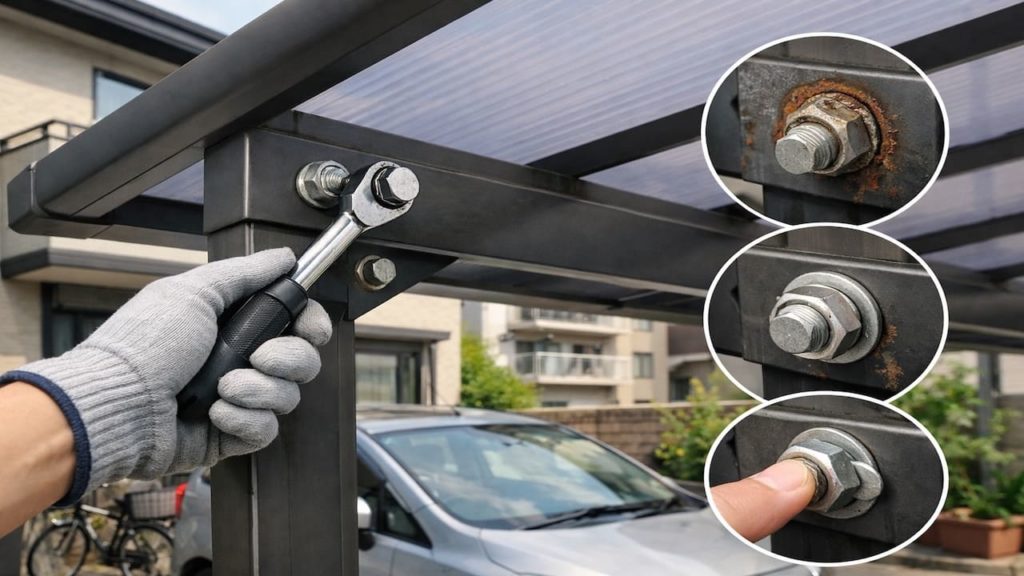
- Check bolt heads for rust bleeding and bubbling paint
- Look for gaps that open and close when touched
- Test if the whole panel moves or only the handrail
- Inspect anchors near corners where water collects
- Check for loose cover caps hiding fasteners
You may want to grab a wrench and crank it down, but you can strip threads or hide a bigger problem. Your goal is diagnosis, not brute force.
3. Why balcony railings loosen over time
Small movement grows when moisture and vibration repeat.
Wind vibration, door slams, and daily touches create micro-movement, and micro-movement eats fasteners slowly. Moisture does the rest: it creeps into joints, weakens coatings, and feeds corrosion under the surface. In apartment life, balconies also get loaded with planters and racks that bump rails without you noticing. Constant little hits—constant loosening.
Keeping the area around the railing clear of climbable objects is a basic fall-prevention habit. According to mainichi.jp.
- Watch for wobble getting worse after storms
- Check if a planter keeps tapping the rail
- Look for water lines where rain keeps sitting
- Inspect screws that look slightly pulled out
- Notice squeaks that appear only in wind
You might blame age and accept it, but loose rails are not “normal aging,” they are a warning. Once you see the pattern, you can stop adding stress to it.
4. How to respond to a loose balcony railing
Limit use, document clearly, then escalate fast.
First, stop leaning on the rail and keep kids and pets away from that edge—no exceptions. Next, take photos and a short video showing the movement and the exact spot, then write down when it started and whether storms made it worse. The cost is mostly time/effort, plus about ¥300–1,500 for basic gloves and a flashlight if you do not have them. If you live in managed housing, contact the management office and request an on-site check. According to ur-cm-support.jp.
- Mark the wobble point with removable tape
- Record a short video showing the movement
- Stop using the railing as a support point
- Remove heavy items that bump the rail daily
- Report it with date photos and exact location
You may want to “tighten one screw” and forget it, but you do not know what the screw is actually holding. If it is structural, you do not gamble. Report it, and let the right person open it up.
5. FAQs
Q1. Is a little wobble ever normal on balcony railings?
Some handrails feel slightly springy, but rattling, clicking, or visible joint movement is not normal. If the movement suddenly changed, treat it as a new risk.
Q2. Should I tighten the bolts myself?
If it is clearly a removable accessory bracket, maybe, but structural rail fasteners are not a casual DIY job. Over-tightening can strip threads and hide the real failure.
Q3. What is the fastest safety step I can do right now?
Stop leaning on it and keep the edge clear. Remove anything that encourages climbing or pushing, and block pet access until it is checked.
Q4. What signs mean it is urgent?
Rust bleeding, widening gaps, wobble along the whole panel, or any grinding sound when touched. Also urgent if you see cracking at the base or floor edge.
Q5. What should I send to management to get a quick response?
A clear video of the movement, a photo of the exact joint, and the date you noticed it. Add whether storms, wind, or recent work happened nearby.
Pro's Tough Talk

I’ve spent 20+ years working around Japanese homes, so I’ve seen what tends to work—and what tends to go wrong—in everyday use. In rainy season gusts, a loose rail is a warning label you can feel.
Here’s the cold breakdown: vibration loosens hardware, moisture feeds rust, and one tiny gap becomes a bigger gap when you keep testing it. That rail is not a “handle,” it’s a cliff edge with a costume on. And rust under paint is a termite in a suit.
Back off the rail now. Today, film the wobble and clear the edge zone. This weekend, push the report through and get an on-site check.
If the wobble is visible you are done testing. That’s the line. If anyone says “it’s probably fine,” ask them to put it in writing and watch how fast the tone changes.
Nope.
Summary
A loose balcony railing is a safety problem, not a small annoyance. Your job is to locate the wobble point and reduce stress on it immediately.
Check for rust, gaps, and movement patterns, then document with photos and video. If it is structural or worsening after wind and rain, escalate to management fast.
Record the wobble today and stop using the rail until it is inspected. Once it is stable, you can rebuild balcony comfort without that constant edge anxiety.