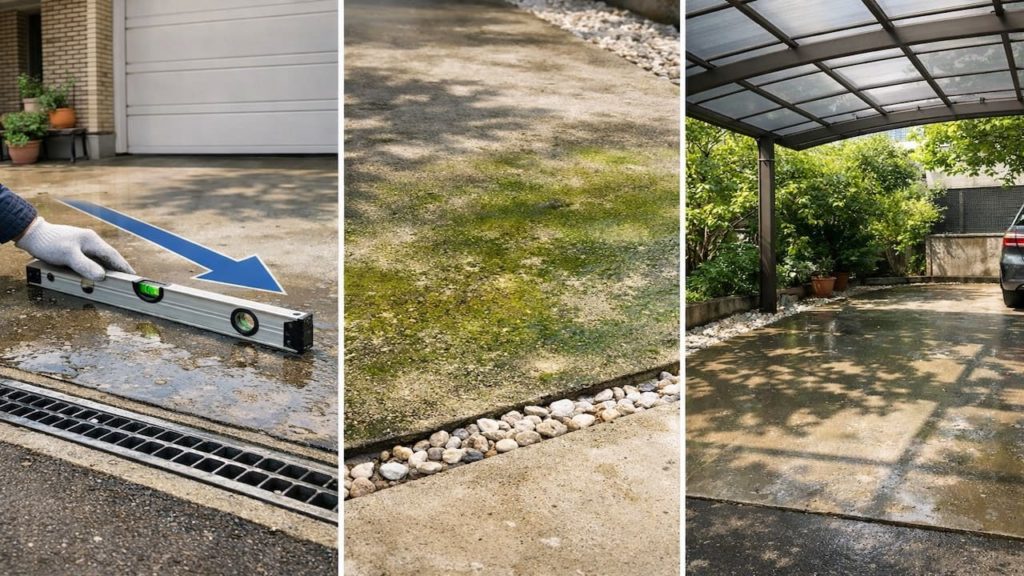
You park under the carport, but rain still drips right off the edge and splashes everywhere. You end up with wet shoes, dirty splash marks, and that annoying drip line you can’t ignore.
The cause can be gutter gaps, wrong slope, clogged seams, or panels that let water run in the wrong direction. In Japan, sudden downpours and long rainy season weeks make small edge issues feel huge fast.
In this guide, you’ll learn how to reduce carport edge drips without doing a full rebuild. You’ll check gutters, adjust slope, seal seams, and control splash so the entrance stays calmer.

Hi, I’m Ken — I’m Japanese, and I live in Malaysia long-term, so I explain everyday life in Japan from a practical ‘from abroad’ perspective.
I hold a building design qualification and I’ve been on site for 20+ years across hundreds of jobs. I turn Japan’s unspoken rules into simple checks, so you can avoid costly mistakes and take the next step with clear actions that feel safe.
1. Carport rain drips at the edge: 5 fixes to try
Most edge drips are a flow problem not a leak.
Water follows the easiest path, and edges are where it breaks free and drops straight down—then splash turns it into a mess. Expect ¥1,000–8,000 for a small brush, sealant, and a simple diverter strip if you need parts. In Japan’s rainy season, one clogged seam can turn into a curtain of drips. Fix the flow first, then worry about looks.
- Clean the gutter channel and seam joints first
- Check panel overlap so water runs the right way
- Add a small drip edge strip to guide water
- Test with a hose to see the real flow
- Reduce splash with gravel strip at drip line
Some people blame the roof panel immediately and want replacement. Usually the panel is fine and the water path is not. If you can see where it starts, you can stop it fast. This is about control, not luck.
2. Gutters slope and seams
Wrong slope makes gutters useless even when clean.
If the gutter is level or back-pitched, water stalls and spills at the edge, then it drips in the same spots every time. Budget ¥2,000–15,000 if you need new gutter pieces, end caps, or bracket adjustments. In Japan, wind-driven rain can push water sideways, so seams and end caps matter more than you think. A tiny gap becomes a drip machine.
- Confirm gutter slopes toward the downspout outlet
- Reseat end caps and tighten seam connections
- Remove leaf sludge that blocks the outlet hole
- Seal seam gaps with compatible outdoor sealant
- Recheck after heavy rain to confirm no overflow
Some folks say “gutters always drip a bit” and accept it. No, a well-sloped gutter drains, it doesn’t decorate your driveway. If it drips from one point, that point has a reason. Fix the slope and the seam, and the drip line usually disappears.
3. Why edge drips happen even on new carports
Edge drips happen when water cannot stay attached.
As water flows, it clings to surfaces, then releases at edges based on speed, dirt, and shape. A dirty edge breaks flow and makes random drip points. In Japan, pollen, exhaust film, and salty air in some areas make edges grimy fast, so water detaches sooner. Even a “new” carport can drip if the edge is dirty or the slope is off.
- Dirt film breaks smooth flow along the edge
- Panel seams create tiny steps that catch water
- Gutter overflow starts when outlet clogs slightly
- Wind pushes sheets of water past the gutter
- Back pitch sends water to the wrong corner
Some people think “drips mean it’s leaking.” Drips often mean the water is just leaving where you don’t want it to. Once you control the release point, the drip becomes predictable and manageable. Control beats guessing.
4. How to test and fix drips without chasing ghosts
Test with a hose so you fix the exact spot.
Use a hose on low flow and mimic rain, then watch where water spills first—this beats waiting for the next storm. Set aside ¥1,000–10,000 for sealant, a drip edge strip, or a small downspout extension if you decide to upgrade. In Japan’s humid months, sealants need dry cure time, so pick a clear day and don’t rush it. After the fix, test again immediately.
- Run hose from high side and watch flow path
- Mark drip points with tape while water runs
- Clean edge film so water clings smoothly again
- Install diverter to push water into gutter channel
- Move splash away using downspout extension piece
Some people keep adding sealant everywhere and still get drips. That happens when the problem is slope or overflow, not a gap. Seal only after you confirm the flow is right. Fix the path, not the symptom.
5. FAQs
Q1. Is dripping at the edge normal?
Some dripping can happen in heavy rain but steady drip lines usually mean overflow or wrong slope. If it drips in the same spot every time, you can fix it.
Q2. Can I just add a bigger gutter?
A bigger gutter helps only if slope and outlet flow are correct. If the outlet clogs, any gutter will overflow eventually.
Q3. What sealant should I use for seams?
Use a sealant that is compatible with your panel and gutter material, and apply it on a dry day. If you are unsure, avoid guessing and check the manufacturer guidance.
Q4. Why does it drip more when wind blows?
Wind can push water past the gutter and make sheet flow detach early. Fixing edge cleanliness and seam steps can help water stay guided.
Q5. When should I call the installer?
If the gutter looks back-pitched, brackets are bent, or panels are misaligned, call service. Structural alignment beats DIY sealing in those cases.
Pro's Tough Talk

I’ve spent 20+ years working around Japanese homes, so I’ve seen what tends to work—and what tends to go wrong—in everyday use. In Japan’s rainy season, edge drips turn your entrance into a splash park if you ignore them.
This is not magic, it’s flow. A dirty edge is like a cracked windshield, it spreads the mess. A wrong slope is like pouring water uphill, then acting offended it spills.
Clean the gutter and outlet first. Test with a hose and mark the drip point. Fix slope or seams only where the water actually escapes.
If it still drips after cleaning and slope checks your gutter capacity is too small. Next move is a better gutter setup or a downspout extension to send water away.
Yeah, stop letting rain bully your driveway.
Summary
Edge drips usually come from overflow, wrong slope, dirty edges, or seam steps that break smooth flow. Clean and test first so you see the real water path.
If drips persist, fix slope and seams, then add a drip edge or extend the downspout to move splash away. If alignment is off, call service instead of smearing sealant everywhere.
Do one hose test today and take control of the drip line. Once it’s calmer, keep exploring related carport upkeep tips to prevent the next rainy season headache.