You hear about joist tape and wonder if it is just another deck upsell. In Japan, decks sit through long humidity swings that punish hidden framing.
You might be fine without it, or you might be setting up slow rot you will only notice when boards start to bounce. The trick is knowing which situation you are in.
In this guide, you’ll learn when joist tape pays off and when it is pointless. You will check moisture risk, detailing, and install timing so you buy with confidence.

Hi, I’m Ken — I’m Japanese, and I live in Malaysia long-term, so I explain everyday life in Japan from a practical ‘from abroad’ perspective.
I hold a building design qualification and I’ve been on site for 20+ years across hundreds of jobs. I turn Japan’s unspoken rules into simple checks, so you can avoid costly mistakes and take the next step with clear actions that feel safe.
1. Deck joist tape worth it? 5 checks before buying
Joist tape is worth it when your joist tops stay wet often.
The tape is basically a cap that sheds water away from the most vulnerable surface of the frame. Deck boards leak water through gaps, and that water sits on joist tops longer than you think, especially in Japan’s rainy season and shaded side yards. If you trap moisture under leaves and dirt, rot loves that spot—quiet damage.
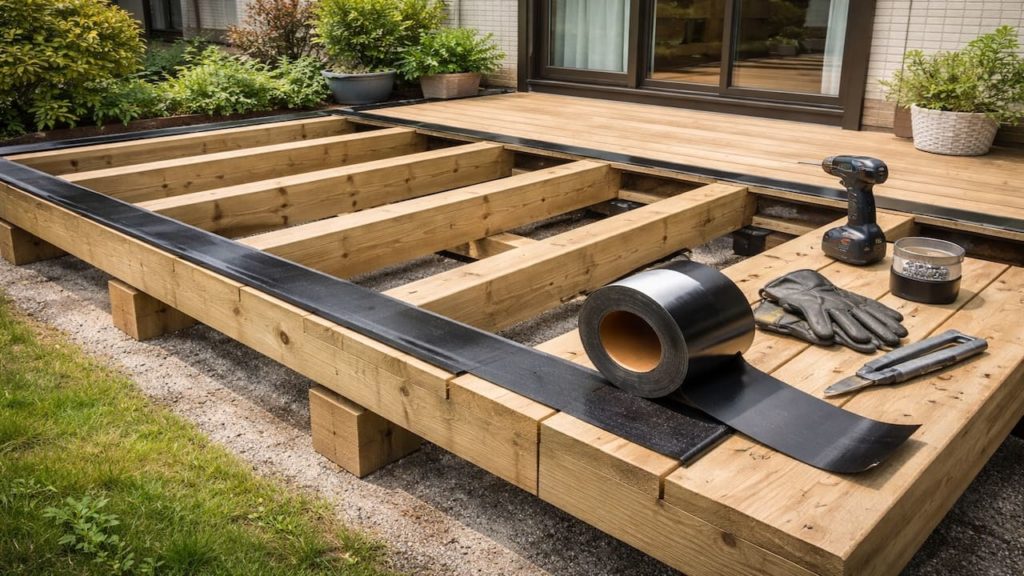
Deck joist flashing tape is commonly described as a water-resistant butyl adhesive that helps resist moisture getting into the deck frame, protecting joist tops from moisture intrusion and rot. According to TimberTech.
- Check if deck stays shaded most of day
- Check if leaves collect between deck boards
- Check joist tops for dark staining lines
- Check if fastener holes sit wet after rain
- Check if you can replace boards soon easily
You might say your lumber is pressure-treated so tape is pointless. Treated wood resists decay, but it still checks, holds water in cracks, and rots faster where moisture sits and dirt packs in, common on compact Japanese decks. Use tape as insurance when your risk is real. Not hype.
2. Cost rot proof
It is not rot proof but it can slow the rot clock.
Joist tape does not make wood immortal, it just blocks the main pathway where water and gunk camp out. If your deck has good airflow and fast dry time, the gain is small; if it stays damp, the gain can be big. For cost, expect roughly ¥1,000–3,000 for a roll of waterproof butyl tape in Japan depending on width and length—enough for small repair zones or a few key joists. According to monotaro.com.
- Compare roll width to joist width first
- Plan extra length for seams and overlaps
- Decide if you tape all joists or only edges
- Check if screws will pierce tape cleanly
- Check if tape surface gets slippery during install
Some people expect tape to stop every kind of rot forever, then call it a scam when something still fails. The goal is reducing wet time at the joist top, not eliminating every drop of moisture in Japan’s humid outdoor air. If your design still traps water, fix that too. Tape is a helper.
3. Why joists rot even under a deck board
Joists rot because water sits where wood cannot dry fast.
Water does not need a big leak, it just needs time. Rain slips between deck boards, runs along the underside, then collects on the flat joist top like a tiny gutter. Add dirt, pollen, and leaf mush, and you get a wet sponge layer that keeps the joist damp for days in Japan’s sticky months. Slow decay.
- Flat joist tops hold water like a tray
- Dirt builds a wet mat that never dries
- Fastener holes pull water into end grain
- Low airflow under decks delays drying cycles
- Small cracks trap moisture deeper over time
You might blame the stain or the boards, but the hidden frame usually dies first. If you reduce wet time at the joist tops, you reduce splitting, black staining, and that soft punky wood surprise later—especially on decks tight to walls. Think like water.
4. How to use joist tape so it actually helps
Clean dry wood and tight seams make the tape work.
Tape works best when it bonds hard and stays sealed at seams. If you stick it on damp wood, dust, or fuzzy fibers, it will lift and turn into a dirt trap instead of a shield. In Japan’s humid weather, pick a dry stretch and let the framing air out before you tape, then press it down firmly—no lazy wrinkles.
- Brush joist tops clean before you tape
- Let framing dry fully after rain events
- Run tape straight and avoid bubbles
- Overlap seams and press edges down hard
- Seal cuts around posts with small patches
Some folks tape only the middle and leave edges open, then wonder why water still creeps in. The edge detail matters because water runs to the path of least resistance, and Japanese decks often shed water toward one side due to tight drainage. Cover the top and wrap slightly down the sides. Better shed.
5. FAQs
Q1. Can joist tape trap moisture and make rot worse?
It can if you install it on wet wood or leave big wrinkles that hold dirt. Installed on dry framing with tight seams, it mainly blocks water entry at the top surface.
Q2. Is joist tape needed for pressure-treated lumber?
It still helps in wet shaded decks—treated lumber is tougher but it still stays wet where water and debris sit. If your deck dries fast and stays clean, you can skip it without regret.
Q3. Should I tape every joist or only some areas?
Priority areas are where water sits longer: near edges, under planters, under doors, and along drip lines. If budget is tight, tape those zones first.
Q4. Can I apply tape without removing deck boards?
Not really for full coverage. You can patch a few exposed sections during small repairs, but real protection needs access to the joist tops.
Q5. What is the biggest mistake people make with joist tape?
They treat it like decoration and skip prep. Dusty damp wood and loose seams mean the tape lifts, then the problem comes back.
Pro's Tough Talk

I’ve spent 20+ years working around Japanese homes, so I’ve seen what tends to work—and what tends to go wrong—in everyday use. Joist tape is not a miracle, but it is also not snake oil.
Here’s the cold truth: rot starts where water parks, and joist tops are the parking lot. If debris sits there, the wood stays wet, checks open up, and fastener holes become tiny straws. Nobody “caused” it, it just happens.
Do this now: clean the gaps and stop the dirt mat. Do this today: inspect a few joist tops through gaps and look for black lines. Do this on the weekend: if you are reboarding anyway, tape the tops with tight overlaps.
If your deck stays damp most of the week use tape. If it dries quick and stays clean, spend that effort on airflow and drainage instead.
Skipping it and calling it “fine” is like leaving your umbrella at home to prove you are brave.
Summary
Joist tape is worth it when your joist tops stay wet and dirty, which is common on shaded decks. It is less useful when your deck dries quickly and stays clean.
Check your moisture and debris risk first, then decide whether to tape all joists or only the high-risk zones. Install on clean dry wood with tight seams so it sheds water instead of trapping dirt.
Pick one joist bay and inspect it today. If you see staining and dampness, plan tape for your next board replacement and keep the frame alive longer.