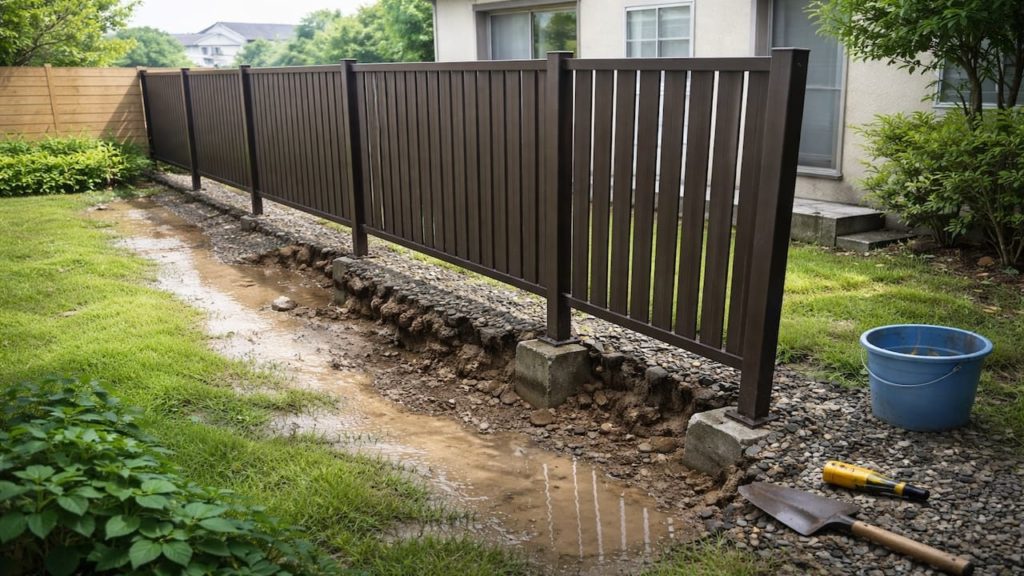
Your fence feels solid most days, then after rain it wobbles again. You grab a post and it moves just enough to make you angry.
In Japan, rainy season moisture, tight lots, and shaded side paths keep soil wet longer than you expect. That wet soil can wash out, soften, and let footings shift.
In this guide, you’ll learn 5 checks to stop fence wobble after rain by fixing soil and footing so the posts stay stable through wet weeks. You will also learn what to watch in Japanese home layouts where drainage and runoff decide everything.

Hi, I’m Ken — I’m Japanese, and I live in Malaysia long-term, so I explain everyday life in Japan from a practical ‘from abroad’ perspective.
I hold a building design qualification and I’ve been on site for 20+ years across hundreds of jobs. I turn Japan’s unspoken rules into simple checks, so you can avoid costly mistakes and take the next step with clear actions that feel safe.
1. Fence wobble after rain again: 5 checks
Wobble after rain is a ground problem first—the post is just reacting.
Rain changes the soil strength and the voids around the footing. In Japan, wet weeks can keep the ground soft, especially beside walls where sun and wind do not dry it. Start with checks that show you where water is entering and where soil is leaving.
- Grab each post and note movement direction
- Check if soil sinks around the post collar
- Look for small gaps where water runs in
- Inspect low spots where puddles sit longest
- Confirm one post is not dragging whole line
It is tempting to blame cheap materials or a bad installer. Most of the time, the real cause is washout or soft soil that never dries, so the fix starts at the ground.
2. Drainage washout and footing
Drainage and washout are the repeat offenders—they loosen the footing little by little.
When water flows along the fence line, it carries fine soil away and leaves voids. When soil stays saturated, it loses grip and the post can pivot even if the concrete is still there. In Japan, narrow side alleys often funnel runoff straight to the post bases.
- Trace rainwater path from higher ground areas
- Find splash zones under eaves and downspouts
- Check for gravel missing around the post base
- Probe soil firmness with a screwdriver near footing
- Inspect footing top shape for water pooling
Many people focus on the fence panels because they move. The panels are innocent, and the footing is guilty, so your checks must be about water paths and soil loss.
3. Why posts wobble after rain in Japanese yards
Wet soil loses strength and voids grow around footings—then wobble shows up.
When the ground is saturated, the soil acts like a weak sleeve instead of a tight clamp. If rainwater runs down the post, or if the footing area becomes a bowl, water stays and keeps weakening the collar. Tight Japanese lots can block drying wind, so the weak period lasts longer and you feel wobble for days.
Fence posts need stable installation and proper support, and depth and concrete choice affect long term stability. According to thisoldhouse.com.
- Water flows and removes fine soil near collar
- Soft ground lets the post pivot under load
- Footing top traps water when shaped flat
- Downspout splash weakens one spot repeatedly
- Shade keeps the base wet for longer
Some people keep tightening brackets and hope it stops. Hardware cannot fix soil that keeps washing out, so the wobble returns after every heavy rain.
4. How to stop wobble by fixing drainage and footing
Fix water flow first then rebuild the collar—do not pour and pray.
Start by redirecting runoff and stopping splash at the base, then restore tight support around the post. For basic supplies like gravel, simple edging, and a small amount of mix, expect ¥1,000–10,000 depending on how many posts need work. In Japan, do this after a dry day so you can see the real voids and not fight mud.
Post setting guides emphasize stable placement, bracing, and proper fill so the post stays plumb while the material sets. According to sakrete.com.
- Redirect downspout splash away from the fence base
- Add gravel and compact it in thin layers
- Reshape top collar to shed water outward
- Brace the post plumb before any setting
- Recheck after next rain and tighten soil again
If you think more concrete always fixes it, slow down. Concrete that traps water can keep soil wet and speed rot for wood posts, so shape, drainage, and compaction matter more than volume.
5. FAQs
Q1. Why does my fence wobble only after rain?
Because wet soil loses grip and creates voids. After rain, the footing area becomes softer and the post can pivot under small force, especially in shaded Japanese side yards.
Q2. How do I tell if it is washout or a broken footing?
If you see gaps and sinking soil around the post base, that is washout or softening. If the post stays loose even after compacting and drying, the footing may be too small or cracked.
Q3. Should I add more soil around the base?
Adding loose soil alone usually fails because it washes away again. Add gravel where it helps drainage, and compact in layers so it acts like support, not decoration.
Q4. Can I fix wobble without removing the post?
Sometimes, if the post is still mostly plumb and the issue is collar voids. If the post is leaning or the footing is moving, you may need to reset that post.
Q5. When should I stop DIY and call a pro?
If the fence is on a boundary line, if multiple posts are moving, or if water is flowing toward the foundation. That combo can turn into a bigger drainage problem, not just a fence issue.
Pro's Tough Talk

I’ve spent 20+ years working around Japanese homes, so I’ve seen what tends to work—and what tends to go wrong—in everyday use. In rainy season weeks, soil turns soft and posts start acting brave until you touch them.
Here is the cold breakdown: wobble is not a mystery, it is physics on wet ground. Washout steals support like termites steal wood, slow and quiet. And a flat collar that holds water is a bathtub for your footing, which is cute until it is not.
Find the water path now. Kill the splash today. Rebuild the collar this weekend.
If the post moves after you fix drainage it needs a reset. If it firms up after compaction and sheds water, you are done and you stop poking it every day like a stress test.
Yeah, nice plan.
You step out after rain and the fence feels loose again. You stomp the soil and promise yourself you will fix it later. That later keeps moving, just like the post.
Summary
Fence wobble after rain is usually drainage washout and soft soil around the footing. Check water paths, voids, and the collar shape before you blame panels or brackets.
Fix runoff and splash first, then compact support back in layers and reshape the top to shed water. If the post still moves after drainage is fixed, that is the line to reset the post.
Redirect water today and the wobble stops repeating. Once the base stays firm, you can move on to straight lines, clean gaps, and easier upkeep through wet seasons.


