Your privacy screen shakes when the wind hits, and the whole setup feels unstable. Even if it has not fallen, the movement makes you nervous.You also hate the noise, because a shaking screen can tap and rattle like it is trying to get attention.
In Japan, gusty storms, rainy-season humidity, and narrow side spaces can funnel wind into short sharp hits. Damp surfaces can also make clamps slip and anchors loosen over time.So a screen that felt solid on day one can start wobbling after a few wet weeks.
In this guide, you’ll learn how to stop a privacy screen from shaking in wind. You’ll check brackets, anchors, and wind exposure, then tighten the system so it stays quiet.You’ll also learn when the screen is simply too big for the mount.

Hi, I’m Ken — I’m Japanese, and I live in Malaysia long-term, so I explain everyday life in Japan from a practical ‘from abroad’ perspective.
I hold a building design qualification and I’ve been on site for 20+ years across hundreds of jobs. I turn Japan’s unspoken rules into simple checks, so you can avoid costly mistakes and take the next step with clear actions that feel safe.
1. Fence privacy screen shakes: 5 checks
Shaking stops when the frame is rigid and the load is spread — not when you just tighten one bolt.
A screen shakes because wind load is concentrated at a few weak points, and those points flex. In Japan, wet surfaces reduce friction and make clamp mounts slide, so the same wind that was “fine” last month becomes a problem now. Your first job is to find what is moving: the screen fabric, the frame, the brackets, or the posts. Clear diagnosis.
- Grab the frame and find the main flex point
- Check every bracket for play and loose holes
- Inspect anchor points for slipping and rotation
- Watch if fabric balloons and pulls mounts hard
- Test after rain when surfaces are slick
You might think shaking means “bad product,” but it is usually mounting and wind size mismatch. Fixing one bracket rarely works if the frame itself is acting like a lever. Spread load and reduce sail effect. That is the real fix.
2. Brackets anchors and wind
Brackets must resist bending and anchors must resist sliding — wind decides the required strength.
Brackets fail when they can flex, and anchors fail when they can slip, especially on smooth wet rails. Wind load also grows fast with screen size, so a slightly larger screen can feel twice as violent in gusts. In Japan’s rainy seasons, metal parts also loosen with vibration and damp expansion cycles. If you buy supplies, plan ¥1,000–12,000 for extra brackets, U-bolts, anchor hardware, and rubber padding depending on your setup.
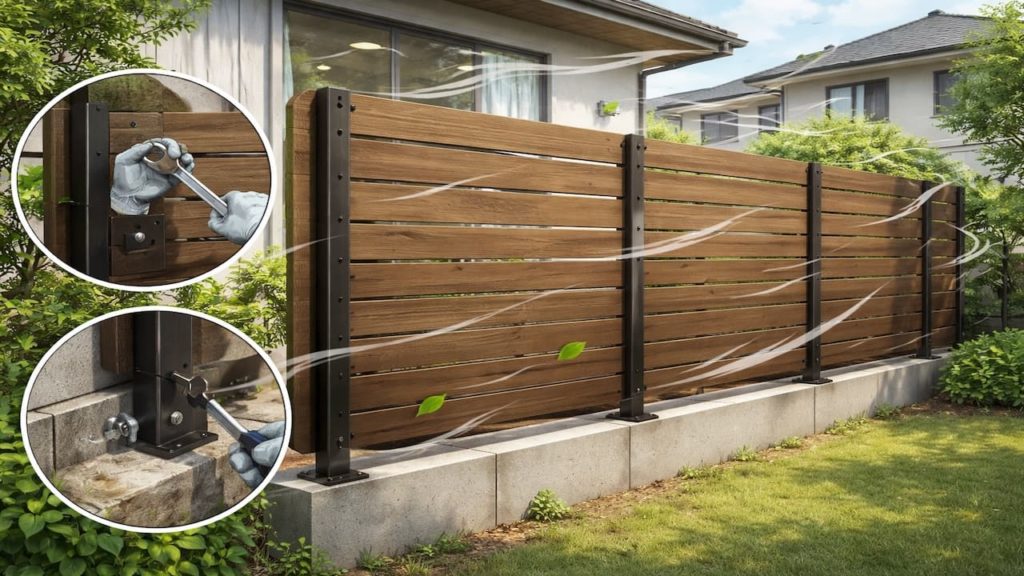
- Add two brackets per post instead of one
- Use U bolts or wrap clamps to prevent rotation
- Pad clamp contact points with rubber strips
- Reduce sail area using vented mesh panels
- Angle screen slightly to shed gust pressure
You might want the strongest anchor possible, but if the bracket still bends, the shake stays. You might also overclamp and damage the rail, then the mount gets worse. Use more attachment points, not more crushing force. More points, less drama.
3. Why screens shake in Japanese wind and tight lots
Gusts and wind funnels create sudden pulse loads — and pulse loads loosen hardware.
In narrow side paths and balcony corridors, wind can accelerate like it is in a tunnel. That makes quick pulses that push and release, which is perfect for loosening bolts over time. Humidity and rain also reduce friction at clamp points, so mounts that rely only on grip can creep. This is why wobble often gets worse after storms, not better.
For this section, cost is mostly time/effort because it is inspection and wind mapping.
- Narrow corridors speed up gust hits on panels
- Pulsing wind loosens bolts through vibration
- Wet rails reduce friction under clamp pads
- Large panels act like sails and amplify flex
- Soft posts let the whole system sway
You might blame “bad installation,” but the site wind is often the hidden boss. If you cannot change the wind, you change the sail and the frame stiffness. That is how pros think about it.
4. How to stiffen a privacy screen and calm it down
Stiffen the frame add bracing then reduce wind force — in that order.
Start by adding a second attachment point per vertical line, then add a diagonal brace to stop racking. Next, add padding at contact points to cut tapping noise, but only after the structure is stable. In Japan, choose corrosion-resistant hardware because damp air will eat weak bolts and loosen them again. Plan ¥3,000–25,000 for additional brackets, braces, and padding depending on size and materials.
- Install diagonal brace to prevent frame racking
- Add mid span anchors to cut lever effect
- Switch to vented fabric to reduce pressure
- Use thread locker on bolts after final alignment
- Recheck torque after first windy day and rain
You might think bracing looks ugly, but a small brace hidden behind the screen is better than a constant shake. You might also think padding fixes it, but padding only quiets, it does not stiffen. Stiffness first, then quiet.
5. FAQs
If the screen is too big for the mount it will always shake — downsizing is sometimes the best fix.
Q1. Why does my screen shake more after rain?
Wet surfaces reduce clamp friction and allow small slips. Rain also adds vibration events, and repeated movement loosens bolts faster.
Q2. Should I tighten clamps as hard as possible?
No, overtightening can deform rails and damage coatings, which makes slipping worse later. Use padding and more attachment points instead of extreme force.
Q3. What is the best way to reduce wind load?
Use vented mesh, reduce the screen area, or angle it slightly so gusts shed off. A solid sheet catches more force and shakes more.
Q4. Do I need a diagonal brace?
If the frame racks side-to-side, yes, a diagonal brace is the fastest way to add stiffness. It stops the “door frame wobble” effect.
Q5. When should I replace the whole setup?
If posts are soft, anchors cannot bite, or the screen area is too large for the available mounts. A stronger base is needed before upgrades.
Pro's Tough Talk

I’ve spent 20+ years working around Japanese homes, so I’ve seen what tends to work—and what tends to go wrong—in everyday use. In rainy-season gusts, a flimsy screen shakes like a shopping bag in a typhoon.
Here’s the cold breakdown. If one bracket takes all the load, it bends, then everything wobbles. If the anchor relies only on friction, wet rails turn it into an ice rink. If the screen is a solid sail, wind slaps it like a drum and you get noise plus fear. Like hanging a bedsheet on a coat hanger and calling it a wall.
Find the flex point now.
Add a second bracket and pad the rail today.
Brace it and reduce sail area this weekend.
If it still shakes hard you reduce screen size or add posts. If a smaller panel stays stable and quiet, that is the correct design. If you keep fighting wind with weak mounts, you will keep losing, and you will keep hearing it.
Yeah, no.
Classic scene: you tighten one bolt, feel confident, then the next gust laughs at you. Another one: you add padding everywhere, and the screen still sways like it is dancing on purpose.
Summary
Privacy screens shake when wind load is concentrated, the frame flexes, or anchors slip on wet surfaces. Japan’s gust funnels and humidity make these problems show up fast.
Fix it by adding attachment points, bracing the frame, and reducing sail force with vented fabric or smaller panels. Padding helps noise, but only after the structure is rigid.
Do one shake test today and stiffen the frame before you add more padding so your screen stays quiet and stable through the next windy week.