You searched because beating your futon feels “traditional,” but you still wake up sneezing or itchy.
In Japan, tsuyu humidity, pollen days, and close balconies make dust control more important than loud cleaning.
In this guide, you’ll learn the real futon beating mistakes that cause damage and dust blowback and what to do instead.

Hi, I’m Ken — I’m Japanese, and I live in Malaysia long-term, so I explain everyday life in Japan from a practical ‘from abroad’ perspective.
I hold a building design qualification and I’ve been on site for 20+ years across hundreds of jobs. I turn Japan’s unspoken rules into simple checks, so you can avoid costly mistakes and take the next step with clear actions that feel safe.
1. Futon beating myths: 5 mistakes
Most myths fall apart fast—hard hits usually spread dust and shorten futon life.
Beating feels satisfying, but it can push dust deeper and rough up the surface. In apartments, sound also travels through thin walls and open balcony partitions. During humid weeks, dust sticks to fabric and returns as a stale smell. Clean habits.
Beating can damage batting and fabric, and hand shaking or a cleaner is advised for dust removal. According to Futon Tokyo.
- Hit futon hard with plastic beater on rail
- Beat futon after drying and skip vacuuming
- Shake futon indoors and breathe dust cloud
- Whack seams and edges where fabric is weak
- Store futon right away while still warm
You might say, “My parents always did this.” True. But modern buildings are tighter, and neighbors are closer, so blowback is bigger. If you still want to “tap,” do it lightly and finish with suction. Japan’s seasons reward quiet routines.
2. Avoid damage and dust blowback
To avoid blowback, remove dust with suction not impact—especially in compact Japanese apartments.
Dust mites and their waste are not removed by noise, and heavy beating can scatter allergens into the air. On windy balcony days, that dust can drift to the unit below and start complaints. Even in dry winters, static makes lint cling and fly. Less drama.
After beating or drying, vacuuming is recommended so mite waste and dust do not remain and raise allergy risk. According to Earth Corporation.
- Cover futon with sheet before moving outside
- Brush surface gently with hand to lift lint
- Vacuum futon slowly to capture fine allergens
- Tap lightly near stains then vacuum the area
- Keep balcony noise low in close apartments
You may worry a vacuum “crushes” the futon. It doesn’t if you use normal suction and keep the nozzle moving. The real damage comes from repeated hard strikes that break fibers and shift filling. Quiet cleaning keeps loft and keeps peace.
3. Why futon beating backfires in daily life
Beating backfires when it turns hidden dust into airborne trouble in Japan’s close living—especially during pollen season.
A futon holds dust in layers, so impact can lift particles without removing them. If you do it indoors, you settle that dust onto tatami, curtains, and clothes. In tsuyu, moisture makes fine debris cling, then smell develops when it stays trapped. Small space problem.
- Understand dust mite waste stays in inner layers
- Know strong hits break fibers and loosen batting
- Realize wind spreads dust to neighbors below
- Remember tsuyu humidity makes dust stick to fabric
- Accept smell control needs drying plus airflow
You might think “I’ll just beat harder and finish faster.” That usually makes the cloud bigger, not the futon cleaner. If allergies flare after you clean, that is a clue, not bad luck. Switch from impact to airflow and suction.
4. How to refresh a futon without beating
The easiest replacement is a routine that dries first then removes dust slowly for Japan’s weather swings—without the loud hits.
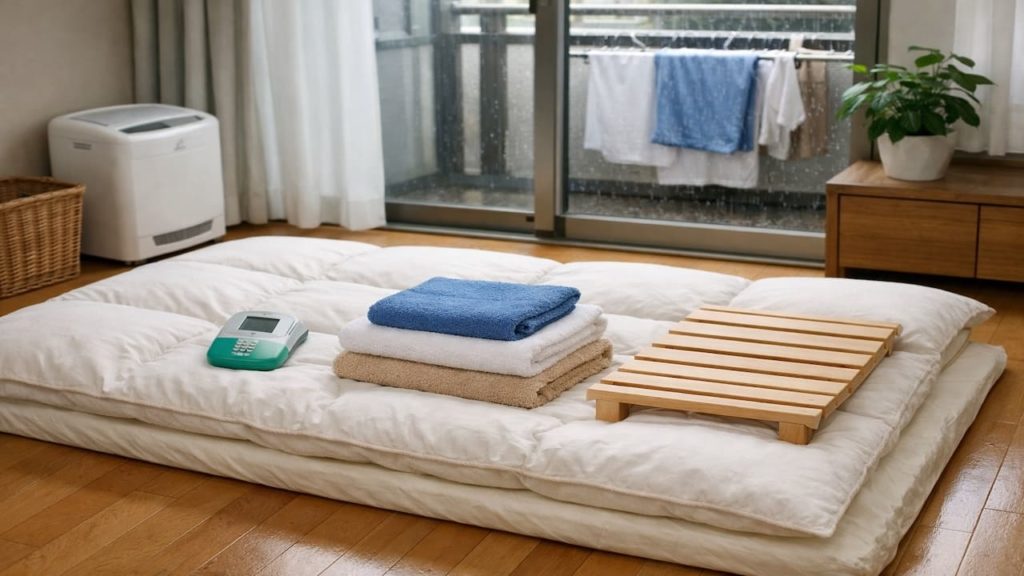
Start with airflow so moisture leaves the core, then clean the surface with controlled motion. In rainy season, do a short indoor stand-up dry with a fan, then vacuum. Simple routine. cost is mostly time/effort.
- Air futon upright with fan for thirty minutes
- Dry both sides by flipping once mid session
- Vacuum surface slowly in overlapping straight passes
- Spot clean cover with damp cloth then dry
- Store futon vertical with gap for airflow
You may think this is “too gentle” to work. It works because you are actually removing particles, not just moving them around. If your room is small, do shorter sessions more often. That fits Japanese apartments better.
5. FAQs
Q1. Is it rude to beat a futon on a balcony?
Often, yes—noise and dust travel in Japanese apartments with shared air space. If you must, keep it light, brief, and never near the rail. Balcony etiquette.
Q2. Does beating kill dust mites?
No it mostly spreads dust and mite waste and can worsen symptoms. Use drying plus slow vacuuming if allergies are a concern.
Q3. What is safer than a futon beater?
Hand brushing and vacuuming remove surface dust with less damage. A fan-assisted airing routine also reduces musty odor in humid months.
Q4. When should I vacuum my futon?
After drying or airing is ideal because particles loosen and lift. Do it before you store the futon so you do not trap debris inside.
Q5. What if my futon smells even after cleaning?
Smell usually means moisture stayed in the core. Increase airflow, dry both sides, and store it upright until the fabric feels room-dry.
Pro's Tough Talk

I’ve been on site for 20+ years. I’ve worked on hundreds of jobs. In Japan, tsuyu humidity and thin walls make “bang bang” care a fast way to get hated.
Cause 1, you think louder means cleaner, but you just launch fine dust. Cause 2, you crush the batting, and the futon turns flat where you sleep. Cause 3, you skip suction, so allergens stay and blow back later. It’s like punching a sponge and calling it dry. It’s like shaking flour beside a fan.
You call that maintenance?
Step 1, dry and air it first. Step 2, vacuum slowly, then brush lightly for lint. Step 3, keep noise low and keep it inside the railing. Quiet care beats loud myths in every season.
Keep smacking it like a drum, and your futon will retire before you do.
Summary
Stop relying on hard beating and start removing dust on purpose. No theatrics.
If symptoms or smell return, assume dust or moisture stayed behind and adjust your routine. If you cannot control it, consider professional cleaning.
Try one gentle refresh cycle this week and judge the morning air, not the noise. Once it works, keep the habit through tsuyu.