You searched because your futon sits on carpet, and the room keeps smelling damp.
In Japan, tsuyu humidity and tight apartments make carpet moisture linger, especially when you fold bedding daily.
In this guide, you’ll learn simple checks that prevent trapped moisture under a futon on carpet so odors do not come back.

Hi, I’m Ken — I’m Japanese, and I live in Malaysia long-term, so I explain everyday life in Japan from a practical ‘from abroad’ perspective.
I hold a building design qualification and I’ve been on site for 20+ years across hundreds of jobs. I turn Japan’s unspoken rules into simple checks, so you can avoid costly mistakes and take the next step with clear actions that feel safe.
1. Futon on carpet: 5 checks
The safest setup is when you keep airflow under the futon every day.
Carpet holds moisture like a sponge, and the futon blocks evaporation when it sits flat. In Japan, rainy season air can stay damp for days, so the underside never fully dries. A small gap under the futon changes everything—especially in one-room layouts. Quiet airflow.
Keeping indoor humidity at or below 50% helps limit dust mites that thrive in moist bedding. According to National Institute of Environmental Health Sciences.
- Lift futon on slats to create airflow
- Check carpet feels cool or damp underneath
- Stand futon upright after waking for drying
- Flip futon to dry both sides evenly
- Vacuum carpet area to remove moisture holding dust
You might think the carpet is “dry enough” if the surface feels fine. But trapped humidity hides at the carpet padding and returns as odor at night. In winter, cold floors increase condensation, so the underside stays wet longer. Do the checks, and your futon stays fresher.
2. Avoid trapped moisture and odors
You avoid odors when you stop warm damp bedding from touching carpet.
The worst moment is right after sleep, when the futon is warm and loaded with moisture. If you leave it flat, that moisture migrates into carpet fibers and gets stuck. Japan’s small rooms also reduce airflow—so drying takes longer than you expect. A simple lift-and-air routine is easier than fighting smell later.
Raising a futon off the floor helps reduce moisture problems by improving airflow under it. According to Futon Beds From Japan.
- Open window and run fan toward futon edge
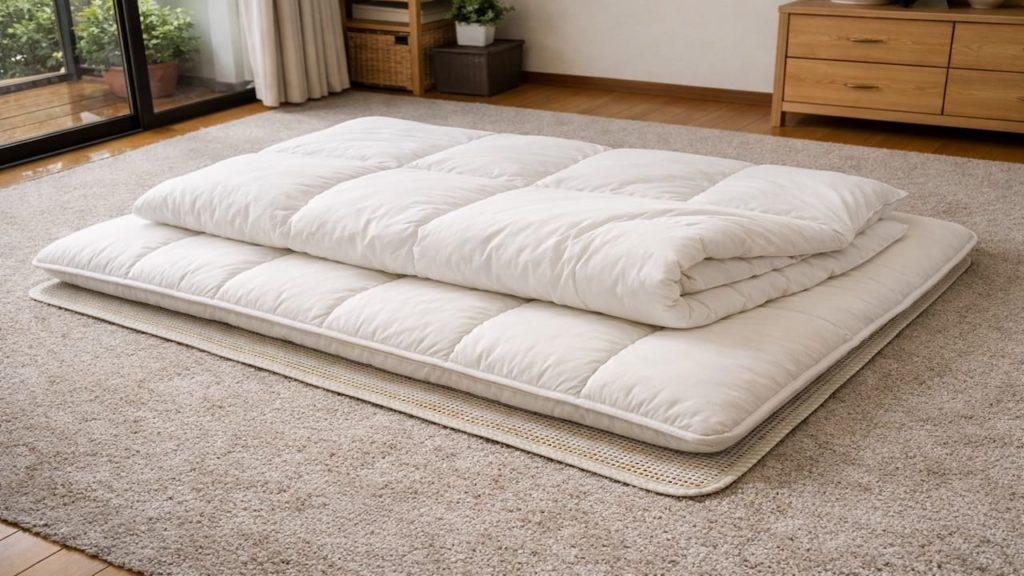
- Use breathable sheet between futon and carpet
- Keep futon away from exterior wall corners
- Leave storage closet open briefly after airing
- Bring futon in before evening humidity rises
You may worry this routine is too much work for daily life. It is lighter than deodorizing a room for weeks. Also, you do not need full sunlight every time in Japan. Air movement is the real lever, and it works on cloudy days too.
3. Why carpet makes futon moisture worse
Carpet makes it worse because it blocks evaporation and traps heat.
A futon needs to breathe from both sides, but carpet closes the bottom like a lid. Warmth from your body pushes moisture down, then the carpet holds it near the surface. During tsuyu, indoor humidity stays high—so that moisture cannot escape. The result is musty odor, dust mite growth, and a heavy feel.
- Notice musty smell stronger near floor level
- Check for dark patches where futon contacts carpet
- Feel futon underside for cool damp spots
- Track odor after rainy days and closed windows
- Compare smell after slat use for one week
Some people blame the futon material or detergent. Sometimes that matters, but the main issue is the sealed bottom surface. Japan’s climate rewards ventilation, not fragrance. Fix the moisture path, and odor fades on its own.
4. How to use a futon on carpet safely
Use a setup that creates a gap and dries the underside daily.
Start with a simple base like slats or a breathable mat, then build a short morning routine. In Japan, this matters most during tsuyu and winter condensation weeks. Keep the carpet dry first, then the futon stays clean longer. cost is mostly time/effort.
- Place slats under futon leaving small air channels
- Stand futon upright for twenty minutes daily
- Run fan low aimed at carpet line
- Move futon position to avoid permanent damp zone
- Clean carpet with vacuum then dry with airflow
You might think slats are only for beds, not carpets. But even a thin gap breaks the moisture loop and reduces odor fast. If space is tight, use shorter sessions more often. Small apartment logic—do the minimum that works.
5. FAQs
Q1. Is it okay to sleep on a futon directly on carpet?
It can be okay for comfort, but moisture risk increases in Japan’s humid months. If you do it, commit to daily airing and underside drying.
Q2. What is the quickest check for trapped moisture?
Touch the carpet under the hip area each morning and notice cool dampness. If it feels cool and wet, you need a gap and more airflow.
Q3. Does a dehumidifier solve the carpet problem?
It helps the room, but the underside can still stay damp if the futon seals the carpet. Use dehumidifying plus a physical gap for best results.
Q4. How often should I air the futon in tsuyu?
Daily short sessions work best in Japan’s rainy season—especially after sweaty nights. Flip once so both sides get time, even if it is cloudy.
Q5. When should I worry about mold?
If you smell strong mustiness, see discoloration, or the carpet feels wet for days, take action. Dry the area hard and consider professional cleaning.
Pro's Tough Talk

I’ve been on site for 20+ years. I’ve worked on hundreds of jobs. In Japan, tsuyu humidity turns “looks fine” into hidden moisture fast.
Cause 1, you sleep warm, then leave the futon flat, and the carpet becomes a wet sponge. Cause 2, you fold it while warm and trap moisture like sealing soup in a jar. Cause 3, you chase fragrance, but you never fix airflow, so the smell just waits. You do the morning rush, step on the carpet, and it feels a bit cool. You notice the odor at night, then pretend it is the fabric.
Come on.
Step 1, lift the futon on something that breathes. Step 2, stand it up and move air along the floor line. Step 3, keep one dry corner and rotate positions. Fix the gap and the odor problem shrinks fast.
Keep sealing moisture into carpet, and your room will smell like a forgotten gym bag.
Summary
Carpet plus futon can work, but only if you stop moisture from getting trapped underneath. Airflow is the key.
If odor returns, assume the underside is still damp and increase the gap and drying time. If the carpet stays wet, escalate quickly.
Do one underside check tomorrow morning and start a short daily airing habit. Your sleep will feel cleaner through Japan’s wet seasons.