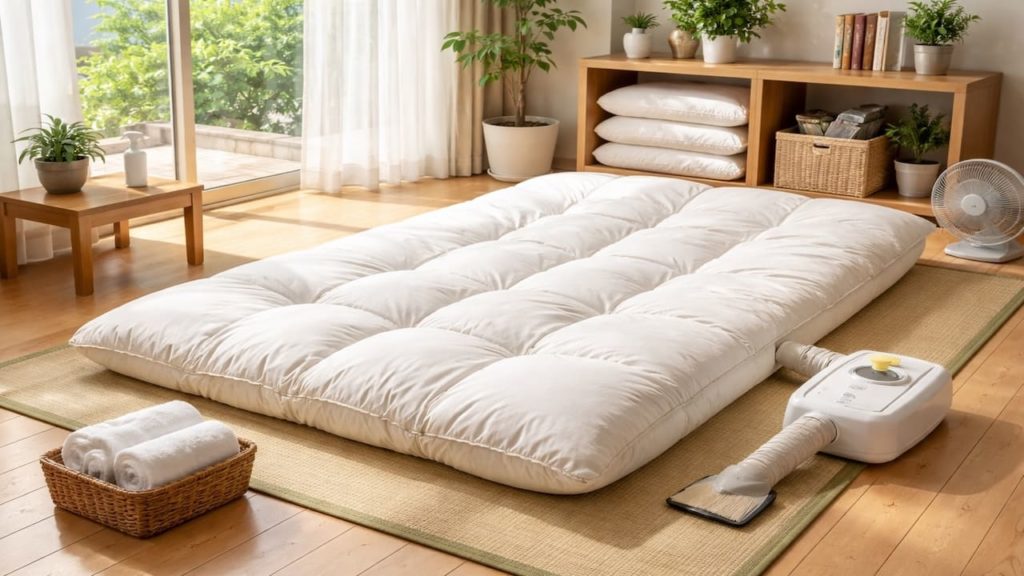
You searched because your cotton futon feels heavy, smells stale, or stays damp after sleep. Quiet problem. Very common.
In Japan, tsuyu humidity and winter cold floors stress cotton fibers, so breathability drops if you skip small care. Even good cotton can turn musty in a closed closet.
In this guide, you’ll learn easy cotton futon care that keeps it breathable and lasting longer with routines that fit apartment life.

Hi, I’m Ken — I’m Japanese, and I live in Malaysia long-term, so I explain everyday life in Japan from a practical ‘from abroad’ perspective.
I hold a building design qualification and I’ve been on site for 20+ years across hundreds of jobs. I turn Japan’s unspoken rules into simple checks, so you can avoid costly mistakes and take the next step with clear actions that feel safe.
1. Futon cotton care: 5 tips
Cotton futons last when you dry out sweat before you store.
Cotton absorbs moisture fast, then holds it deep inside—especially in Japan’s rainy season. If you only dry the surface, the core stays damp and starts smelling. A short daily air-out beats rare “perfect” sun days. Rhythm.
Cotton fillings are generally not meant to be machine washed, and stains are better handled by wiping and using a cover. According to Futon Tokyo.
- Stand futon upright to vent the underside
- Flip futon once to dry both faces
- Air closet space before putting bedding away
- Brush surface lightly to lift sticky lint
- Rotate head to foot weekly for even loft
You may think cotton means “natural so it handles itself.” Not in Japan’s humidity. Cotton is honest, but it remembers moisture. Keep the daily vent, and the futon stays springy longer.
2. Keep it breathable and long lasting
Breathability stays high when you give cotton air and sunlight in small doses.
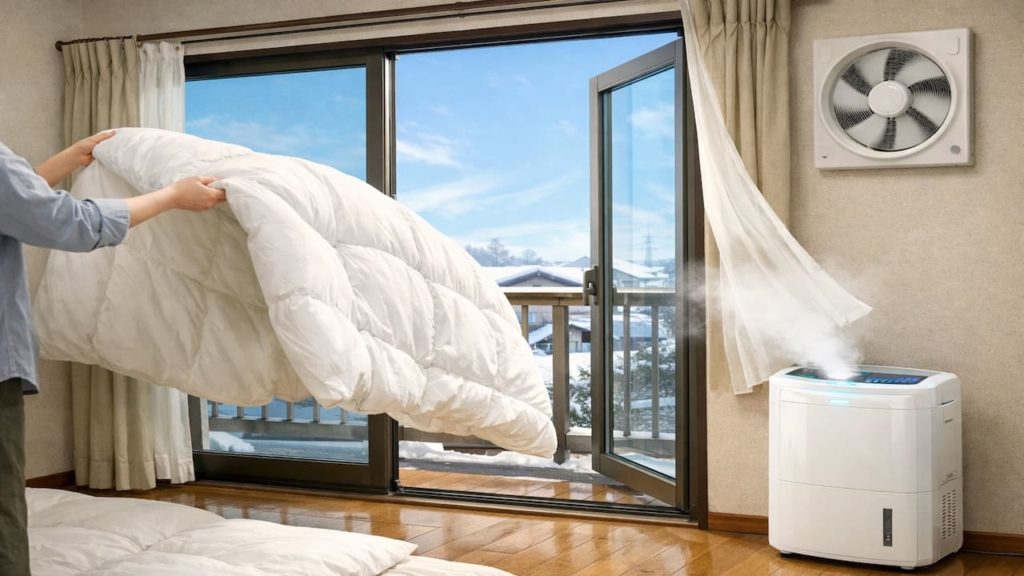
Sunning a shikibuton is common in Japan because cotton needs time to breathe and release built-up moisture. If you cannot use a balcony, indoor sun near a window still helps when you add airflow. Apartments compress air paths—so you must create them on purpose. Consistency.
Sunning helps moisture dissipate and can reduce mold and mildew risk by letting the futon breathe. According to J-Life International.
- Use a cover sheet to block outdoor dust
- Clip edges gently to prevent wind tugging
- Dry near window with fan on low
- Vacuum cover surface slowly to remove fine dust
- Store futon with a small airflow gap
You might worry sunlight will fade fabric. Cover it and shorten exposure, then finish with indoor airflow. Japan’s weather changes fast, so a flexible routine matters. Keep it repeatable.
3. Why cotton futons lose breathability
Breathability drops when cotton clumps and compresses from moisture.
Moisture makes fibers stick, and body heat pushes sweat into the center at night. In Japan, many rooms have limited cross ventilation, so the underside stays cool and damp longer. Still air is the enemy—especially behind closets and along cold walls. Mechanism.
- Check underside for cool damp feel each morning
- Look for lumpy zones where hips usually rest
- Smell folded center to detect early mustiness
- Notice if loft never returns after airing
- Watch for closet corners that feel humid
You may assume the futon is “done” once it feels heavy. Often it just needs better drying and rotation. In tsuyu, you need more frequent short airing. Fix the cause before replacing.
4. How to care for cotton futons weekly
Weekly care works when you reset loft and remove dust without soaking.
Pick one day, do a quick flip, a slow vacuum, and a light wipe for spots. In Japan’s rainy months, add a short indoor airing block with a fan, then store only when room-dry. If you need basics like clips or a cloth, ¥100–500 for basic supplies is enough. Short and repeatable—routine.
- Vacuum both sides using an upholstery nozzle
- Wipe small stains with damp cloth then dry
- Dry futon near sunlit window for one hour
- Rotate futon position to avoid permanent dents
- Air closet boards before storing bedding again
You might think weekly care is pointless without deep washing. Cotton hates soaking and slow drying, so deep washing can backfire. Do the small reset, and breathability stays stable in Japan. Keep it boring.
5. FAQs
Q1. Can I wash a cotton futon in a washing machine?
Usually no, because cotton filling can clump and dry unevenly. Use a washable cover, and spot clean the surface instead. No soaking.
Q2. How often should I air a cotton futon in Japan?
In tsuyu months, short daily airing helps most—think minutes, not hours. In drier seasons, a few times per week can be enough if storage is ventilated.
Q3. What is the fastest way to keep cotton breathable?
Stand it up after waking and vent the underside for a short block. Airflow matters more than perfect sunshine in small apartments.
Q4. Should I beat cotton futons to fluff them?
Light tapping is fine, but hard beating can stress seams and spread dust. Flipping and controlled airflow usually work better.
Q5. When is it time to replace a cotton futon?
If it stays lumpy after rotation and airing, or odor returns quickly even with routine care, the filling may be packed down. Try a base change first, then decide.
Pro's Tough Talk

I’ve been on site for 20+ years. I’ve worked on hundreds of jobs. Japan’s tsuyu humidity makes cotton act like a sponge with a memory.
Cause 1, you fold it warm and trap sweat inside the layers. Cause 2, you store it flat on a closet board, so the underside never breathes. Cause 3, you try to “wash it clean,” then it dries slow and turns musty anyway. You do that morning rush fold, shove it in, then sniff it at night like a sad detective. You hang it once, it rains, and you quit for a week. You treat a dehumidifier like a magic charm, then never open the closet.
Come on.
Step 1, stand it up and move air under it. Step 2, rotate and flip so cotton stays even. Step 3, keep storage ventilated with a gap. Drying beats deodorizer every single time.
Treat cotton like a wet towel in a drawer, and it will repay you with that “old closet” punchline.
Summary
Cotton futon care is mostly moisture control—simple, not fancy. Airflow wins.
Check the underside, keep airflow, and rotate so the filling stays even. If musty smell returns fast, your storage routine needs work.
Start with a ten minute upright air-out tomorrow and keep the weekly reset on one fixed day. Small routines fit Japan’s seasons best.