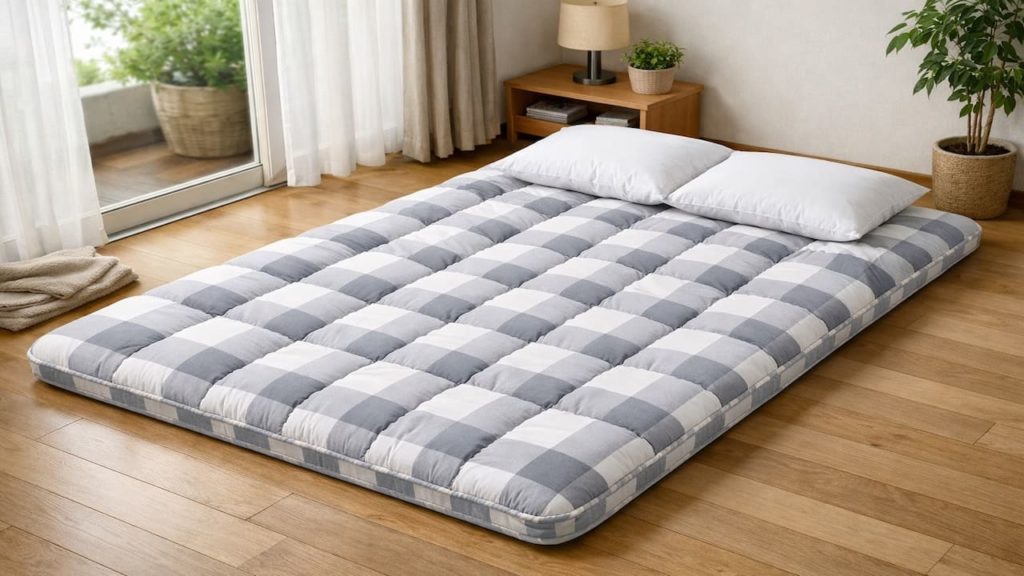
If you add a mattress pad to your futon, you want comfort without waking up sweaty. You also want fewer damp smells in the morning.
In Japan, tsuyu humidity and small rooms make heat and moisture build up faster than people expect. Floor sleeping can feel warm, then suddenly clammy.
In this guide, you’ll learn how to add a futon pad without trapping heat. You will know what to check so the futon stays breathable in Japan’s seasons.

Hi, I’m Ken — I’m Japanese, and I live in Malaysia long-term, so I explain everyday life in Japan from a practical ‘from abroad’ perspective.
I hold a building design qualification and I’ve been on site for 20+ years across hundreds of jobs. I turn Japan’s unspoken rules into simple checks, so you can avoid costly mistakes and take the next step with clear actions that feel safe.
1. Futon mattress pad: 5 checks
Choose a pad that adds comfort while still letting air move.
Breathability matters more on a futon because you sleep close to the floor in Japan, especially on tatami. Some materials sleep cooler by allowing airflow and using naturally breathable layers like latex or wool with cotton covers. According to Sleep Foundation. A heat trap. Your goal is cushioning that does not seal sweat into the core during tsuyu.
- Check pad material for airflow and moisture release
- Check thickness so hips sink without full seal
- Check cover fabric for quick drying cotton feel
- Check washability so skin oils do not linger
- Check underside grip so pad does not bunch
It sounds picky, but one wrong pad can make summer nights feel sticky even with a fan. In Japan’s rainy weeks, trapped moisture becomes odor fast. Use the checks once, then you stop second guessing every morning.
2. Add comfort without heat buildup
Pair soft feel with an airflow path under your body.
A breathable core can still sleep warm if the cover blocks airflow, so core and cover must match. According to Sleep Foundation. In Japan, a futon on the floor already has less ventilation than a bed frame—so your pad must not turn it into a sealed sandwich. Small rooms. Aim for materials that stay springy and do not hug too tightly all night.
- Choose pad with ventilated structure not flat foam
- Use breathable fitted cover to reduce heat cling
- Place futon on slats or tatami for airflow
- Run fan across floor level to move humid air
- Air pad and futon separately after sweaty nights
You might think thicker is always better for comfort. But too much sink reduces airflow and raises skin temperature, especially in Japan’s humid summer. Comfort is not just softness, it is temperature control.
3. Why futon pads trap heat in Japan
Heat builds up when the pad hugs and blocks evaporation.
Many pads work by contouring close, which can restrict airflow around your body. On a futon, that contouring sits on a low ventilation base, so sweat has fewer escape routes in Japan apartments. Rainy season nights. If the room is humid, evaporation slows and the pad feels warmer even when the air is not hot.
- Notice sweating points around back and hips daily
- Check pad surface for clingy slow drying feel
- Compare comfort after baths versus dry evenings
- Observe odor rebound after closet storage next day
- Track room humidity changes during tsuyu week
People blame their body heat. Often the pad is holding moisture against the skin, then warming it like a wet towel. Once you see the pattern, you can fix it with materials and airflow, not panic.
4. How to pick a futon mattress pad that stays cool
Pick the thinnest pad that solves pressure without sealing.
Start with a breathable material and a washable cover, then set up airflow in your room for Japan’s seasons. A good futon pad often costs ¥1,000–6,000, and paying for washability is usually smarter than paying for extra thickness—especially during tsuyu. Choose a pad you can dry fast, because fast drying is what prevents heat buildup and odor.
- Select breathable fill like wool latex or open cell
- Choose cover you can wash and dry quickly
- Test pad on futon for two night trial
- Lift futon daily to vent underside moisture
- Store pad flat or loosely rolled not compressed
You might want a plush hotel feel. But on a futon, too plush can turn into sticky sleep and damp smell in Japan’s rainy months. Choose cool comfort first, then adjust with blankets and room airflow.
5. FAQs
Q1. Is a mattress pad or a topper better for a futon?
A pad is usually thinner and easier to dry, which helps in Japan’s humid season. A thick topper can be comfy but may trap more heat if it hugs tightly.
Q2. What material feels coolest for futon sleeping?
Look for breathable structures and covers that dry fast, especially in tsuyu. Latex and wool tend to breathe better than dense foam when airflow is limited.
Q3. How do I stop sweat smell after adding a pad?
Air the pad and futon separately, and avoid storing them damp in a closet. Japan apartments can hold humidity low near the floor, so use fan crossflow.
Q4. Can I use a waterproof pad on a futon?
Use waterproof only when needed because it can trap heat. If you must use one, add ventilation time every morning so moisture does not stay sealed.
Q5. How often should I wash a futon mattress pad cover?
Wash often enough that skin oils do not build up and hold odor, usually weekly or biweekly. In Japan summer, increase frequency if you sweat at night.
Pro's Tough Talk

I’ve been on site for 20+ years. I’ve worked on hundreds of jobs. Japan’s tsuyu humidity turns “cozy” into “clammy” overnight if you block airflow.
Three causes, straight: you buy thick foam that hugs too much, you never vent the underside, and you store it damp because the room looks tidy. One scene is waking up sweaty, then folding everything fast and rushing out. Another scene is sniffing the pad, spraying something, and hoping for magic.
Three-step fix: pick breathable material, move air at floor level, and dry before storage. A pad is like wrapping yourself in plastic wrap, and like leaving wet laundry in a bag.
Seriously.
Cool sleep comes from airflow and boring routines. If you skip that, your pad will turn into a sweaty drama queen.
Summary
Add comfort by choosing a breathable pad and keeping an airflow path under your body. Japan’s humid season punishes thick clingy layers on floor bedding.
Use a repeatable routine: air the pad, vent the futon underside, and avoid damp closet storage. If heat buildup returns, reduce thickness and improve cover washability.
Pick breathability first and comfort will follow. Keep exploring simple futon airflow habits so your sleep stays dry and calm through every season.