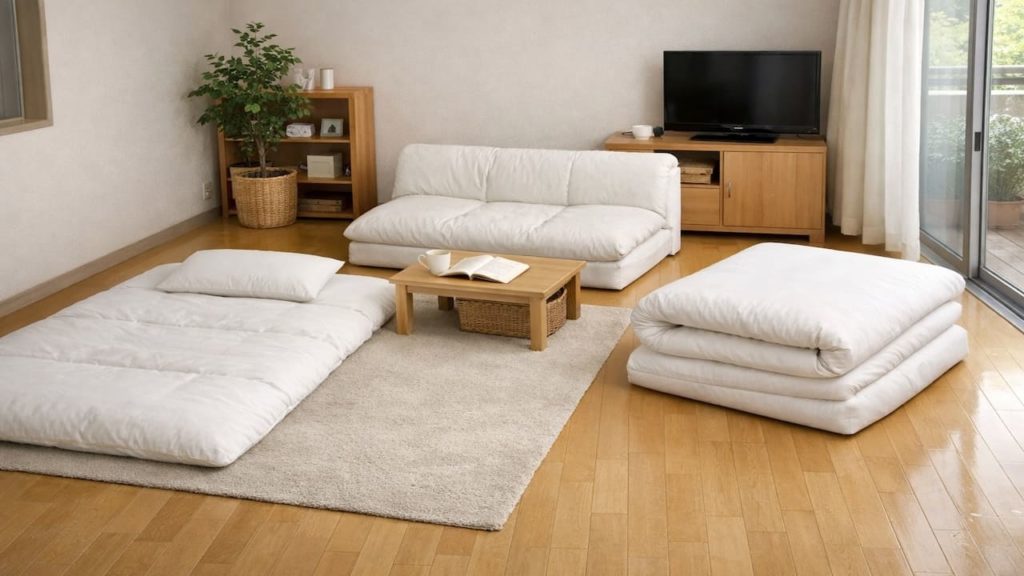
If you sleep on a futon, size choices feel bigger than they should. One wrong width can turn daily folding into a hassle.
In Japan, small rooms, narrow closets, and tsuyu humidity change how bedding behaves. A futon that looks fine online can feel huge on the floor.
In this guide, you’ll learn how to choose a futon size that fits your room and keeps daily folding realistic. You will also avoid common comfort mistakes in Japan’s seasons.

Hi, I’m Ken — I’m Japanese, and I live in Malaysia long-term, so I explain everyday life in Japan from a practical ‘from abroad’ perspective.
I hold a building design qualification and I’ve been on site for 20+ years across hundreds of jobs. I turn Japan’s unspoken rules into simple checks, so you can avoid costly mistakes and take the next step with clear actions that feel safe.
1. Futon size selection: 5 checks
Pick a size that you can lift and fold daily.
In Japan, the “best” size is the one you will actually manage every morning—weight and handling matter as much as sleep comfort. Many households use single futons side by side instead of one huge piece because big futons are heavy to move. According to Futon Tokyo.
Start with room behavior, not marketing photos. Room math.
- Measure clear floor length from wall to wall
- Measure walking lane after futon is laid
- Check closet opening width for folded bundle
- Check your lift strength for morning folding
- Check drying space for upright airing in tsuyu
You might assume bigger always means better sleep. But in a typical Japan apartment, a too wide futon becomes a storage and drying problem, then odor shows up faster.
2. Fit your room and daily folding
Your daily fold routine decides the right dimensions.
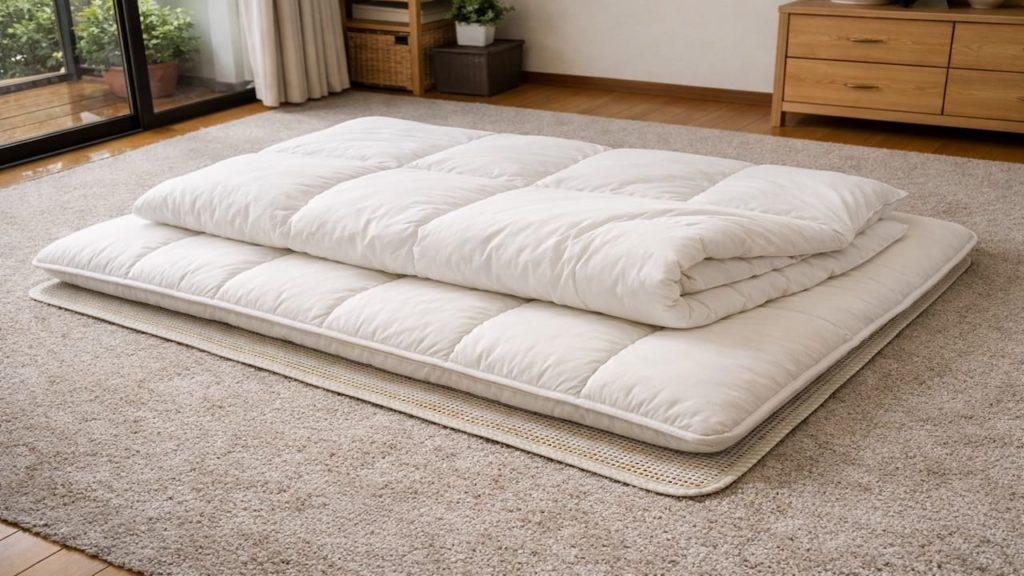
If you fold and store daily in Japan, the folded footprint matters as much as the flat footprint. Some futons start as a fabric casing size and end up slightly smaller after filling, so “listed” size and “finished” size can differ. According to Takaokaya Kyoto.
Plan for where the folded bundle sits—then pick the width that lets you keep a clear lane in the room. Folding friction.
- Choose single width if you fold every morning
- Choose semi double only if storage allows
- Leave one hand gap beside closet door frame
- Keep futon off wall to avoid damp corners
- Use washable cover to protect during folding
You may feel you are “downgrading” by picking smaller. In Japan life, a manageable futon gets aired more often, stays drier, and ends up feeling better long term.
3. Why futon size feels wrong after a move
Size feels wrong when your body and room constraints collide.
On the floor, your usable width is not the room width, because you still need a walking lane and space to fold in Japan’s tight layouts—so the math surprises people. If the futon touches the wall or curtains, the underside dries slower in tsuyu and can start smelling musty. Storage also changes comfort because frequent folding compresses the same crease line if the size is awkward. Daily rhythm.
- Notice shoulder space when you roll at night
- Check heel overhang at the foot edge
- Check pillow zone crowding near the wall
- Watch fold line creating one permanent ridge
- Track odor rebound after closet storage days
You might blame the futon quality. Often the width is forcing bad placement and bad drying in Japan, so the futon never gets the airflow it needs to stay fresh.
4. How to choose futon size for your room
Choose size by measuring lanes then matching sleep style.
Measure the room, mark your walking lane, and decide where the folded bundle lives in Japan—then choose the smallest size that still fits your sleep. If you are buying new, a basic shikifuton often lands around ¥10,000–45,000 depending on fill and thickness, so getting the size right saves wasted upgrades. Do not chase “hotel width” if you cannot air it.
Make one choice and support it with habits. Season shift.
- Mark futon outline on floor with masking tape
- Test fold and store path in one minute
- Pick width that leaves a clear walking lane
- Pick length that supports full body alignment
- Plan airflow spot for rainy season drying
You may want a wider futon for comfort. But if it blocks folding, it will sit flat and damp during Japan’s tsuyu, and comfort drops because odor and clumps build faster.
5. FAQs
Q1. Is a single futon too narrow for adults?
Many adults sleep well on a single, especially if they mostly sleep on their back. In Japan, a single is easier to fold, air, and store, which keeps it drier.
Q2. Should couples buy one big futon?
Two singles side by side are often easier to handle—especially in small Japan homes. You can also separate them for airing during tsuyu weeks.
Q3. How do I decide between semi double and double?
Decide by your folding path not by sleeping width. If the folded bundle blocks your closet or walking lane, the bigger size will feel worse over time.
Q4. What length should I choose if I am tall?
Check whether your heels hang off when you stretch, and whether your pillow pushes you downward. In Japan rooms, you may also need extra clearance to avoid touching walls.
Q5. Can the wrong size cause more odor?
Yes, because awkward size leads to less airing and more wall contact, which slows drying. During Japan rainy season, that moisture rebound makes musty smells show up faster.
Pro's Tough Talk

I’ve been on site for 20+ years. I’ve worked on hundreds of jobs. In Japan, small rooms and tsuyu humidity make bedding care either easy or miserable.
Three causes, no drama: you buy too wide because it looks “premium,” you cannot fold it cleanly so it stays flat, and you store it half damp to save time. It’s like buying a giant door for a narrow hallway, and like trying to dry a sponge inside a box.
Here are the two scenes I see all the time: you drag the futon to the corner, it scrapes the wall, and the underside never dries. You fold it crooked, the ridge hardens, and you pretend your back pain is “aging.”
Come on.
Pick the size you can move daily and your futon stays healthy.
Stop buying a “dream size” you cannot handle, or your room will start running your life.
Summary
Futon sizing is about daily handling, not just sleeping width. In Japan, you need space to walk, fold, air, and store through humid seasons.
Measure the lane, test the fold path, and choose the smallest size that still supports your sleep. If the futon touches walls or blocks storage, odor and wear accelerate.
Choose a size you can fold weekly without stress—then keep the routine simple and the futon will last longer.