Your genkan step-up feels normal until it’s wet, and then your foot slides at the worst moment. One wet sock is enough.
Japan’s rain, snow melt, and humid summers push water into the entry fast, especially in compact apartments with smooth tile or stone.
In this guide, you’ll learn how to check genkan step up safety in 5 minutes. You’ll also set the entry so slips stay rare in every season.

Hi, I’m Ken — I’m Japanese, and I live in Malaysia long-term, so I explain everyday life in Japan from a practical ‘from abroad’ perspective.
I hold a building design qualification and I’ve been on site for 20+ years across hundreds of jobs. I turn Japan’s unspoken rules into simple checks, so you can avoid costly mistakes and take the next step with clear actions that feel safe.
1. Genkan step-up safety: 5 checks
Check grip and visibility before you blame yourself—it’s the fastest safety upgrade.
Wet soles plus a small height change is a classic slip setup in Japan’s rainy months. You also twist at the step to face inside, park shoes, and grab bags. The step is short, so your body has less time to correct a slide. Japanese homes often have an elevated entrance floor where shoes come off. According to PMC.
- Touch the step edge and feel slickness
- Walk heel to toe and note grip
- Check sock traction on the landing area
- Look for water tracks from umbrella drips
- Test lighting shadows around the step line
You might think “I’m careful, I won’t fall,” but the slip happens during normal turning and lifting. Genkan steps are small, so you get less recovery time if your heel skates. Use the checks to remove surprises before guests, kids, or tired parents hit the step. Routine.
2. Prevent slips on wet entry floors
Stop water at the door and the step stays grippy—even on smooth tile.
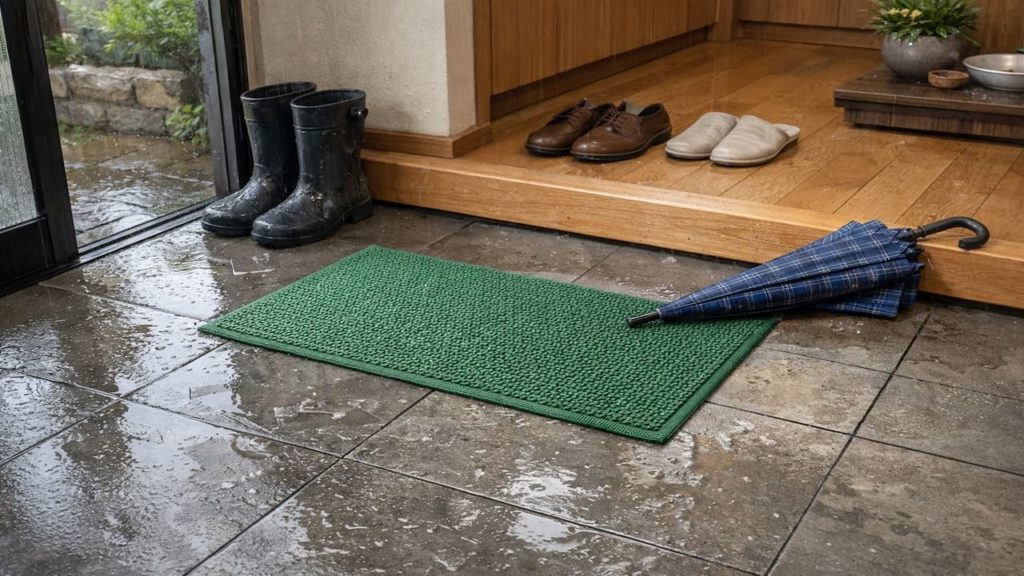
In winter rain, coat water and shoe water collect in one tight zone, then spread as you walk. In summer humidity, the floor can feel dry but still slick under socks. The danger is a thin film you can’t see until it grabs your heel. Thin film.
- Place an absorbent mat where shoes first land
- Hang umbrellas so drips miss the floor
- Wipe the step edge after every wet entry
- Keep slippers away from the wet zone
- Store wet boots on a tray not tile
You might say mats look messy and catch dust, and that’s fair in small Japanese entries. Use a low-profile mat that stays flat, and wash it before it turns grimy. If the mat curls, replace it, because curled corners trip people and trap water. Drying.
3. Why do genkan step-ups become slip traps in rainy season?
The slip happens during the turn not the step—your weight shifts before you feel it.
When you step up, your center of mass moves forward while your heel is still wet. At the same time, you rotate to face inside and reach for storage or a door lock. That twist shrinks contact area and drops friction fast, especially when you hurry in from rain. Timing.
- Notice where your foot lands on ascent
- Watch for toe-only contact on the edge
- Spot glossy patches worn by daily traffic
- Remove shoe piles that force awkward stepping
- Check for loose tiles or lifted thresholds
Some people blame the builder, but many slips happen on perfectly “normal” floors. Water, turning, and clutter stack up into a predictable failure you can repeat on demand. If you fix the pattern first, the surface often becomes good enough. Pattern.
4. How to make your genkan step-up safer today
Add grip where your foot actually loads and keep the step line obvious.
Start with a non-slip strip or clear grit tape on the step edge, then adjust the mat position—basic supplies are often ¥500–3,000. Next, set a one-motion routine: enter, drip off, step up, then store. Japan’s dark winter evenings make contrast and lighting do real work, even in small hallways. Quick wins.
- Apply non-slip tape along the step edge
- Install a small motion light facing down
- Add a low bench for seated shoe changes
- Use a tray to catch wet footwear
- Keep one towel near the genkan entrance
You may worry tape looks cheap or peels off in humidity, and cheap tape does fail. Clean and dry the surface, then press hard and wait before first use. If it still peels, switch to a grittier tread, and trim corners so they don’t lift. Maintenance.
5. FAQs
Q1. Should I wear socks on wet genkan tile?
Skip socks on wet tile and step into slippers fast if the floor feels slick. Socks reduce friction, especially on polished surfaces. Use a dry landing spot before you step up.
Q2. Is a thick mat safer than a thin mat?
Not always. Thick mats can bunch up and create a toe catch. Pick low-profile mats with a stable backing.
Q3. Can I just mop more often?
Mopping helps, but wet cleaning can backfire—dry the step edge right after. In Japan’s humid months, “damp” can last longer than you think. Clean, then dry, then ventilate.
Q4. What if the step height feels too tall?
Use a small bench or a stable handhold nearby. Seated shoe changes reduce wobble at the edge. If it hurts, treat it as a mobility warning.
Q5. How do I make it safer for kids?
Keep the genkan clear and keep water off the floor. Kids run in with wet shoes and fast turns. Make the safe path obvious and boring.
Pro's Tough Talk

I’ve been on site for 20+ years. I’ve worked on hundreds of jobs. Japan’s rainy season turns genkan floors into tiny skating rinks if you ignore the basics. A fall at the entry can ruin a whole weekend.
Common scene: you rush in with wet socks, hold a bag in each hand, and pivot on the edge like you’re doing a dance move. Then you try to hang the umbrella while balancing on one foot. You also kick off shoes too early and land half barefoot. It’s not “clumsy.” It’s a bad setup.
Three causes, every time: smooth finishes that love water, a step line you can’t read in dim light, and clutter that forces a foot angle. Don’t blame your feet or your age. Nobody plans to slip, but the genkan doesn’t care. Like oil on a frying pan. Like a banana peel on a dojo floor.
Stop trusting your balance and start trusting your setup before someone eats the floor. Do it before the first fall, not after the bruise.
Sure, keep doing the umbrella drip shuffle; the floor is judging you.
Summary
Check friction, water paths, and the step line first today. If one of those is weak, that’s your real cause.
When the entry stays damp, focus on stopping water and simplifying the landing area. If you still feel uneasy, add grip, light, and a clear path, in that order. Consistency.
Do one small fix today and make slips boring so you can focus on life, not catching yourself.