Cold air creeping under your kotatsu blanket can ruin the whole point of sitting there. Winter mood killer.
You can feel warm at your knees, yet your ankles get hit by drafts. Small Japanese rooms cool fast in winter, especially with thin walls and hard floors.
In this guide, you'll learn how to size a kotatsu blanket for real warmth so the edges stop leaking. You'll also learn quick checks that fit typical Japan apartments on cold nights.

Hi, I’m Ken — I’m Japanese, and I live in Malaysia long-term, so I explain everyday life in Japan from a practical ‘from abroad’ perspective.
I hold a building design qualification and I’ve been on site for 20+ years across hundreds of jobs. I turn Japan’s unspoken rules into simple checks, so you can avoid costly mistakes and take the next step with clear actions that feel safe.
1. Kotatsu blanket size: 5 checks
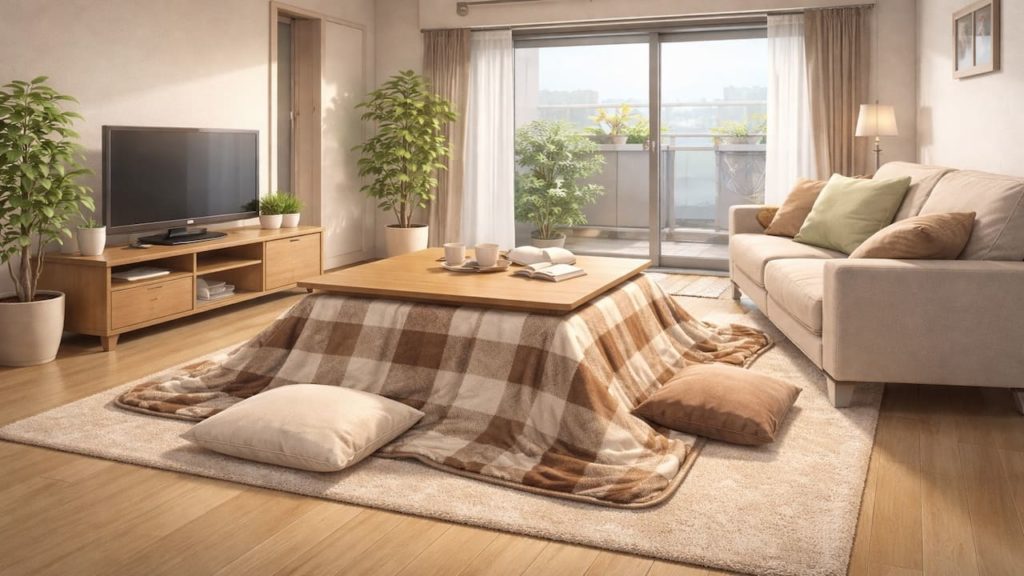
Pick a blanket that overhangs evenly on every side to block edge drafts.
Start with the tabletop size, then plan for enough drop to reach near the floor in a seated room. In Japan, cold air often slides along tatami or laminate floors—so the edge seal matters more than loft. A common shopping flow is to match blanket categories to table shape and tabletop dimensions. According to nitori-net.jp.
- Measure tabletop width and depth with a tape
- Check table height from floor to top
- Plan 50 to 60 cm drop per side
- Match blanket shape to your table shape
- Test drape by pinching corners to floor
People think bigger is always warmer, but too big can puddle and trip you in tight genkan-to-living layouts. If the blanket drags, it also picks up dust and moisture from winter rain days. The goal is not maximum fabric, it's a clean seal. Overhang control.
2. Stop drafts around the edges on cold nights
Focus on edge contact not blanket thickness when drafts are the problem.
Drafts sneak in through the gap between blanket and floor—not through the middle. In many Japanese homes, a low table means the blanket must hug the floor line to stop airflow. Some products even list compatible kotatsu table sizes to guide that fit. According to irisohyama.co.jp.
- Sit normally and feel air at ankle level
- Press blanket edge to floor and compare
- Move legs and check seal stays closed
- Lift blanket slightly and watch heat escape
- Mark leak spots with small tape tabs
You might blame the heater or think your blanket is too thin, but thickness won't fix a bad edge line. If the edge lifts every time you shift, warmth dumps out fast. Fixing the seal often feels like upgrading the heater without touching the dial. Edge discipline.
3. Why kotatsu blankets leak heat at the edges
Most edge drafts come from drop length mismatch not from weak heaters.
When the drop is short, warm air rises and gets pulled out as you move your legs. In Japan's dry winter air, even small leaks feel sharp because your skin cools fast. Thick rugs can also raise the floor level—shortening your drop without you noticing. Physics, not vibes.
- Compare drop length on all four sides
- Check rug thickness under blanket edge line
- Look for gaps near corners after sitting down
- Watch blanket ride up when knees shift
- Feel airflow direction with a light tissue
Some people insist the only answer is a giant comforter, but the real issue is geometry. A blanket that is wide but short still leaks at the corners. Once you see the drop, you can solve it with sizing or simple edge habits. Seal beats bulk.
4. How to choose the right size and seal
Use a simple size rule then tune the edges for your room.
As a starting point, aim for about 50 to 60 cm of drop per side when seated on the floor in Japan. If you are buying a new blanket, common kotatsu comforter ranges are roughly ¥3,000–¥12,000 depending on size and fabric. Then add small habits that keep the edge closed even when you move—this matters in apartments with chilly window drafts.
- Add drop by choosing next size up
- Tuck excess fabric under a seat cushion
- Clip corners with simple blanket clips for sealing
- Layer a thin throw along the edge line
- Keep a rug lip outside the blanket edge
It can feel annoying to manage a blanket, but this is a one-time setup you repeat all winter. You don't need perfect numbers, you need repeatable closure. Once the edges behave, you stop thinking about cold ankles and start relaxing again. Warmth stays put.
5. FAQs
Q1. How big should a kotatsu blanket be compared to the table?
Table size plus about 100 to 130 cm in both directions is a practical starting point. Then check the drop reaches near the floor on all sides.
Q2. Is square or rectangular better for sealing drafts?
Match the blanket shape to the tabletop shape first. A quick check. Rectangular blankets seal corners better on long tables.
Q3. What if my room is too small for a larger blanket?
Choose the right drop, then control extra fabric with tucks. Folding the edge under a zabuton can stop puddling and keep heat in.
Q4. Do I need a kotatsu under-mat to stop edge drafts?
Not always, but a rug helps by reducing floor airflow. In Japan apartments with cold laminate floors, re-check drop length because it changes the edge line.
Q5. Why do my feet get cold even when my upper body is warm?
Your legs move, the edge lifts, and warm air escapes—then your feet stay cold. Once you seal the perimeter, your feet usually warm up within minutes.
Pro's Tough Talk

I've been on site for 20+ years. I've worked on hundreds of jobs. Japan winters aren't Arctic, but drafty rooms make them feel personal.
Here's what's really happening: your drop is short, your rug is thick, and you keep kicking the edge open. Like a rice bag with a torn corner, heat spills out no matter how much you pour in. Like a loose jacket zipper, the gap does all the damage.
Do this now. Measure the tabletop and check drop on each side. Choose the next size up if the drop is short. Then clip or tuck the corners so they stop riding up.
If your ankles feel wind your setup is leaking and you're paying for heat you never keep. Reality check.
You know the scene: you finally get comfy, then you shift once and your toes get slapped by cold air. You know the other scene: someone stands up, the blanket lifts, and everyone screams like the kotatsu betrayed the family. Come on. Seal the edges, or keep donating heat to the room like a winter charity.
Summary
Check tabletop size, then confirm drop length to the floor line. In Japan's winter rooms, the edge seal decides whether drafts win—especially on windy nights.
Corner control. If your blanket still leaks after a size check, fix corners with tucks or clips.
Get the drop right then lock the perimeter and your kotatsu will feel warmer immediately. Do one quick edge test tonight, then keep browsing for the next home-life fix.