You want a simple lawn calendar, but Japan’s seasons do not stay in neat boxes. One week feels like spring, then the next week feels like early summer.
Most lawn problems come from timing drift, not effort. In Japan, rainy season humidity and tight home yards can keep grass wet longer, while winter dryness can slow recovery when you least expect it.
In this guide, you'll learn how to time lawn care in Japan by checks. You will use seasonal signals to decide what to do this week, not what a generic calendar says.

Hi, I’m Ken — I’m Japanese, and I live in Malaysia long-term, so I explain everyday life in Japan from a practical ‘from abroad’ perspective.
I hold a building design qualification and I’ve been on site for 20+ years across hundreds of jobs. I turn Japan’s unspoken rules into simple checks, so you can avoid costly mistakes and take the next step with clear actions that feel safe.
1. Lawn care calendar in Japan 5 checks for all seasons
Use growth and moisture checks to choose the right task each season.
A lawn calendar works only if it matches what the grass can recover from right now—Japan loves curveballs. The easiest way is to run the same 5 checks all year, then pick the task that fits the signal. Japan’s rainy season timing is also announced as a rough “goro” because the seasonal transition is not a single day. According to jma.go.jp.
- Check new growth after mowing within 3 days
- Check soil moisture by screwdriver push depth
- Check weeds type shifting with temperature changes
- Check moss or slime in shaded wall corners
- Check foot traffic paths compacting entry routes
People want fixed dates, but the lawn responds to conditions, not your phone calendar. If you do spring actions during a cold stall, nothing sticks. If you do summer actions during rainy-season wetness, disease pressure jumps. Run the checks, then pick the season move that actually lands.
2. Spring summer fall winter timing
Match tasks to stress level so you help the lawn instead of testing it.
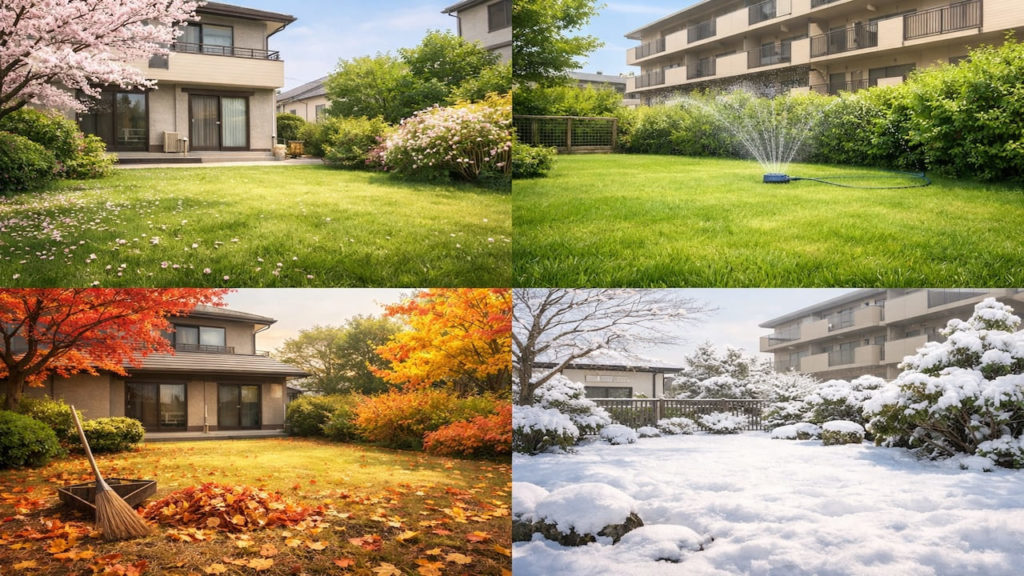
Spring is for wake-up and gentle correction, not aggressive reshaping. Summer is survival mode in humid Japan, so you focus on airflow, mowing height, and watering timing. Fall is repair season when growth is steady and weeds slow down, and winter is protection and patience. One mindset shift—do less when the lawn is stressed, do more when it can heal.
- Spring: rake light thatch and reset mowing height
- Summer: water at sunrise and avoid night wetness
- Summer: raise cutting height to shade soil
- Fall: overseed thin spots and improve soil contact
- Winter: keep traffic off soft dormant areas
Some folks treat summer like the best time to “fix everything” because it looks active. In Japan’s sticky nights, that is how fungus and thinning start. Others ignore fall, then complain in spring that nothing is dense. Treat fall like your rebuild window, and treat summer like your damage-control window.
3. Why Japan lawns go sideways when timing is off
Wrong timing stacks stress until the lawn cannot bounce back.
Most lawns fail by a chain reaction: you mow low, the soil heats up, roots shrink, then one wet stretch triggers disease or weeds. Japan adds humidity and sudden rain bursts, so leaf wetness lasts longer in narrow yards with fences that block wind. Add compacted paths near the genkan route and you get thin strips that never fully recover. Small mistakes, repeated.
- Scalping triggers heat stress and shallow rooting
- Evening watering keeps blades wet too long
- Compaction blocks air and water infiltration
- Thatch traps moisture and hides early symptoms
- Skipping fall repair leaves weak spring coverage
It is easy to blame “bad grass” or “bad seed,” but timing is the quiet villain. The same action can be helpful in one season and harmful in another. If you keep repeating the wrong-season move, you are basically training the lawn to fail. Fix the timing, and the lawn starts looking like it got a personality upgrade.
4. How to build a simple Japan lawn calendar you can follow
Run the checks weekly and choose one seasonal priority task.
Keep it simple: pick one priority per week, not five random chores. Spring priority is cleanup plus gentle feeding, summer priority is mowing and moisture control, fall priority is repair and density, winter priority is protection and tool prep. If you need basics like fertilizer, seed, and a blade sharpen or replacement, expect about ¥1,500–6,000 depending on what you already own. One clean routine—no spiraling.
- Spring: mow higher first then lower gradually
- Summer: sharpen blade and mow only when dry
- Fall: patch bare spots with seed and light cover
- Fall: topdress thin and sweep into low dips
- Winter: clean tools and plan drainage fixes
People try to do “calendar perfect” lawn care, then burn out by June. If you keep one weekly check routine, you always know what the lawn needs next. If your week is busy, just do the highest leverage move for that season. Consistency beats hero weekends every time.
5. FAQs
Q1. When should I start spring lawn care in Japan?
Start when growth is consistent and the lawn rebounds after mowing. If the grass stays flat and slow for a week, wait and focus on light cleanup only.
Q2. What is the biggest summer mistake in Japan?
Watering at night is a common one—humid evenings can keep leaves wet until morning. Switch to sunrise watering and raise mowing height to reduce stress.
Q3. Is fall really the best time to repair?
Yes, because growth is steady and heat stress is lower. Repairs like overseeding and leveling have a better chance to root and hold.
Q4. What should I do in winter if the lawn looks dead?
Do not panic and do not scalp it. Keep traffic light, clean tools, and plan spring fixes based on where thinning happened.
Q5. How often should I run these checks?
Once a week is enough for most home lawns. After heavy rain or a heat spike, do a quick extra look so problems do not sneak in.
Pro's Tough Talk

I’ve spent 20+ years working around Japanese homes, so I’ve seen what tends to work—and what tends to go wrong—in everyday use. Your lawn calendar is not a holy book, it’s a steering wheel.
Here’s the brutal breakdown. Spring is when the lawn can heal, so you can correct small issues without paying interest. Summer is when the lawn is already sweating, so extra stress turns into disease or thinning fast. Fall is your rebuild season, like patching a roof before the storm season, and winter is a pause button, not a failure screen. You know that rushed mow before work where you drop the deck too low and regret it all day?
Do the 5 checks today. Pick one task for this week. Repeat next week, no drama.
If you keep missing the timing then the lawn will punish you with weeds, bare stripes, and that soft spongy feel underfoot. If you run the checks for 4 weeks and nothing improves, that’s your signal to address compaction, drainage, or shade as the next real target.
Nice plan.
Summary
A Japan lawn calendar works best when it follows growth and moisture, not fixed dates. Use the same 5 checks all year, then pick the season-appropriate move.
If summer is causing trouble, reduce stress and keep leaves dry overnight. If fall is wasted, spring will feel like a struggle no matter what you buy.
Run the 5 checks once a week and choose one priority task per season. That rhythm keeps the lawn steady and makes the next article you read actually useful.