You walk out after rain and see the same puddles sitting on your patio. Pooling is annoying, slippery, and it can stain tile or loosen joints over time.
Most puddles are not “bad tile.” They come from a slope that is almost right but not consistent, plus an edge that traps runoff. In Japan, humid wet weeks make those small errors show up fast.
In this guide, you’ll learn how to find the true low spots and fix runoff using slope checks and edge control. You’ll also learn quick moves that help before a full rebuild.

Hi, I’m Ken — I’m Japanese, and I live in Malaysia long-term, so I explain everyday life in Japan from a practical ‘from abroad’ perspective.
I hold a building design qualification and I’ve been on site for 20+ years across hundreds of jobs. I turn Japan’s unspoken rules into simple checks, so you can avoid costly mistakes and take the next step with clear actions that feel safe.
1. Patio drainage puddles form: 5 checks to stop pooling fast
Puddles form where water has no committed path out even if the patio looks flat.
First, confirm the puddle is a real low point, not just slow drying from shade. Japan’s overcast days can make damp areas look worse, so test with a controlled pour and see if water actually settles. Mark the perimeter of the puddle, then look 30 cm past it for the exit it never reaches. That gap is the story.
- Pour a bucket and watch where water stops
- Mark the puddle outline with chalk for tracking
- Check if puddles repeat in the exact same spots
- Look for debris dams near joints and edges
- Compare after sun versus shade to confirm pooling
You might think one small puddle is harmless. It becomes grime, then algae, then a slippery patch, and then your joints start loosening. Fix it early and it stays small. That’s the cheap win.
2. Slope and edge runoff
Slope fails when the edge blocks runoff so you need both working together.
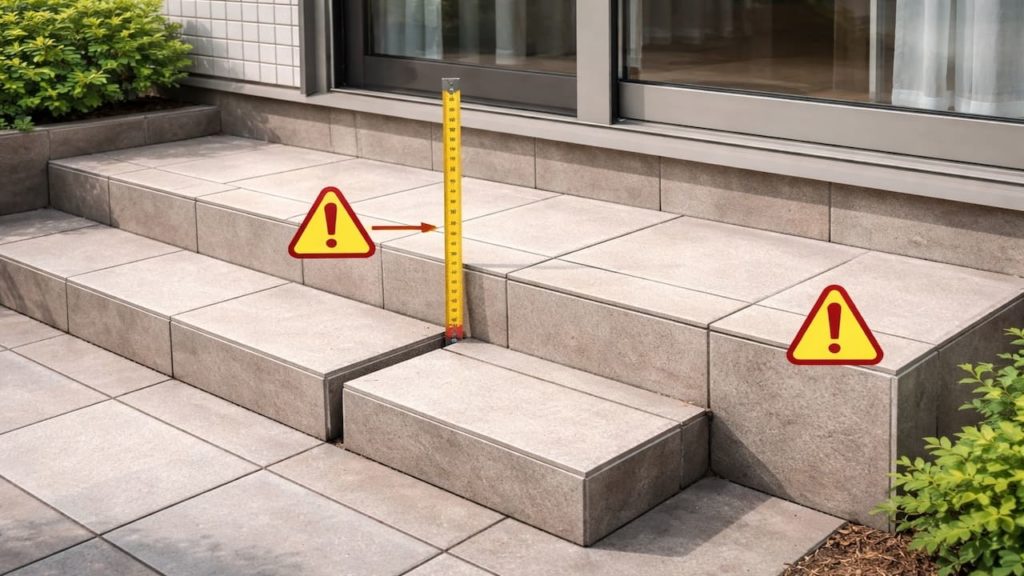
A patio can have decent slope in the middle but still pool near the edge if a border brick, bead of mortar, or lifted tile lip creates a mini dam. In many Japanese patios, tight boundary walls and narrow drains make edge runoff fragile—one raised edge and water has nowhere to go. Check slope direction and the edge profile at the same time.
- Use a long straight board to read slope
- Check slope in two directions not one line
- Inspect border bricks for a raised lip dam
- Look for sealant beads that trap water at edges
- Confirm runoff exit point is lower than patio edge
You might aim for “perfectly level” because it looks neat. That’s how water wins. A gentle consistent fall looks level to your eyes but drains like a champ. Behavior over appearance.
3. Why pooling keeps coming back after you clean
Pooling returns because geometry stayed the same and dirt just made it more obvious.
Cleaning removes grime but doesn’t change slope. If the base settled, joints washed out, or the edge lifted slightly, the low point remains. Japan’s wet season can also wash fine sand into joints, building tiny ridges that redirect water into puddles. So even if you scrub, the puddle is still waiting.
- Base settlement creates a permanent low dish
- Joint sand ridges redirect water into a pocket
- Edge restraint creep makes a dam at borders
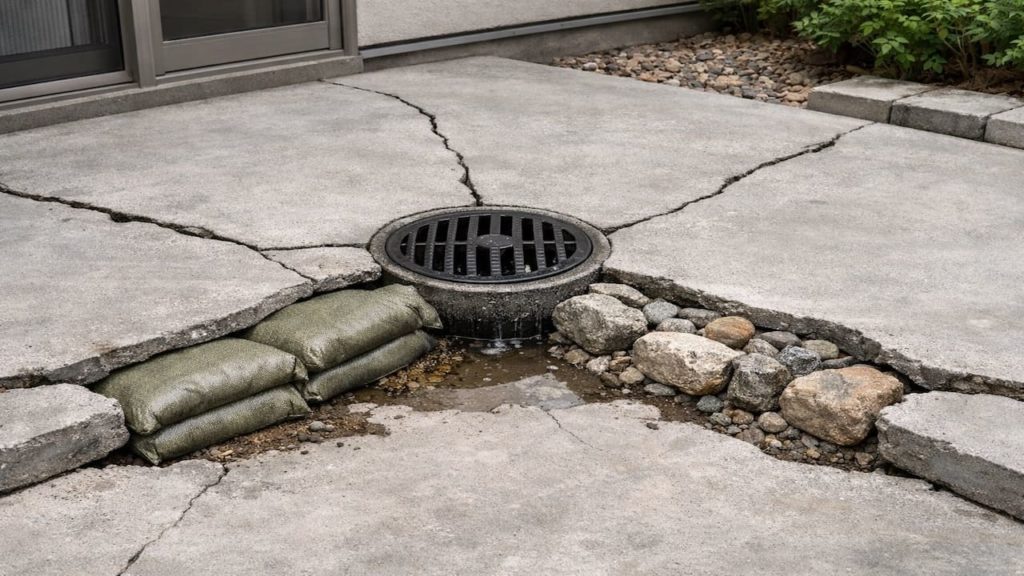
- Drain outlet clog makes water back up slowly
- Tile film slows flow and increases surface tension
You might blame “bad drainage in the neighborhood.” Sometimes the patio outlet is blocked right at your edge, not outside. Fix your exit first, then judge the bigger system. Small fixes can work.
4. How to stop pooling fast without redoing everything
Clear the exit and shave the dam before you commit to lifting pavers.
Cost is mostly time/effort. Start by clearing debris and checking that water can leave at the edge or drain point. If a border lip or sealant bead is trapping water, remove or reduce it so runoff can pass. If the low spot is caused by settled base, the real fix is lifting and resetting that area, but you can still reduce pooling by restoring the exit path and smoothing joint ridges. Quick relief first, then proper repair if needed.
- Clean drains and edge gaps so runoff can escape
- Remove small dams from mortar or sealant beads
- Brush joints to flatten sand ridges that divert flow
- Lift and reset only the worst low paver zone
- Recheck with bucket test and mark improvement
You might want to fill the puddle area with extra joint sand. That hides it for a bit, then the sand moves and the puddle comes back. If the surface is shaped wrong, you must change the shape or the exit. Do the simple exit fixes first, then decide if lifting is necessary.
5. FAQs
Q1. How do I tell if it is pooling or just slow drying?
Pooling stays in the same outline after a bucket test even when you stop adding water. Slow drying looks damp but does not form a stable water line.
Q2. Can I fix pooling by adding more sealant to joints?
No, sealant does not create slope and can trap water if applied wrong. Fix the runoff path and surface geometry first.
Q3. Why does pooling get worse in rainy season?
More frequent wet cycles keep the base and joints saturated, and fine debris builds small dams. Humidity also slows evaporation so puddles linger longer.
Q4. Do I need to rebuild the whole patio to fix one low spot?
Not always. If the rest drains well, lift and reset only the low zone and restore the exit path. If multiple puddles exist, the slope plan is wrong overall.
Q5. What is the most common edge runoff mistake?
A raised border lip that blocks water and a missing exit point. Water needs a lower outlet, not a higher barrier.
Pro's Tough Talk

I’ve spent 20+ years working around Japanese homes, so I’ve seen what tends to work—and what tends to go wrong—in everyday use. If puddles keep forming, the patio is basically telling you “I have no exit.”
The mechanism is dumb and brutal: a tiny low dish holds water, a tiny edge lip acts like a dam, and grime makes the water stick around longer. A patio that is “almost sloped” is like a sink that is “almost draining.” And a border brick lip can turn your runoff into a kiddie pool.
Do this now: bucket test and chalk the puddle outline. Do this today: clear the exit and remove the edge dam. Do this on the weekend: lift and reset the worst low paver zone if needed.
If the same puddle returns after you clear the exit the base has settled and you need a reset in that area. If water backs up from a drain, unclog the outlet first or you will chase symptoms forever.
You know that moment you step around the puddle every day like it’s a pet? And then one day you slip and suddenly it’s an emergency. Yeah. The puddle has been training you.
Summary
Puddles form where water has no path out, usually from inconsistent slope or an edge that blocks runoff. Confirm true pooling with a bucket test and mark the low spot.
Fix fast by clearing exits, removing small edge dams, and flattening joint ridges. If the puddle returns in the same outline, lift and reset that low area to restore slope.
Do one bucket test and clear one runoff exit today so you stop guessing and start draining. Then keep going with the next patio fix while you have momentum.