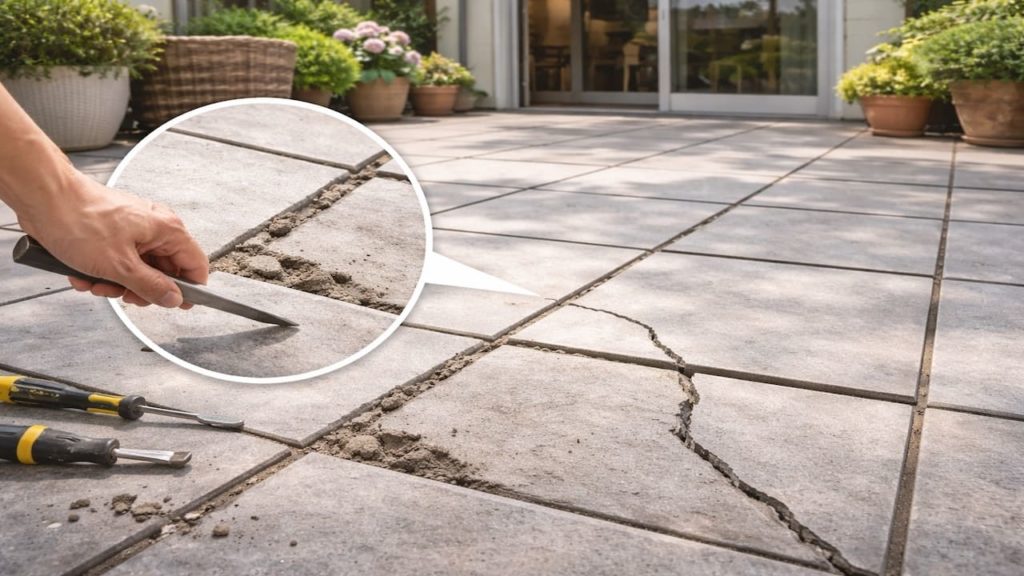
You’re seeing cracks near a tree and wondering if roots are pushing your patio up. It starts as a hairline, then you notice a slight lip and the crack seems to “walk” wider.
Tree-root damage can look like normal cracking at first, but root heave creates movement and height change. In Japan, wet seasons can soften soil and let roots and slabs shift faster than you expect.
In this guide, you’ll learn 5 signs roots are the driver not just shrinkage and when to act before lifting spreads. You’ll also learn how to check for heave safely without guessing.

Hi, I’m Ken — I’m Japanese, and I live in Malaysia long-term, so I explain everyday life in Japan from a practical ‘from abroad’ perspective.
I hold a building design qualification and I’ve been on site for 20+ years across hundreds of jobs. I turn Japan’s unspoken rules into simple checks, so you can avoid costly mistakes and take the next step with clear actions that feel safe.
1. Patio cracks from tree roots: 5 signs to act before lifting spreads
Root cracking is a lifting problem not a surface problem.
Unlike shrinkage cracks, root heave usually creates height differences and directional movement. The crack often points toward the tree and grows as the root thickens. In Japanese yards, limited soil zones around patios can force roots to travel shallow, right under edges. Early action can prevent trip hazards and bigger resets later.
- Crack has a raised lip you can feel
- Crack line points toward the nearby tree
- Tiles rock or slab sounds hollow near crack
- Gap widens after rain then stays open
- Surface slopes changed and puddles now form
Some people say all cracks look the same, so ignore it. Nope. A crack with height shift is movement, and movement spreads. If your foot catches, it’s already past cosmetic.
2. Root heave and shift
Root heave lifts in slow steps—and each step stresses joints and edges.
Roots expand in diameter each year and can wedge under slabs, pavers, and compacted base. Once a root creates a small lift, water can enter the gap, soften the base, and accelerate shifting. Japan’s rainy season makes that cycle faster, especially where patios border soil beds. The result is a lift zone that grows outward, not just one crack.
- Check if lift is highest closest to tree
- Look for joint gaps opening along one edge
- Probe under lifted edge for void space
- Inspect soil bed for exposed surface roots
- Watch for repeated washout after heavy rain
You might think cutting the visible root fixes it. That can stress the tree and sometimes does not stop movement because other roots take over. Control the risk first: reduce trip hazards and stop water entry, then plan the right fix.
3. Why roots lift patios and why it accelerates
Roots follow moisture and oxygen near the surface.
Shallow roots often develop where soil is compacted, wet, or short on oxygen, so they run along the top layers. Patios can also trap moisture at the edge, making roots explore under the slab. As the root grows, it acts like a slow jack, lifting a point and forcing the surface to crack at weak lines. Once lifted, water intrusion and freeze-thaw in cold areas can worsen movement.
- Compacted soil pushes roots to grow shallow
- Moist edges attract roots toward patio perimeter
- Growing roots wedge and lift like slow jacks
- Cracks allow water to soften base and shift
- Trip lips spread as the lift area expands
Some people blame the concrete mix or tile quality. Materials matter less than forces. If the ground is being pushed up, the surface is just the messenger. Stop the push or redesign around it.
4. How to act early before lifting becomes a full redo
Confirm the lift zone then plan a targeted reset.
Start by measuring height difference across the crack and mapping the lifted area, because that defines scope. Then reduce water entry by sealing cracks temporarily and improving drainage away from the lift point. For basic supplies like a straightedge, sealant, and marking tape, expect about ¥1000–5000, but the big cost is labor if you end up lifting pavers or cutting and repouring. In Japan, limited access and narrow side yards can raise labor cost, so catching it early matters.
- Measure lip height using a straightedge and coin
- Mark lifted tiles or slab edges with chalk
- Redirect runoff so water stops feeding the gap
- Temporarily seal cracks to limit water entry
- Consider root barrier when resetting the edge
Some people jump straight to tearing out everything. That can be overkill if only one edge zone is lifting. Targeted repair works when the lift is localized and you stop the moisture path. If the lift keeps growing, expand scope before it becomes dangerous.
5. FAQs
Q1. How do I tell root heave from normal concrete cracking?
Root heave usually includes a height lip, not just a line. If one side is higher and the crack aims toward the tree, roots are a strong suspect.
Q2. Can I just grind down the raised lip?
Grinding can reduce trip risk short-term, but it does not remove the lifting force. If the root keeps growing, the lip can come back and cracks can spread.
Q3. Is it safe to cut roots near a patio?
Cutting roots can affect tree stability and health, so be careful and consider professional advice. Even if you cut one root, others may still cause future lifting.
Q4. Will sealing the crack stop the lifting?
Sealing does not stop the root, but it can slow water intrusion that accelerates base softening and shifting. Think of sealing as a slowdown step, not a cure.
Q5. When is a full patio redo unavoidable?
If the lift spreads across a wide area or creates multiple trip lips, the base and surface may need a reset. If the tree cannot coexist with the patio layout, redesign may be the cleanest fix.
Pro's Tough Talk

I’ve spent 20+ years working around Japanese homes, so I’ve seen what tends to work—and what tends to go wrong—in everyday use. Root heave is the slow bully that turns a flat patio into a trip hazard while you pretend it’s “just a crack.”
Three things make it worse: the root keeps thickening, water gets into the gap, and the base softens so the lift spreads. A root is a living pry bar, and it does not care about your grout line. You step out at night, catch a toe on the lip, and suddenly you’re wide awake. You sweep and the crack looks cleaner, but the patio is still moving.
Right now, measure the lip height and mark the lift zone. Today, stop water from feeding the crack and seal it as a temporary block. This weekend, plan a targeted reset and consider a root barrier to protect the edge.
Do that and you stay ahead of the lift instead of reacting to it. If there is a height step and it grows season by season you act now, because grinding and patching won’t stop growth. If it is a flat hairline with no movement, monitor it and focus on drainage.
Nope.
The patio is not being dramatic, the tree is just getting stronger every year. Ignore it and you’ll be the one doing the comedy fall routine.
Summary
Root-driven cracks usually come with a raised lip, directional cracking toward the tree, and changing slope or puddles. Those are movement signals, not cosmetic lines.
Measure and map the lift zone, reduce water intrusion, and plan a targeted reset before the heave spreads. If lifting keeps growing season to season, redesign and root control become cheaper than constant patching.
Measure one crack lip today and you’ll know if you’re dealing with roots or simple shrinkage. Then move to the next patio repair topic that matches your lift pattern and lock in a safer surface.