You notice cracks forming near the patio steps, and they seem to grow faster than the rest of the slab. It makes you worry about safety, wobble, and whether the step base is shifting.
Cracks near steps can come from footing movement, settlement, or water getting under the edge and washing support out. In Japan, heavy rain weeks and freeze nights can accelerate tiny movement into visible cracks.
In this guide, you’ll learn 5 checks to judge movement and safety near patio steps before you patch anything. You’ll also learn what signs mean “watch it” versus “fix it now.”

Hi, I’m Ken — I’m Japanese, and I live in Malaysia long-term, so I explain everyday life in Japan from a practical ‘from abroad’ perspective.
I hold a building design qualification and I’ve been on site for 20+ years across hundreds of jobs. I turn Japan’s unspoken rules into simple checks, so you can avoid costly mistakes and take the next step with clear actions that feel safe.
1. Patio cracks near steps: 5 checks for movement and safety
Cracks near steps matter more because people load that spot hard.
Steps concentrate foot traffic and shifting loads, so weak base shows there first. The key is to check whether the crack is just a surface line or a sign of movement under the step footing. In Japanese patios, narrow side drainage can funnel water to the step edge, washing fines out and letting the corner settle. If the crack changes over time, treat it as movement, not cosmetics.
- Check if step edge feels hollow when tapped
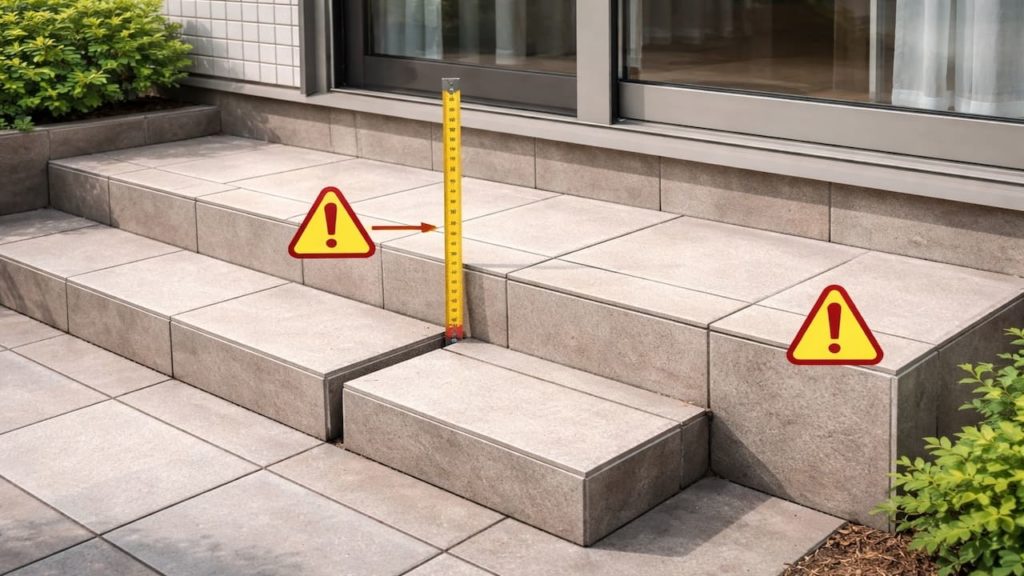
- Look for height difference across the crack line
- Test wobble by stepping at the outer corner
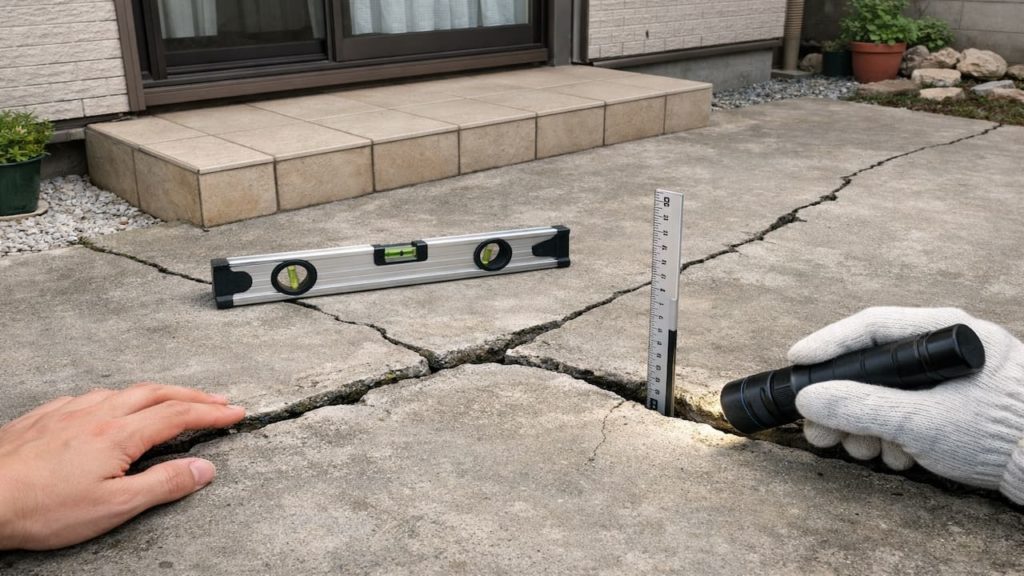
- Mark crack ends and measure growth weekly
- Inspect for washed out sand or base at edge
Some people rush to fill cracks with caulk and call it safe. That hides the symptom while the base keeps moving. If there is a lip or wobble, patching is not the fix. Movement diagnosis comes first.
2. Footing shift and settle
When the footing shifts the crack will keep reopening—even with perfect filler.
Steps often sit on a different base condition than the patio surface, so the step footing can settle separately. Water infiltration at the step joint can wash support out, especially if runoff hits that corner during storms. If you see repeated wetness at the crack, you likely have active water feeding the settlement. Basic supplies for monitoring, sealing small joints, and simple edge fill are usually ¥1000–5000, but cost is mostly time/effort if you are only checking and marking.
- Use a straightedge to spot a sinking corner
- Check joint between step and slab for gaps
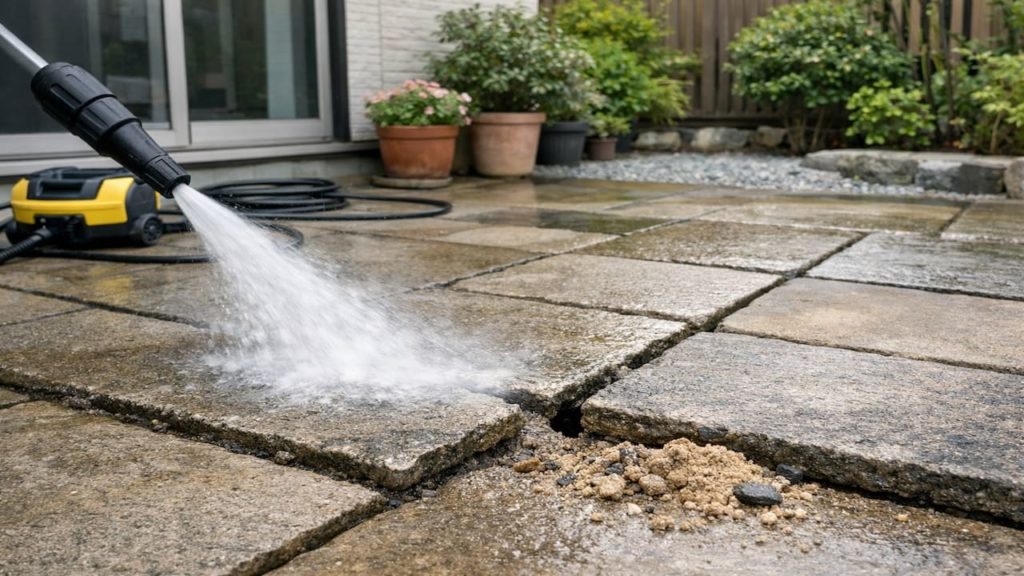
- Look for water path that targets the step base
- Probe for voids under the step edge safely
- Confirm handrail and step nosing feel solid
People assume all cracks mean “bad concrete.” Not always. A stable crack can be harmless, but a moving step base is a safety issue. If the crack shows displacement, treat it like structure, not paint.
3. Why cracks form near steps first
Load concentration plus water plus weak confinement triggers cracking.
Steps create stress points because loads focus at corners and edges, especially where the slab is thinner. If the base under the step edge gets wet and loses fines, the slab loses support and cracks along the weakest line. Freeze cycles can pry at that crack if water sits and refreezes at night. In Japan, shaded step corners can stay damp longer, feeding that cycle quietly.
- Step corners concentrate force and stress the slab
- Water washout removes support under the edge
- Settlement creates bending that cracks the surface
- Freeze expansion pries open damp crack edges
- Foot traffic vibration pumps fines out over time
Some people only look at the crack line and ignore the water path. That is a miss. If you don’t control water and base support, the crack is a messenger that keeps returning. Fix the message source.
4. How to make steps safer and stop cracks from spreading
Stabilize the base and control water before you patch.
Start with safety: if there’s a lip or wobble, reduce risk with a temporary traction strip or marker and avoid heavy loads on the corner. Then correct the water path by fixing slope, drip points, and edge drainage so the step base stays drier. If you end up lifting and re-bedding step pavers or rebuilding a corner base, supplies and materials can run ¥5000–30000 depending on scope and whether you add edge restraint. In Japan’s rainy periods, timing matters because wet base work fails if you rebuild on mud.
- Mark trip edges and add temporary traction strip
- Redirect runoff away from step corner line
- Fill voids under edge only after proper dry
- Relevel loose step units and compact base
- Patch cracks after movement stops and base stabilizes
Some people patch first because it looks cleaner. That’s backwards if movement is active. Patch after you stop the shift. Otherwise you’ll re-crack the repair and keep paying in time and frustration.
5. FAQs
Q1. When is a crack near steps actually dangerous?
When it creates a lip or wobble that can trip or when the step feels unstable. If the crack is hairline and the surface is level, it is usually less urgent.
Q2. How can I tell if the crack is growing?
Mark the ends with a pencil and measure width weekly, and take a photo from the same angle. If it changes after storms or freeze nights, movement is active.
Q3. Can I just fill the crack with flexible sealant?
Sealant can keep water out, but it won’t stop settlement if the base is failing. Use sealant only after you confirm the step base is stable.
Q4. Why does the crack widen after rain?
Rain can soften or wash out support under the step edge, letting it settle more. It can also make the crack more visible by darkening the edges.
Q5. Should I call a pro for step-area cracks?
If the step moves, rocks, or shows noticeable displacement, yes. Movement near stairs is a safety issue, and a pro can confirm footing and base conditions.
Pro's Tough Talk

I’ve spent 20+ years working around Japanese homes, so I’ve seen what tends to work—and what tends to go wrong—in everyday use. Cracks near steps are never “just looks,” because people stomp that spot every day and the slab listens.
Three reasons this shows up: the step base settles differently, water keeps feeding the corner, and the edge lacks support. A step corner is like the hinge on a door, it takes the abuse and fails first. You walk down carrying groceries, your foot hits a slight lip, and your brain goes “uh oh.” That is your free warning system.
Right now, check for wobble and height difference across the crack. Today, mark the crack and run a hose test to see if water targets the corner. This weekend, fix runoff and stabilize the base before you even think about patching.
Do that and the crack stops acting like a daily alarm. If there is a lip you treat it as a trip hazard and you fix movement, not cosmetics. If it is hairline and stable, keep water out and monitor it, but don’t panic.
Nope.
Ignoring a moving step crack is like ignoring a loose tooth, it doesn’t get better with vibes. Fix the corner before it bites you.
Summary
Cracks near patio steps matter because they can signal movement and become trip hazards. Check for wobble, height differences, growth after storms, and signs of washout at the edge.
Control water paths and stabilize the base first, then patch only after movement stops. If the step feels unstable or the crack creates a lip, treat it as urgent safety work.
Do the wobble and height check today and mark the crack so you can track change after rain. Then move to the next patio drainage or base stability fix that matches what you find.