You notice the interlocking pavers drifting, and the surface no longer feels flat underfoot. You came here because you want to know if it is “normal settling” or the start of a real failure.
It can be a harmless bedding shift, or it can be the base losing support from water and fine soil moving. In Japan, sudden downpours and long wet seasons can quietly accelerate washout even on small home driveways.
In this guide, you’ll learn how to spot settling early and fix the cause before the whole area turns into a wavy mess. You will check the surface signs, confirm what is happening underneath, and reset a small patch without redoing everything.

Hi, I’m Ken — I’m Japanese, and I live in Malaysia long-term, so I explain everyday life in Japan from a practical ‘from abroad’ perspective.
I hold a building design qualification and I’ve been on site for 20+ years across hundreds of jobs. I turn Japan’s unspoken rules into simple checks, so you can avoid costly mistakes and take the next step with clear actions that feel safe.
1. Pavement shifts on interlocking 5 signs of settling
Settling shows up as patterns not just a single dip.
Interlocking pavers “talk” through repeatable clues—ignore them and the movement spreads. In tight Japanese home entries, even a small shift changes how water runs and where dirt packs in. Look for changes that keep returning after sweeping and rain.
- Watch for new gaps along joint lines
- Check for lipping where pavers catch toes
- Notice rocking when you step on corners
- Find low spots where puddles linger
- Spot sand pumping out after heavy rain
Some people say “pavers always move” and stop thinking right there. Sure, tiny seasonal changes happen, but settling keeps making the same spots worse. If the surface gets easier to trip on, that is not harmless. Treat it like an early warning, not decoration.
2. Base voids and washout
The pavers are fine but the support below is failing.
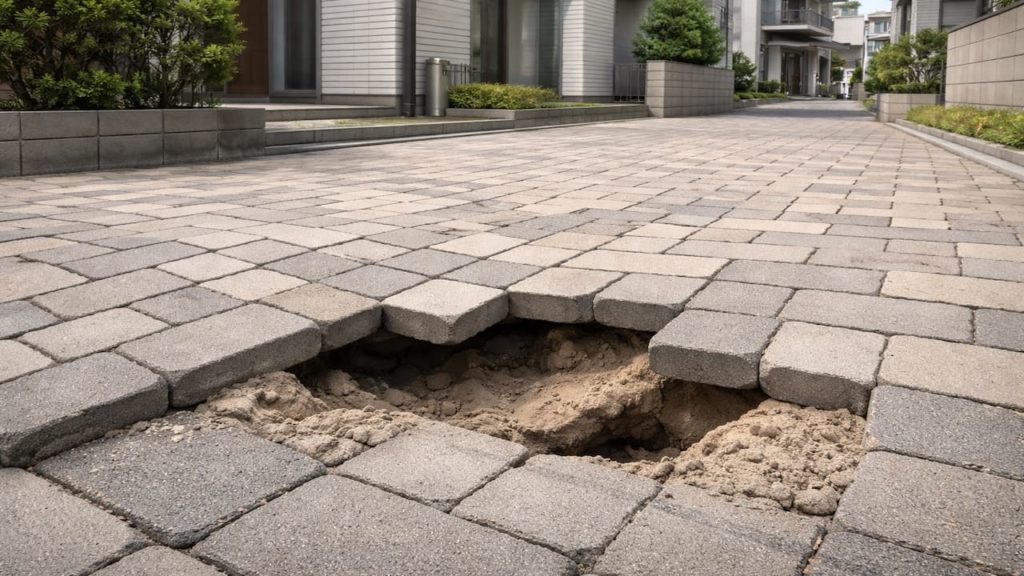
When water sneaks under the edge, it carries fines away and leaves little caves—then the pavers drop into them. Japan’s rainy season can turn a small edge leak into repeated washout if drainage is weak. Good installs focus on stable layers and drainage details, not just the pretty top. According to lampus.com.
- Lift one paver and inspect bedding sand
- Probe the base and feel for hollows
- Check edges where runoff enters first
- Look for muddy streaks exiting joint gaps
- Tap surface and listen for dull spots
You might think more joint sand will fix everything, and sometimes it helps for a week. If voids exist, sand just keeps migrating into empty space. That is why the surface “resets” after every storm. Fix the support, then lock the joints again.
3. Why interlocking pavers settle after heavy rain
Water pressure and weak edges do the real damage.
Settling is usually a chain reaction—water finds a path, soil softens, then the base loses shape. Roof runoff, hose washing, and sloped driveways can push water to one edge again and again. Once fines start moving, the pattern lines open up and the surface follows.
- Redirect downspout flow away from paved areas
- Stop hose runoff from washing joint sand
- Seal edge leaks where water enters base
- Improve drainage so puddles clear quickly
- Add edge restraint where borders keep spreading
“But it was fine for years” is the classic line right before it gets worse. Time hides slow erosion until one storm finishes the job. Also, small home changes matter, like adding a planter that blocks runoff. If the same spot sinks twice, the cause is still there.
4. How to reset a sunken patch without redoing everything
Pull the patch clean and rebuild the support layers.
This is not magic, it is boring base work—done carefully it holds. You usually only need basic supplies, like joint sand and a small amount of base material, often around ¥1,200–2,000 per item you restock. According to monotaro.com. In Japanese homes, keep noise and dust down, and stack pavers neatly so the pattern returns.
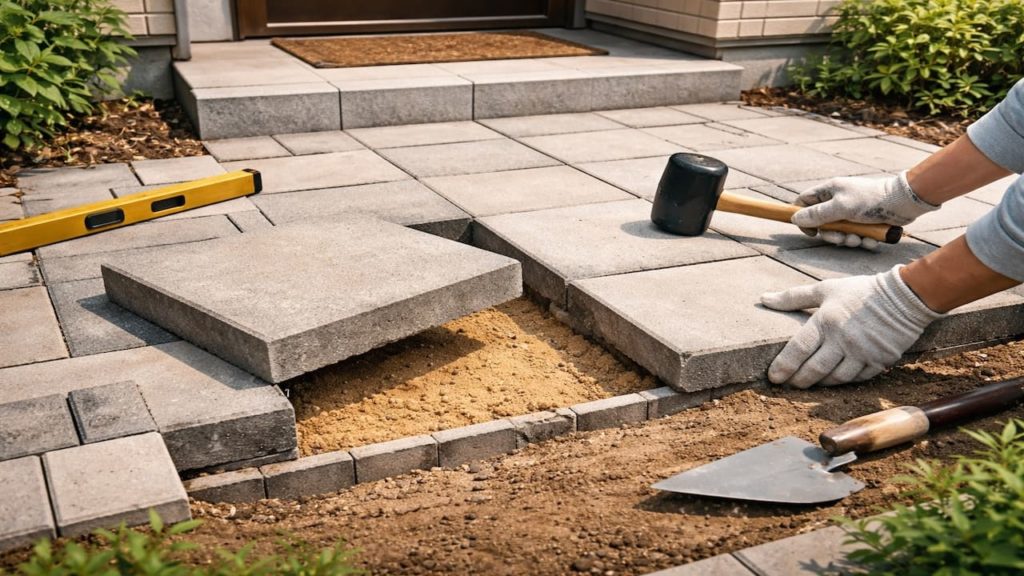
- Pull pavers neatly and stack by pattern
- Remove loose sand and scrape bedding flat
- Add base material and compact in thin lifts
- Screed fresh bedding and set pavers level
- Sweep joint sand then compact and top off
People try to hammer the surface flat and call it “fixed.” That only crushes bedding and makes the next dip faster. If you cannot compact the base, at least stop the water entry first. Do it once with care, and you stop chasing the same sinkhole.
5. FAQs
Q1. Is a little movement always a problem?
No, slight shifts can happen after the first rains, especially on new work. It becomes a problem when the same area keeps dropping or starts rocking under your foot.
Q2. How do I know if it is base settling or just loose sand?
If the paver rocks the support below is missing. Loose joint sand looks messy, but the paver still feels solid when you step on it.
Q3. Can I fix this without lifting any pavers?
You can try topping up joint sand, but it will not stop a void under the surface—so it comes back. If the dip is repeatable after rain, lift the patch and confirm the base.
Q4. Will this get worse in Japan’s rainy season?
It can, because long wet weeks keep the base soft and wash fines out little by little. The earlier you block water entry and restore edge support, the less the damage spreads.
Q5. When should I call a pro instead?
If the sinking area is wide, near a drain, or next to a structure, get help. Also call one if you cannot compact the base or control runoff where it starts.
Pro's Tough Talk

I’ve spent 20+ years working around Japanese homes, so I’ve seen what tends to work—and what tends to go wrong—in everyday use. When pavers start drifting, the “small problem” story is usually a lie you tell yourself.
Here’s the cold truth: water gets under an edge, then it steals support like a pickpocket in a crowd. The base is the mattress under your futon, and if it sags, everything on top sags too. You didn’t “mess it up,” you just got the physics bill in the mail.
Stop the water path now. Lift the worst patch today and look for hollow spots. Rebuild and compact the base this weekend.
If the same spot sinks twice the cause is still active. If you block runoff and rebuild support and it still moves, that’s your sign to bring in heavier compaction gear and deeper base work.
Sure, blame the pavers. Next time you trip on that lip in the dark, tell your ankle it was “character.”
Summary
Settling is not random, and the surface shows clear signs before it gets ugly. Watch for repeat dips, rocking corners, and sand pumping after rain.
Next, confirm what is happening below, because voids and washout are the real drivers. If the dip returns after you sweep and compact, lift the patch and fix the support.
Do one clean reset on the worst spot today and stop the water path that feeds it. Then check the nearby joints and edges so the shift does not migrate.