You step outside after rain and the pavement still has puddles hours later. You searched because you want drainage fixed, not just a quick sweep of water.
Puddles can come from a small low spot, clogged silt at joints, or a slope that sends water to the wrong place. In Japan, sudden downpours and long rainy season stretches make tiny drainage flaws show up fast.
In this guide, you’ll learn how to diagnose puddles and improve drainage by checking slope, low spots, and silt traps in a simple order. You’ll also learn which fixes are safe to DIY and which ones mean the base is failing.

Hi, I’m Ken — I’m Japanese, and I live in Malaysia long-term, so I explain everyday life in Japan from a practical ‘from abroad’ perspective.
I hold a building design qualification and I’ve been on site for 20+ years across hundreds of jobs. I turn Japan’s unspoken rules into simple checks, so you can avoid costly mistakes and take the next step with clear actions that feel safe.
1. Pavement puddles after rain 5 checks to fix drainage
Puddles happen where water cannot exit fast enough.
The surface tells you the story if you watch it during and right after rain. In Japanese home entries, narrow paths, tight drains, and plant beds often force water to turn corners and slow down. Your job is to find the exact “stop point” where flow dies.
- Watch water flow during the next rainfall
- Mark where puddles stay after one hour
- Check if debris blocks the nearest outlet
- Look for silt lines showing runoff direction
- Test if the surface feels spongy underfoot
Some people assume puddles mean the whole area is wrong. Often it is one low corner or one clogged seam acting like a dam. If you find that one choke point, the fix gets smaller. Locate first, then fix.
2. Slope low spots and silt
Fixing puddles is mostly about restoring slope and removing silt.
Silt builds up like a thin carpet, and it blocks micro-drainage between pavers, joints, and drain grates. Low spots collect that silt, then hold water longer, then grow algae and smell—nice loop. Japan’s rainy season keeps washing fine dirt onto surfaces, so silt control matters more than people think.
- Use a straight board to spot low depressions
- Check joints for packed mud blocking drainage
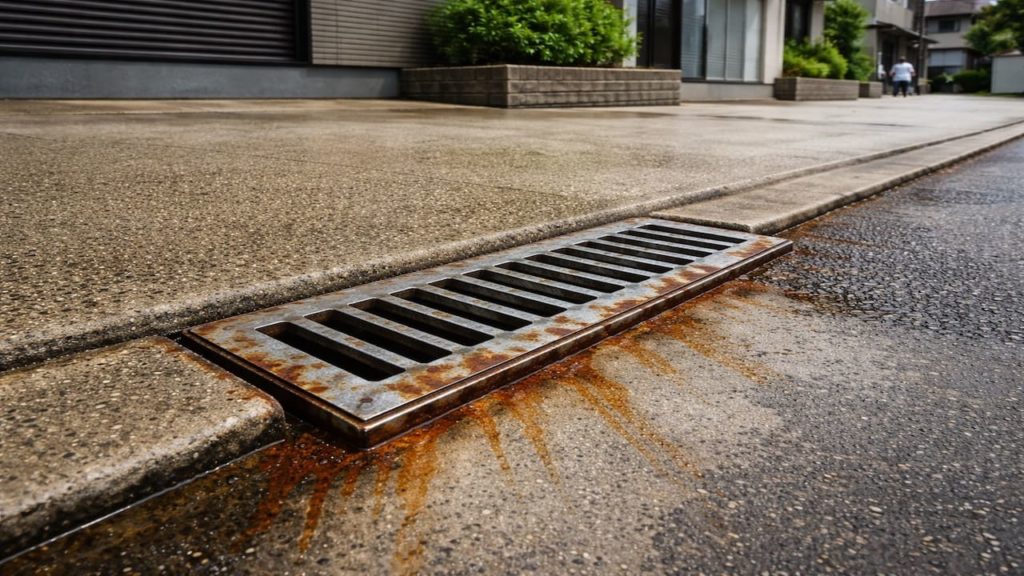
- Inspect drain grates and channels for silt mats
- Look for edge soil spilling onto pavement seams
- Confirm downspouts dump water near the puddle
You might think “just drill a hole” or “add a drain” right away. If the slope and silt are the real problem, extra drains just clog too. Start with cleaning and restoring flow, then add hardware only if needed. Do the simple stuff first.
3. Why puddles keep forming even after you sweep water away
If the base or slope is wrong water will always return.
Sweeping removes the symptom, not the cause, so the same puddle reforms at the same outline. A slight settlement can create a basin, and once it exists, it collects silt and deepens. In Japan, repeated wetting and drying plus vehicle loads on small driveways can slowly change the grade.
- Settlement creates a shallow bowl over time
- Silt deposits raise surrounding edges like a rim
- Clogged joints stop water from infiltrating
- Runoff concentrates at one corner repeatedly
- Edge soil erosion spills material into seams
People say “it’s just a little puddle” until algae makes it slippery. Puddles also accelerate staining and freeze damage in cold regions. If the outline stays the same after each storm, it is a shape problem. Shape beats effort.
4. How to fix puddles and improve drainage safely
Clean outlets then correct the low spot and reset joints.
Start with silt removal and outlet clearing, then address the low area by lifting and re-bedding pavers or adding a thin leveling layer where appropriate. For DIY supplies like a stiff broom, small shovel, joint sand, and basic base material, expect around ¥800–3,000 and cost is mostly time/effort. In Japanese homes, keep runoff controlled so dirty water does not flow into neighbors’ doors or shared paths.
- Clear drains and sweep silt away from outlets
- Flush joints and remove packed mud completely
- Lift pavers at the low spot and re-level base
- Compact then reset pavers with proper slope
- Refill joints and compact to lock everything
You might want to pour mortar into the low spot and call it fixed. That often traps water and cracks later because the base is still moving. If you cannot lift and re-level, at least stop silt from building and redirect downspout flow. But the best fix is restoring slope.
5. FAQs
Q1. How long is “too long” for a puddle to stay?
If it remains after an hour of no rain and mild wind, it is worth fixing. Persistent puddles usually mean a low spot or a blocked outlet.
Q2. Can clogged joints alone cause puddles?
Yes, packed silt can stop water from infiltrating and force it to sit on the surface. Cleaning and refilling joints can make a big difference.
Q3. Do I need to install a new drain?
Not always. Try restoring slope and clearing outlets first, because new drains clog fast if silt control is still bad.
Q4. Why are puddles worse near plants or lawn edges?
Soil and mulch wash onto pavement and block seams, and roots can create uneven settling. Edges also tend to be the lowest and least supported zones.
Q5. When should I call a pro?
If the surface is sinking, rocking, or you see voids under pavers, get help. Base failure needs proper compaction and sometimes deeper drainage work.
Pro's Tough Talk

I’ve spent 20+ years working around Japanese homes, so I’ve seen what tends to work—and what tends to go wrong—in everyday use. If your pavement holds puddles, it’s telling you “the water has nowhere to go,” and it’s not being subtle.
Here’s the cold breakdown: slope is the steering wheel, low spots are the bathtub, and silt is the plug in the drain. You can sweep all day, but the next storm refills the same bathtub. And that slippery algae that shows up? That’s the puddle sending you a thank-you card.
Clear the outlet now and remove the silt mat. Mark the low spot today with a straight board and chalk. Re-level the low patch this weekend and reset joints tight.
If puddles return after you restore slope and clean outlets, the base is settling or a downspout is still dumping water into the same zone. If the surface feels spongy or rocks, stop guessing and get the base checked.
Keep calling it “a small puddle,” and soon you’ll have your own backyard koi pond.
Summary
Puddles after rain usually come from a low spot, weak slope, or silt blocking drainage paths. Watch flow during rain, mark the puddle outline, and find the choke point.
Fix the simple causes first by clearing outlets and removing packed silt, then correct the low area by restoring slope. If the same outline returns, the shape or base is still wrong.
Clear the silt today and mark the low spot so your next repair targets the real cause. Then restore slope and lock the joints so water can finally leave.