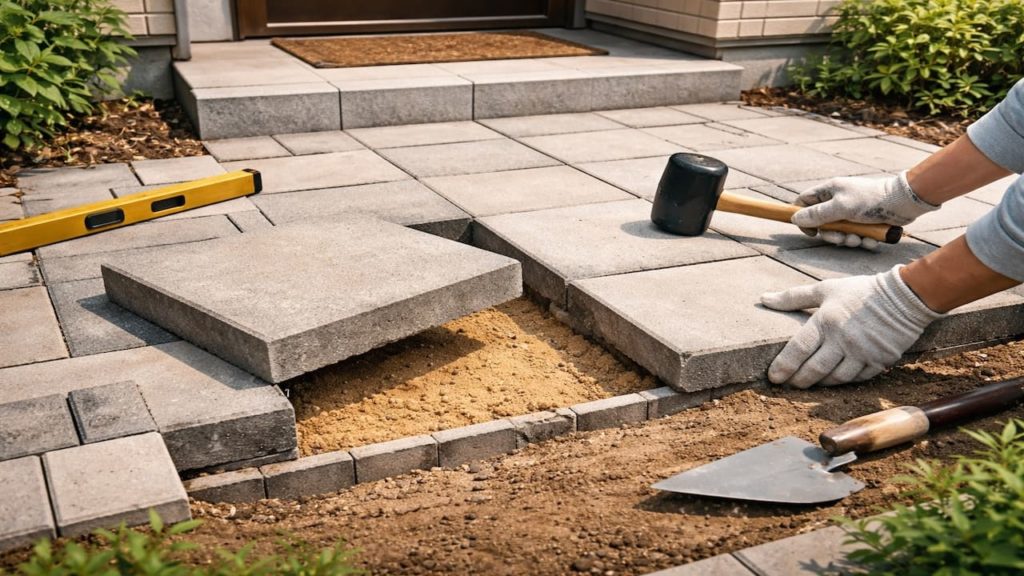
You step on a pavement tile and it rocks or clicks on the slab underneath. You searched because you want it stable again without cracking the tile.
Wobble usually comes from uneven bedding sand, missing support at corners, or weak edge restraint letting tiles drift. In Japan, rain and humidity can wash fine sand out of joints, and tight walkways get repeated foot hits on the same spots.
In this guide, you’ll learn how to stabilize wobbling tiles on a slab by checking base sand, support points, and edge hold. You’ll also learn a simple reset method that keeps drainage working.

Hi, I’m Ken — I’m Japanese, and I live in Malaysia long-term, so I explain everyday life in Japan from a practical ‘from abroad’ perspective.
I hold a building design qualification and I’ve been on site for 20+ years across hundreds of jobs. I turn Japan’s unspoken rules into simple checks, so you can avoid costly mistakes and take the next step with clear actions that feel safe.
1. Pavement tiles wobble on slab 5 checks to stabilize
Tiles wobble when one corner loses support or the tile shifts off level.
On a slab, the slab is not the problem most of the time, the bedding layer is. A few millimeters of uneven sand or grit under one corner is enough to create rocking. In Japanese entries, fine dust and silt can migrate under tile edges after rain splash and sweeping.
- Press each corner and feel which one lifts
- Listen for clicking sound when you step down
- Check joints for missing sand and open gaps
- Look for edge tiles drifting outward over time
- Inspect for silt piles trapped at tile edges
Some people blame the slab and assume it needs resurfacing. Usually you just need to lift one tile and fix the bedding, not rebuild everything. If only one or two tiles rock, it’s a local support issue. Treat it locally.
2. Base sand and edge hold
Stable tiles need even bedding sand and tight edge restraint.
Bedding sand must be thin and uniform, or it compresses unevenly and creates a hollow corner. Edge restraint matters because without it, tiles can spread and lose tight contact, then sand escapes. In Japan’s rainy season, water can carry fine sand out through joints if the edge is open and the slope pushes flow outward.
- Measure if bedding is thicker on one side
- Check if sand is washed out at the outer edge
- Look for edge restraint gaps or loose border pieces
- See if water flow runs along the tile edge
- Confirm joints are not fully packed with sand
You might think adding more sand on top fixes it. Top sand helps joints, but it does not rebuild the missing support under a corner. Also, if edge hold is weak, sand will keep escaping. Fix the base first, then lock the edge.
3. Why tiles on slabs start rocking over time
Rocking starts when sand migrates and small debris lifts corners.
Sweep grit into joints and it can ride under the tile edge, lifting a corner like a tiny shim. Water then washes bedding sand away from the low side, leaving a void. In Japan, daily wet-dry cycles and fine dust from roads can slowly change the bedding layer even on a solid slab.
- Debris acts like a wedge under tile corners
- Water carries bedding sand toward drains and edges
- Repeated stepping compacts sand unevenly over time
- Edge gaps let tiles creep and joints widen
- Algae film keeps edges damp and sand mobile
People try to ignore it until it “settles.” It usually settles into worse wobble because the tile keeps pumping sand out when you step. That pumping also cracks grout or chips tile edges. Stabilize early, before the tile becomes the hammer.
4. How to reset wobbling tiles on a slab the right way
Lift the tile, clean the slab, then re-bed evenly and re-sand joints.
Remove the tile carefully, vacuum all grit, then spread a thin uniform bedding layer and set the tile flat, checking level and corner support. For basic supplies like joint sand, a small trowel, shims, and a rubber mallet, expect around ¥800–3,000, and cost is mostly time/effort. In Japanese outdoor areas, keep the slope so water still drains and do not trap water with an overly thick bed.
- Lift the tile using suction cup or pry pads
- Vacuum slab and remove all grit completely
- Spread thin bedding sand and screed it flat
- Set tile then tap gently to full support
- Pack joints with sand and compact thoroughly
You might want to glue the tile down with random adhesive. That can trap moisture, fail in freeze-thaw zones, and make future repairs painful. If you need bonding, use a product meant for exterior tile-on-slab systems, but for most patio tiles, a proper bedding reset is enough. Keep it reversible and drainable.
5. FAQs
Q1. Can I just pour sand into the joints to stop wobble?
It may reduce movement slightly, but it will not fix a missing support corner under the tile. You need to re-bed the tile if it rocks.
Q2. How do I know if the slab itself is uneven?
If multiple tiles in a line rock the same way, the slab may have a dip or ridge. If only one tile rocks, it is usually bedding or debris under that tile.
Q3. Should I use mortar instead of sand on a slab?
Not for a quick fix. Mortar can crack, trap water, and make future access hard unless the system is designed for it.
Q4. Why do edge tiles wobble more often?
Edges lose sand faster and have less confinement, so tiles can drift and joints open. Edge restraint keeps the whole field locked in place.
Q5. When should I call a pro?
If many tiles are rocking, the slab has drainage issues, or you see water pooling under tiles, get help. That can mean slope correction and a full reset.
Pro's Tough Talk

I’ve spent 20+ years working around Japanese homes, so I’ve seen what tends to work—and what tends to go wrong—in everyday use. A wobbling tile is not “a small annoyance,” it’s a future chip and a future trip.
Cold breakdown: one corner lost support, and now the tile is a seesaw. Every step pumps sand out and invites more grit in, like a tiny bellows. It’s like trying to balance a table with a folded napkin under one leg, and then wondering why it keeps moving.
Find the lifting corner right now and mark it. Lift that tile today and vacuum the slab clean. Re-bed it this weekend with a thin even layer and lock the edges tight.
If the tile rocks again after a proper reset, you either have edge restraint failure or a slab low spot that is affecting multiple tiles. If only the edge row keeps loosening, fix the border hold first or you’ll keep chasing the same wobble.
Keep ignoring the click-click, and soon your tile will start answering back with crack-crack.
Summary
Wobbling tiles on a slab usually come from uneven bedding sand, debris under corners, or weak edge restraint. Check which corner lifts, whether joints are losing sand, and whether edge tiles are drifting.
The real fix is lifting the tile, cleaning the slab, re-bedding evenly, then refilling joints and restoring edge hold. If many tiles rock, the slab slope or border system may need bigger work.
Lift one rocking tile today and reset the bedding so the movement stops before it chips edges. Then lock the border so the same wobble doesn’t return.


