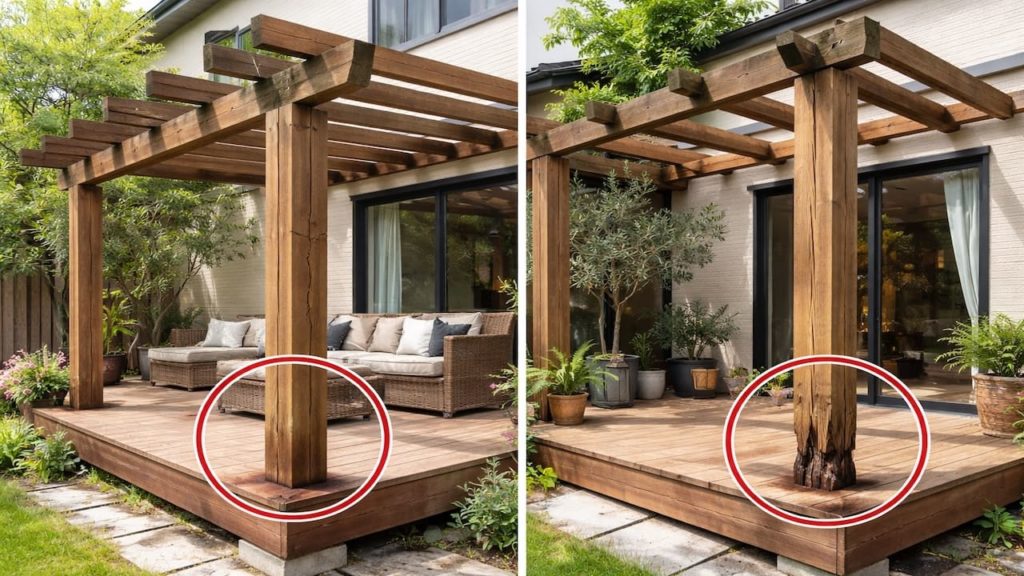
You notice cracks near the pergola post base, or the post feels slightly off. That small sign can make the whole structure feel unreliable.You also worry water is getting in and quietly making things worse. You want to catch it early, not after a big wobble.
Post bases fail for a few repeat reasons, not random bad luck. Japan’s rainy season and humid summers keep concrete and hardware wet longer than you expect.That wet cycle can loosen anchors, widen cracks, and invite rot at the bottom. Small movement becomes a habit.
In this guide, you’ll learn how to spot pergola post base trouble early and fix the right cause. You’ll check cracks, water paths, and movement so the base stays stable.You’ll also know when it’s a simple maintenance job and when it’s reinforcement time.

Hi, I’m Ken — I’m Japanese, and I live in Malaysia long-term, so I explain everyday life in Japan from a practical ‘from abroad’ perspective.
I hold a building design qualification and I’ve been on site for 20+ years across hundreds of jobs. I turn Japan’s unspoken rules into simple checks, so you can avoid costly mistakes and take the next step with clear actions that feel safe.
1. Pergola post base problems: 5 signs
These 5 signs tell you the base is losing stability.
Post base issues usually show up as tiny clues before anything “fails”—that’s your advantage. In Japan, wet ground and splashback during tsuyu keep the base area damp, and damp makes both concrete and fasteners behave worse over time. If you catch the pattern early, fixes stay small and cheap. No hero work.
- Hairline cracks radiate from the base plate
- Rust stains bleed out after heavy rain
- Post rocks when you push with one hand
- Concrete edge chips and keeps flaking off
- Gap grows between base plate and concrete
Some people ignore hairline cracks because “concrete always cracks.” True, but cracks plus water plus movement is a different story. If your post can move, the crack is not just cosmetic. Treat these as early warnings, and your pergola stays boringly solid.
2. Cracks water and movement
Cracks with water and movement mean the base is shifting.
Cracks alone can be harmless, but water makes them expand and carry grime deeper into the base—then hardware starts corroding. Movement is the multiplier because every wobble pumps the crack like a tiny hinge. In tight Japanese yards, drainage is often poor near fences, so the post base sits in damp conditions longer than it should. That’s why you check all three, not one.
Many post base connectors are designed to hold the post above concrete to reduce moisture contact at the end grain. According to strongtie.com.
- Trace cracks and note their direction and length
- Check for standing water after a storm
- Look for wet lines under the base plate
- Press the post and watch the plate edge
- Listen for clicking at the anchor points
You might think the noise is “just the roof,” but clicking often comes from the base. If water sits there, corrosion and loosening speed up. Fix the water path, confirm the base is seated, and the movement usually calms down fast.
3. Why post bases fail around pergolas
Most failures start with drainage and poor load transfer.
A pergola post base has two jobs: keep the post positioned and send loads into the footing without slip—simple, but unforgiving. If water pools at the base, it weakens the concrete surface, rusts anchors, and invites decay where wood meets moisture. Japan’s humid seasons plus sudden downpours mean you get repeated wetting even when you “never hose that area.” Then tiny settlement or vibration turns into permanent looseness. Slow physics.
- Water pooling softens surface and widens cracks
- Anchor corrosion reduces grip inside concrete
- Footing settlement tilts the post slowly
- Base plate gaps allow micro sliding each gust
- Wood end grain stays damp and begins rot
People love to blame the fastener brand, but the environment is the bigger driver. If the base stays wet, even good hardware suffers. Control water and loads first, then hardware choices actually matter.
4. How to stabilize a post base before it gets worse
Stop movement first, then block water, then reinforce.
Start with a simple test: can you make the post move by hand, or only under wind load. If it moves, don’t rush to seal cracks; sealing without stopping movement is just makeup on a bruise—looks better, still hurts. Next, fix water: improve runoff direction, remove debris that traps moisture, and keep the base area drying after rain. For basic supplies, expect ¥1,000–6,000 for a wire brush, rust inhibitor, shim material, and a small sealant tube.
- Mark the post and track if tilt increases
- Tighten anchors to snug and recheck movement
- Shim the base plate only where it is safe
- Clear drainage so water cannot pool there
- Seal small cracks after movement is controlled
You might say “I’ll just seal everything and forget it,” but that can trap moisture and hide a loosening anchor. If the base still rocks after tightening, you need reinforcement, not more sealant. When in doubt, stabilize the load path, then protect the surface, and you stop the chain reaction.
5. FAQs
Q1. Are small concrete cracks around a post base always bad?
No, small cracks can be normal, but cracks plus water and wobble is a red flag. Track it for a week and check after rain.
Q2. What is the quickest sign the base is unsafe?
If the post rocks by hand it needs action. Even slight movement can loosen anchors further and grow cracks.
Q3. Can I just add more screws or anchors?
Sometimes, but only after you control water and confirm the footing is sound—otherwise you are anchoring into a problem. If concrete is weak or crumbling, new anchors will not hold well.
Q4. Should I seal cracks right away?
Seal after you stop the movement and the area dries properly. If you seal while it is shifting, the crack will reopen and you learn nothing.
Q5. When should I call a pro?
If the post lean increases, cracks widen fast, or the footing seems to settle, call help. If it is only surface cracking with no movement, you can usually monitor and maintain.
Pro's Tough Talk

I’ve spent 20+ years working around Japanese homes, so I’ve seen what tends to work—and what tends to go wrong—in everyday use.
A post base is the foundation’s handshake with the pergola, and a sloppy handshake turns into a shove. You get water sitting there, then the base starts acting like a loose tooth, wiggling a little more every day. Nobody wakes up wanting a wobbly post, it just happens because the bottom was ignored.
Right now: push the post and see if it moves. Today: clean the base, tighten what is loose, and clear the water path. This weekend: stop repeat wetting and add reinforcement if movement returns.
If it moves after tightening the fix is reinforcement not wishful thinking. If you see fresh rust streaks or widening cracks, that’s your stop sign.
Come on.
Scene one: you’re carrying laundry outside and the post shivers when you brush it. Scene two: you hear a tiny click every gust and keep pretending it is fine.
Summary
Watch for cracks, rust stains, gaps, and any post movement at the base. Those signs usually show up before real damage spreads.
If the post rocks or the crack pattern changes after rain, control movement and water first. If it keeps returning, reinforce instead of endlessly sealing.
Do the push test and base check today. Then keep tightening and drying habits so the pergola stays stable through the seasons.