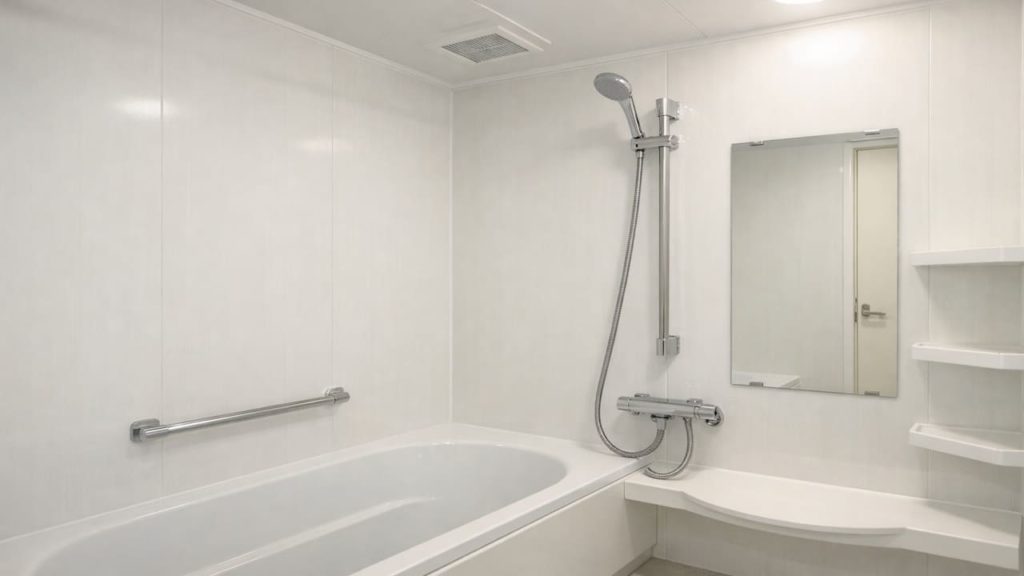
You see a white crust on the unit bath faucet, mirror edge, or drain cover. It feels rough, and it keeps coming back after “normal” cleaning.
This is usually limescale from mineral deposits, plus soap film acting like glue, so scrubbing harder can backfire. In Japan, compact unit baths and humid seasons make residue stick fast on warm wet surfaces.
In this guide, you’ll learn 5 safe tips to remove white crust without damage. You will also know when the stain is not limescale anymore.

Hi, I’m Ken — I’m Japanese, and I live in Malaysia long-term, so I explain everyday life in Japan from a practical ‘from abroad’ perspective.
I hold a building design qualification and I’ve been on site for 20+ years across hundreds of jobs. I turn Japan’s unspoken rules into simple checks, so you can avoid costly mistakes and take the next step with clear actions that feel safe.
1. Unit bath limescale: 5 Tips
Soften the crust first then wipe it off, because force creates scratches that catch more scale later.
Limescale is mineral buildup that hardens when droplets dry on metal and resin. In Japan, hot showers plus steady ventilation can dry droplets into rings overnight, especially on the faucet base. A diluted citric acid solution can help loosen many deposits when you rinse well afterward. According to TOTO.
- Rinse warm water over the white crust
- Apply diluted citric acid on white spots
- Cover with plastic wrap to keep it wet
- Rub gently using soft sponge in small circles
- Rinse thoroughly then wipe completely dry
Some people jump to abrasive pads and win the battle, then lose the war. Micro-scratches make future scale bond faster, and the surface looks dull. If you soften and lift, you protect the finish. Clean shine.
2. Remove white crust safely
Match the method to the surface finish—coatings and gloss layers hate strong acids and rough tools.
Mirrors and some glossy parts may have coatings that react poorly to acids, even mild ones. In Japan rentals, “one wrong cleaner” can leave a permanent haze you cannot reverse. Treat acids as a spot tool, not an everywhere spray, and test a hidden corner first. According to LIXIL.
- Test cleaner on a hidden corner first
- Avoid abrasive pads on glossy resin panels
- Use microfiber cloth to lift softened residue
- Limit acid contact time to 15 minutes
- Rinse with plenty water to remove residue
People hear “citric acid is gentle” and go full send, then wonder why the mirror looks cloudy. Gentle still means chemical, and coatings are picky. If you keep it short and rinse well, it stays safe. Calm hands.
3. Why limescale turns into white crust
White crust forms when minerals dry repeatedly, then soap and skin oils lock the layer in place.
Each droplet leaves a tiny mineral ring, and rings stack into a crust over time. Japan’s humid air slows full drying in corners, so half-dry film stays sticky and grabs more minerals next shower. Heat from the bathroom makes evaporation uneven, so you see thick deposits at edges and seams. Layer cake.
- Look for white rings where droplets always sit
- Check faucet base and showerhead faceplate edges
- Inspect mirror bottom and shelf seams closely
- Feel for roughness after the area dries
- Note if residue appears within two days
It is tempting to blame “bad water,” but the real trigger is repeated drying on the same spot. If you change droplet patterns, you change the problem. A small habit shift matters. Physics.
4. How to remove limescale without scratching surfaces
Use a two step approach and stop early, because the goal is safe removal, not total punishment.
First remove soap film with a neutral bathroom cleaner, then use diluted acid only on the remaining white crust. Basic supplies usually cost ¥300–1,200, and the rest is careful timing and rinsing. In Japan unit baths, rinsing matters because cleaner residue can dry into a new white film. Finish with a dry wipe, not air drying.
- Clean with neutral bathroom cleaner before acid
- Apply acid only on stubborn white spots
- Use soft toothbrush for seams and corners
- Rinse long then wipe dry with towel
- Repeat short cycles instead of longer soaking
Some stains are etched, not crust, and no cleaner will restore the original gloss. If the surface stays matte after the crust is gone, stop and accept it as wear. If you keep grinding, you only widen the damage. Stop point.
5. FAQs
Q1. Is limescale the same as soap scum?
No, limescale is mineral deposits, while soap scum is oily film mixed with residue. Many white stains are both, so you often need a two step method.
Q2. Can I use vinegar instead of citric acid?
Vinegar can work, but the smell can linger in a small unit bath. If you use it, keep contact time short and rinse more than you think.
Q3. Why did my mirror get cloudy after cleaning?
You may have affected a coating or scratched the surface with a rough tool or too strong acid time. Try gentler cleaning and avoid repeated rubbing on the same spot.
Q4. How often should I do limescale removal in Japan?
In humid seasons, a quick wipe after bathing prevents the crust better than monthly deep cleaning. Do a targeted acid spot clean only when you feel roughness.
Q5. What is the fastest prevention habit?
Wipe water off the faucet base and mirror edge after bathing. That single minute stops the dry rings that become crust.
Pro's Tough Talk

I’ve spent 20+ years working around Japanese homes, so I’ve seen what tends to work—and what tends to go wrong—in everyday use. In the rainy season, that “tiny white crust” spreads like chalk dust on a black shirt.
Cause one: you scrub dry crust like sandpaper, and you carve tiny grooves that collect minerals like a gutter. Cause two: you soak everything in acid, and coatings react, so the mirror looks tired forever. Cause three: you do not rinse well, and leftover cleaner dries into a new white film, like frosting you never asked for.
Stop dry scrubbing now. Do one short softening pack today. Rinse long and wipe dry this weekend.
Softening and rinsing beats brute force every time. If you did this and it still fails, next is accepting etching and switching to prevention on that surface.
You can clean limescale, sure, but you cannot un-scratch your way back to glossy. Genius move.
Summary
Soften the white crust, wipe gently, then rinse and dry to finish. In Japan unit baths, prevention is mostly stopping droplets from drying into rings.
Use neutral cleaner first, then acid only on what remains, and avoid rough tools. If the area stays cloudy after crust removal, treat it as etching and stop.
Wipe the faucet base and mirror edge tonight—that one minute blocks the next layer from forming. Keep the routine and deep cleaning becomes rare.