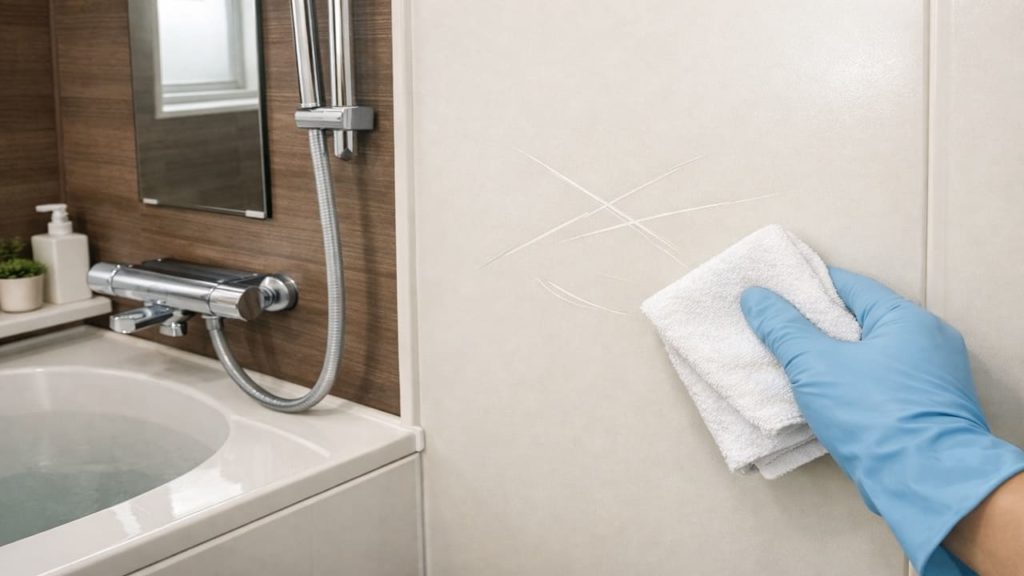
You notice faint scratches on your unit bath wall panels after cleaning. Under the light, they look worse than the dirt you removed.
Most scratches come from tiny grit, rough tools, or the wrong “miracle sponge,” not from bad materials. In Japan, compact unit baths and humid seasons make dull panels feel dirty faster.
In this guide, you’ll learn 5 checks to avoid panel scratches while cleaning and keep the finish looking new. You will also know what to do if damage already happened.

Hi, I’m Ken — I’m Japanese, and I live in Malaysia long-term, so I explain everyday life in Japan from a practical ‘from abroad’ perspective.
I hold a building design qualification and I’ve been on site for 20+ years across hundreds of jobs. I turn Japan’s unspoken rules into simple checks, so you can avoid costly mistakes and take the next step with clear actions that feel safe.
1. Unit bath scratches on panels: 5 Checks
Scratches usually come from your tool and pressure—not from the stain itself.
Unit bath panels look tough, but the surface can mark if you grind grit across it. The problem gets worse when moisture stays, because fine scratches hold soap film in Japan’s tsuyu months. Start by checking what is touching the panel, then how you move it. Control beats force.
Abrasive cleaners and abrasive sponges can cause discoloration or scratches and are often listed as not recommended for bath surfaces. According to Panasonic.
- Rinse panels first to remove loose grit
- Use soft polyurethane sponge without hard side
- Wipe in one direction and avoid circles
- Reduce pressure and let cleaner do work
- Dry panels with microfiber to stop residue
You might think “I must scrub harder,” but that is how the finish gets hazy. If a mark improves when wet and shows when dry, it is often a micro scratch pattern. Go gentler and more consistent. Your panels will thank you.
2. Avoid damage while cleaning
Stop using hidden abrasives like melamine foam—they erase stains by shaving the surface.
Melamine sponges feel soft, yet they act like ultra fine sandpaper on many finishes. In Japan rentals, one enthusiastic session can turn a glossy panel into a dull patch that never looks “clean” again. Also watch out for the hard side of a dual sponge and powdered cleansers used too often. Safe is boring.
Using cream cleanser too aggressively can cause scratches, so instructions often warn against over-rubbing. According to LIXIL.
- Test any tool on low corner first
- Skip melamine sponge on glossy wall panels
- Choose neutral cleaner and rinse fully
- Place towel under bucket to prevent scuffs
- Keep nails and rings away from panel edges
Some people blame “cheap materials,” but the same panel stays perfect with soft tools. If you must use a stronger cleaner, reduce pressure and shorten contact time. The goal is clean, not polished down. Damage is permanent.
3. Why unit bath panels scratch so easily
Panels scratch when grit becomes a sanding layer—and cleaning turns into grinding.
The most common grit is not sand from outside, it is dried soap scum, hair fragments, and mineral dust trapped on a sponge. Japan bathrooms dry slower in humid weather, so residue builds and hardens, then breaks into tiny particles. If you wipe fast in circles, you drag those particles across the surface. Slow wins.
- Check sponge for trapped hair and grit
- Look for white crust near lower wall edge
- Notice scratches forming in repeated wipe zone
- Inspect shelf lip where residue dries first
- Confirm panel is cool before heavy cleaning
You might feel stuck because scratches are easier to see after cleaning. That is normal, because you removed the film that was hiding them. Focus on preventing new scratches, not chasing perfection. Clean panels still look good.
4. How to clean panels without scratching
Use rinse plus gentle wipe plus full dry—it is the safest routine in Japan unit baths.
First rinse the wall to float away grit, then clean with a soft sponge and neutral cleaner, then dry the surface fully. Basic supplies are usually ¥100–500 for basic supplies like a microfiber cloth or small squeegee. The dry step matters because leftover film turns into the next sanding layer. Keep the habit small.
- Rinse wall with warm shower for ten seconds
- Apply neutral cleaner using soft sponge gently
- Wipe straight lines from top to bottom
- Rinse cleaner off and remove all foam
- Dry panels completely with microfiber cloth
People skip rinsing and start wiping on a dry wall, then wonder why scratches multiply. Others polish one spot for minutes and make a visible patch. If you did gentle cleaning and it still looks cloudy, stop rubbing and change the light angle. Prevention beats regret.
5. FAQs
Q1. Are unit bath wall panels acrylic or something else?
It depends on the model, but many finishes are scratch sensitive when abrasives are used. Treat every panel as “soft finish” until you confirm the manual.
Q2. Can I remove existing scratches by polishing?
Polishing can make it worse if you do not know the surface coating. If the scratch disappears when wet, focus on keeping it clean and preventing new marks.
Q3. What is the safest tool set for renters?
Soft sponge microfiber cloth and neutral cleaner—those choices avoid most damage in Japan rentals. Add a small squeegee for drying, not for scrubbing.
Q4. Why do scratches look worse after cleaning?
Because you removed the haze that was hiding them, and the light reflects more clearly. Dry the panel and check from different angles before you panic.
Q5. When should I tell management about damage?
If the finish is peeling, if a deep gouge can catch a fingernail, or if you suspect it was pre-existing. Take clear photos under direct light and save the date.
Pro's Tough Talk

I’ve spent 20+ years working around Japanese homes, so I’ve seen what tends to work—and what tends to go wrong—in everyday use. I’ve been on site for 20+ years. I’ve worked on hundreds of jobs. In tsuyu, people “clean harder” and scratch faster.
Cause 1: you wipe without rinsing, so grit turns into sandpaper on your sponge. Cause 2: you use melamine foam and think it is magic, but it is just shaving the surface like a quiet file. Cause 3: you press harder when the stain resists, like pushing a shopping cart with a flat wheel and acting surprised at the noise.
Rinse the panel and sponge now.
Switch to soft tools and lighter pressure today.
Commit to dry down after every shower this weekend.
Gentle routine beats aggressive scrubbing every time. If you did this and it still fails, next is checking the product manual or asking management what panel finish you have.
You know that moment when you see a tiny mark, then you scrub “just one more time,” and it becomes a whole patch. Yeah.
Keep chasing stains with abrasives, and you’ll end up cleaning your own scratches.
Summary
Most unit bath panel scratches come from abrasive tools, trapped grit, and too much pressure. In Japan humidity, residue hardens and turns cleaning into grinding.
Rinse first, wipe gently in straight lines, and dry fully so film does not become the next scratch source. If scratches keep appearing, stop using melamine foam and hard sponge sides.
Do the 5 checks tonight and change your tool habit—your panels will stay clearer with less work. Your future self in Japan’s rainy season will be grateful.